Region auswählenSelect a region
Wählen Sie eine Region auf der Karte oder in der Liste.Choose a region on the map or in the list.
Länder & RäumeCountries & areas
- LänderCountries
- Regionale RäumeRegional areas
- Übernationale ZusammenschlüsseSupranational unions
Keine Treffer.No matches.
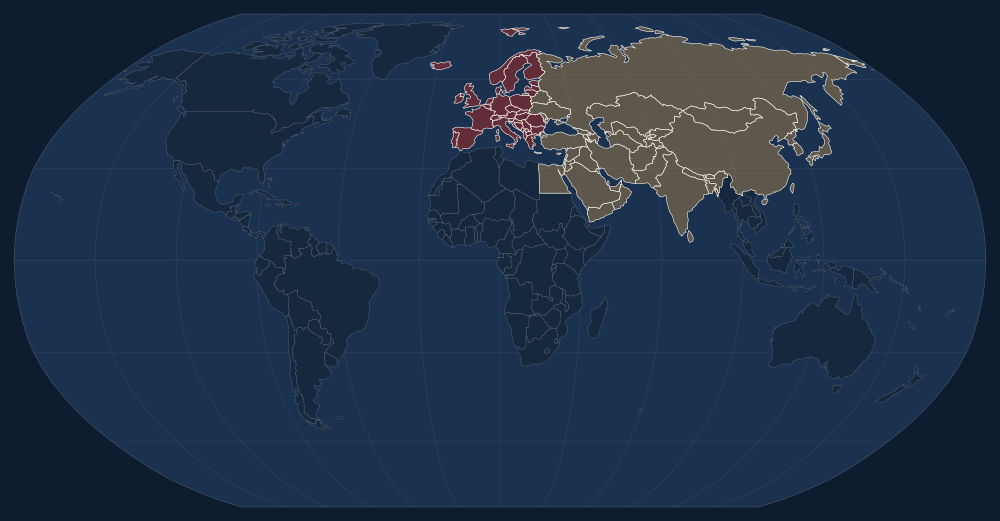
EuropaEurope
4 Länder, EU und Ostseeraum4 countries, EU and Baltic Sea region
Orientierungskarte, keine amtliche Darstellung von Grenzen.Orientation map, not an official depiction of borders.
Beiträge zur RegionContributions by region
Aktuelle Beiträge zu EuropaCurrent contributions on Europe
EuropaEurope
Politische, wirtschaftliche, gesellschaftliche und kulturelle Entwicklungen in Europa, eingeordnet in größere eurasische Zusammenhänge.Political, economic, societal and cultural developments in Europe, placed in wider Eurasian context.
Nach Land oder Raum filternFilter by country or area
Osteuropa und RusslandEastern Europe & Russia
Entwicklungen in Russland, der Ukraine und im postsowjetischen Raum: Sicherheit, Diplomatie, Wirtschaft und Gesellschaft.Developments in Russia, Ukraine and the post-Soviet space: security, diplomacy, economy and society.
Nach Land oder Raum filternFilter by country or area
ZentralasienCentral Asia
Entwicklungen in Zentralasien in ihren regionalen und globalen Zusammenhängen: Rohstoffe, Konnektivität und wachsende wirtschaftliche Bedeutung.Developments in Central Asia in their regional and global context: resources, connectivity and growing economic importance.
Nach Land oder Raum filternFilter by country or area
Kaukasus und Kaspischer RaumCaucasus & Caspian region
Der Südkaukasus mit seinen sicherheitspolitischen, wirtschaftlichen und gesellschaftlichen Fragen, an der Schnittstelle mehrerer Räume.The South Caucasus and its security, economic and societal questions, at the intersection of several regions.
Nach Land oder Raum filternFilter by country or area
OstasienEast Asia
Ostasiens Rolle in der internationalen Ordnung, Wirtschaft und Wissenschaft, mit besonderem Blick auf China.East Asia’s role in the international order, economy and science, with a particular focus on China.
Nach Land oder Raum filternFilter by country or area
SüdasienSouth Asia
Die wachsende Bedeutung Südasiens im eurasischen und globalen Kontext, häufig im Rahmen von BRICS und multipolarer Ordnung.The growing importance of South Asia in the Eurasian and global context, often within the framework of BRICS and a multipolar order.
Nach Land oder Raum filternFilter by country or area
Westasien und Naher OstenWest Asia & Middle East
Entwicklungen im Nahen Osten in ihren Wechselwirkungen mit dem eurasischen Raum: Energie, Sicherheit und Diplomatie.Developments in the Middle East and their interplay with the Eurasian space: energy, security and diplomacy.
Nach Land oder Raum filternFilter by country or area
Länder- und RaumprofileCountry and area profiles
DeutschlandGermany
Deutschland (amtlich Bundesrepublik Deutschland) liegt in Mitteleuropa und ist das bevölkerungsreichste Land der Europäischen Union. Als föderale parlamentarische Republik mit stark exportorientierter Wirtschaft spielt es eine zentrale Rolle in der EU und in den internationalen Beziehungen Europas. Hauptstadt und Regierungssitz ist Berlin.Germany (officially the Federal Republic of Germany) lies in Central Europe and is the most populous member state of the European Union. A federal parliamentary republic with a strongly export-oriented economy, it plays a central role in the EU and in Europe’s international relations. Berlin is the capital and seat of government.
BasisdatenKey facts
Hauptstadt:Capital: Berlin
Fläche: rund 357.600 km² (Gesamtfläche)Area: approx. 357,600 km² (total area)
Bevölkerung: rund 83,6 Mio. (31.12.2024); vorläufig rund 83,5 Mio. (Ende 2025)Population: approx. 83.6 million (31 Dec 2024); provisionally approx. 83.5 million (end 2025)
Amtssprache: DeutschOfficial language: German
Währung: Euro (EUR)Currency: euro (EUR)
Geografie & GesellschaftGeography & society
Nachbarstaaten: Dänemark, Polen, Tschechien, Österreich, Schweiz, Frankreich, Luxemburg, Belgien, Niederlande (9)Neighbours: Denmark, Poland, Czechia, Austria, Switzerland, France, Luxembourg, Belgium, Netherlands (9)
Größte Städte: Berlin, Hamburg, München, Köln, Frankfurt am MainLargest cities: Berlin, Hamburg, Munich, Cologne, Frankfurt am Main
Verstädterung: rund 78 % leben in städtischen Räumen (2023)Urbanisation: about 78% live in urban areas (2023)
Altersstruktur: alternde Bevölkerung, Durchschnittsalter rund 44,6 Jahre; über ein Fünftel ist 65 Jahre oder älter (2024)Age structure: an ageing population, average age about 44.6 years; more than a fifth are aged 65 or over (2024)
WirtschaftEconomy
Deutschland hat die größte Volkswirtschaft der Europäischen Union. Prägend sind eine starke Industrie, insbesondere Automobilbau, Maschinenbau, Chemie und Elektrotechnik, ein hoch entwickelter Dienstleistungssektor sowie ein dichtes Netz kleiner und mittlerer Unternehmen. Die Wirtschaft ist exportorientiert und eng in internationale Lieferketten eingebunden; wichtige Handelspartner liegen innerhalb der EU sowie in Nordamerika und Asien. Aktuelle Themen sind der Umbau der Energieversorgung, Digitalisierung, Fachkräftesicherung und die Wettbewerbsfähigkeit der Industrie. Als Mitglied von EU, Eurozone, G7 und OECD ist Deutschland ein zentraler Partner für den wirtschaftlichen Austausch zwischen Europa und den Ländern Eurasiens.Germany has the largest economy in the European Union. It is characterised by a strong industrial base, notably automotive manufacturing, mechanical engineering, chemicals and electrical engineering, a highly developed services sector, and a dense network of small and medium-sized enterprises. The economy is export-oriented and deeply integrated into international supply chains; key trading partners lie within the EU as well as in North America and Asia. Current issues include the transformation of energy supply, digitalisation, securing skilled labour and industrial competitiveness. As a member of the EU, the eurozone, the G7 and the OECD, Germany is a central partner for economic exchange between Europe and the countries of Eurasia.
Politisches System & RegierungPolitical system & government
Regierungsform: föderale parlamentarische RepublikForm of government: federal parliamentary republic
Staatsoberhaupt: Bundespräsident Frank-Walter Steinmeier (seit 2017, wiedergewählt 2022)Head of state: Federal President Frank-Walter Steinmeier (since 2017, re-elected 2022)
Regierungschef: Bundeskanzler Friedrich Merz (CDU), im Amt seit 6. Mai 2025Head of government: Federal Chancellor Friedrich Merz (CDU), in office since 6 May 2025
Regierung: Koalition aus CDU/CSU und SPD; Vizekanzler Lars Klingbeil (SPD)Government: coalition of CDU/CSU and SPD; Vice-Chancellor Lars Klingbeil (SPD)
Letzte Bundestagswahl: 23. Februar 2025Last federal election: 23 February 2025
ParlamentParliament
Der Deutsche Bundestag ist das direkt gewählte Bundesparlament mit 630 Sitzen (21. Wahlperiode). Über den Bundesrat wirken die 16 Länder an der Gesetzgebung mit.The German Bundestag is the directly elected federal parliament with 630 seats (21st electoral term). The 16 federal states take part in legislation through the Bundesrat.
Ergebnis der Bundestagswahl 2025Result of the 2025 Bundestag election
Sitzverteilung nach dem amtlichen Wahlergebnis vom 23. Februar 2025: CDU/CSU 208, AfD 152, SPD 120, Bündnis 90/Die Grünen 85, Die Linke 64, SSW 1 (insgesamt 630 Sitze). Die Regierungskoalition aus CDU/CSU und SPD verfügt über 328 Sitze.Seat distribution according to the official election result of 23 February 2025: CDU/CSU 208, AfD 152, SPD 120, Alliance 90/The Greens 85, The Left 64, SSW 1 (630 seats in total). The governing CDU/CSU-SPD coalition holds 328 seats.
Aktuelle Zusammensetzung des BundestagesCurrent composition of the Bundestag
Aktuelle Fraktionsstärke (Stand: Juli 2026): CDU/CSU 208, AfD 150, SPD 120, Bündnis 90/Die Grünen 85, Die Linke 64, fraktionslos 3 (insgesamt 630 Sitze). Fraktionslos sind der SSW-Abgeordnete sowie zwei zwischenzeitlich aus der AfD-Fraktion ausgeschiedene Abgeordnete.Current parliamentary group strength (as of July 2026): CDU/CSU 208, AfD 150, SPD 120, Alliance 90/The Greens 85, The Left 64, three non-attached members (630 seats in total). The non-attached members are the SSW member and two members who left the AfD group in the meantime.
Aktuelle politische LageCurrent political situation
Nach der vorgezogenen Bundestagswahl vom 23. Februar 2025 bildeten CDU/CSU und SPD eine Koalitionsregierung. Am 6. Mai 2025 wählte der Bundestag Friedrich Merz zum Bundeskanzler; im ersten Wahlgang verfehlte er die erforderliche Mehrheit und wurde erst im zweiten Wahlgang gewählt. Die Regierung stützt sich auf eine Mehrheit von 328 der 630 Sitze. Zweitstärkste Kraft und größte Oppositionsfraktion ist die AfD. Zentrale Themen der laufenden Wahlperiode sind unter anderem Haushalts- und Steuerpolitik, Verteidigung und Infrastruktur, Migration sowie die wirtschaftliche Wettbewerbsfähigkeit. Bundespräsident Frank-Walter Steinmeier nimmt als Staatsoberhaupt überwiegend repräsentative und integrierende Aufgaben wahr. Die nächste reguläre Bundestagswahl wird nach dem derzeitigen Wahlzyklus für 2029 erwartet. Ein genauer Wahltermin ist noch nicht offiziell festgelegt. Eine vorgezogene Wahl könnte den Zeitplan verändern.Following the early federal election of 23 February 2025, CDU/CSU and SPD formed a coalition government. On 6 May 2025 the Bundestag elected Friedrich Merz as Chancellor; he fell short of the required majority in the first ballot and was elected only in the second. The government rests on a majority of 328 of the 630 seats. The AfD is the second-largest force and the largest opposition group. Central issues of the current term include budget and tax policy, defence and infrastructure, migration and economic competitiveness. As head of state, Federal President Frank-Walter Steinmeier performs largely representative and unifying functions. The next regular Bundestag election is expected in 2029 under the current electoral cycle. An exact election date has not yet been officially scheduled. An early election could alter the timetable.
Regionale & internationale RolleRegional & international role
Deutschland ist Gründungsmitglied der europäischen Integration und einer der einflussreichsten Mitgliedstaaten der Europäischen Union. Es gehört der Eurozone, dem Schengen-Raum, der NATO, den G7 und G20 sowie den Vereinten Nationen und der OECD an. Für den eurasischen Raum ist das Land ein wichtiger Handels- und Kooperationspartner; die Beziehungen zu einzelnen Staaten unterscheiden sich je nach politischen und wirtschaftlichen Rahmenbedingungen.Germany is a founding participant in European integration and one of the most influential member states of the European Union. It belongs to the eurozone, the Schengen Area, NATO, the G7 and G20, as well as the United Nations and the OECD. For the Eurasian space it is an important trade and cooperation partner; relations with individual states vary according to political and economic circumstances.
Offizielle QuellenOfficial sources
Die Bundeswahlleiterin – Bundestagswahl 2025, ErgebnisseThe Federal Returning Officer – 2025 Bundestag election results
WahlergebnisElection result
Geprüft am 29. Juli 2026Verified on 29 July 2026
Deutscher Bundestag – Sitzverteilung (21. Wahlperiode)German Bundestag – seat distribution (21st term)
Aktuelle ParlamentszusammensetzungCurrent parliamentary composition
Geprüft am 29. Juli 2026Verified on 29 July 2026
Die Bundesregierung – Bundeskanzler und BundeskabinettThe Federal Government – Chancellor and cabinet
Regierung und RegierungschefGovernment and head of government
Geprüft am 29. Juli 2026Verified on 29 July 2026
Der BundespräsidentThe Federal President
StaatsoberhauptHead of state
Geprüft am 29. Juli 2026Verified on 29 July 2026
Statistisches Bundesamt (Destatis) – BevölkerungsstandFederal Statistical Office (Destatis) – population
Bevölkerung, Demografie und WirtschaftPopulation, demographics and economy
Geprüft am 29. Juli 2026Verified on 29 July 2026
Europäische Union – EU-MitgliedstaatenEuropean Union – EU member states
Internationale Mitgliedschaft (EU)International membership (EU)
Geprüft am 29. Juli 2026Verified on 29 July 2026
Zuletzt aktualisiert: 29. Juli 2026Last updated: 29 July 2026
FrankreichFrance
Frankreich (amtlich Französische Republik) liegt in Westeuropa und verfügt zusätzlich über Überseegebiete auf mehreren Kontinenten. Es ist Gründungsmitglied der Europäischen Union, ständiges Mitglied des UN-Sicherheitsrats und Atommacht. Als halbpräsidentielle Republik mit einer der größten Volkswirtschaften Europas spielt Frankreich eine zentrale Rolle in der europäischen und internationalen Politik. Hauptstadt ist Paris.France (officially the French Republic) lies in Western Europe and additionally holds overseas territories on several continents. It is a founding member of the European Union, a permanent member of the UN Security Council and a nuclear power. A semi-presidential republic with one of Europe’s largest economies, France plays a central role in European and international affairs. The capital is Paris.
BasisdatenKey facts
Hauptstadt:Capital: Paris
Fläche: rund 551.700 km² (Kernland); mit Überseegebieten rund 632.800 km²Area: approx. 551,700 km² (metropolitan France); approx. 632,800 km² including overseas territories
Bevölkerung: rund 69,1 Mio. (1. Januar 2026); davon rund 66,8 Mio. im Kernland und rund 2,3 Mio. in den ÜberseegebietenPopulation: approx. 69.1 million (1 January 2026); of which about 66.8 million in metropolitan France and about 2.3 million in the overseas departments
Amtssprache: FranzösischOfficial language: French
Währung: Euro (EUR)Currency: euro (EUR)
Geografie & GesellschaftGeography & society
Nachbarstaaten (Kernland): Belgien, Luxemburg, Deutschland, Schweiz, Italien, Monaco, Spanien, Andorra; über Überseegebiete auch Brasilien, Suriname und die NiederlandeNeighbours (metropolitan): Belgium, Luxembourg, Germany, Switzerland, Italy, Monaco, Spain, Andorra; via overseas territories also Brazil, Suriname and the Netherlands
Größte Städte: Paris, Marseille, Lyon, Toulouse, NizzaLargest cities: Paris, Marseille, Lyon, Toulouse, Nice
Verstädterung: rund 81 % leben in städtischen Räumen (2023)Urbanisation: about 81% live in urban areas (2023)
Altersstruktur: rund 22 % sind 65 Jahre oder älter (2026); die Geburtenzahl ist zuletzt gesunkenAge structure: about 22% are aged 65 or over (2026); the number of births has recently declined
WirtschaftEconomy
Frankreich hat eine der größten Volkswirtschaften der Europäischen Union. Kennzeichnend sind ein starker Dienstleistungssektor, eine leistungsfähige Industrie in Bereichen wie Luft- und Raumfahrt, Fahrzeugbau, Pharmazie und Energie sowie eine bedeutende Landwirtschaft und Lebensmittelproduktion. Das Land ist ein großer Agrarproduzent und Exporteur, und die Stromerzeugung stützt sich in hohem Maße auf Kernenergie. Frankreich ist eng in europäische und internationale Lieferketten eingebunden; wichtige Handelspartner liegen innerhalb der EU sowie in weiteren Regionen. Als Mitglied von EU, Eurozone, G7 und OECD ist Frankreich ein zentraler Partner für den wirtschaftlichen Austausch zwischen Europa und den Ländern Eurasiens.France has one of the largest economies in the European Union. It is characterised by a strong services sector, a capable industrial base in areas such as aerospace, vehicle manufacturing, pharmaceuticals and energy, and significant agriculture and food production. The country is a major agricultural producer and exporter, and electricity generation relies to a high degree on nuclear power. France is closely integrated into European and international supply chains; key trading partners lie within the EU and in other regions. As a member of the EU, the eurozone, the G7 and the OECD, France is a central partner for economic exchange between Europe and the countries of Eurasia.
Politisches System & RegierungPolitical system & government
Regierungsform: halbpräsidentielle Republik (Fünfte Republik)Form of government: semi-presidential republic (Fifth Republic)
Staatsoberhaupt: Staatspräsident Emmanuel Macron (seit 2017, wiedergewählt 2022)Head of state: President Emmanuel Macron (since 2017, re-elected 2022)
Regierungschef: Premierminister Sébastien Lecornu, im Amt seit 9. September 2025Head of government: Prime Minister Sébastien Lecornu, in office since 9 September 2025
Regierung: zweite Regierung Lecornu; Sébastien Lecornu wurde nach der Vertrauensniederlage der Regierung Bayrou am 9. September 2025 zum Premierminister ernannt, nach dem Rücktritt seiner ersten Regierung am 6. Oktober 2025 am 10. Oktober 2025 erneut ernannt; die Ministerinnen und Minister wurden am 12. Oktober 2025 ernannt, eine Regierungsumbildung erfolgte am 26. Februar 2026; Minderheitsregierung ohne absolute MehrheitGovernment: the second Lecornu government; Sébastien Lecornu was appointed Prime Minister on 9 September 2025 following the Bayrou government’s loss of a confidence vote, re-appointed on 10 October 2025 after his first government resigned on 6 October 2025; the ministers were named on 12 October 2025, with a government reshuffle on 26 February 2026; a minority government without an absolute majority
Letzte Parlamentswahl: 30. Juni und 7. Juli 2024 (vorgezogen)Last legislative election: 30 June and 7 July 2024 (snap election)
ParlamentParliament
Das Parlament besteht aus zwei Kammern: der Nationalversammlung (577 direkt gewählte Sitze) und dem Senat (348 überwiegend indirekt gewählte Sitze). In der Nationalversammlung sind für die absolute Mehrheit 289 Sitze nötig; keine Fraktion verfügt über eine eigene Mehrheit. Präsidentin ist Yaël Braun-Pivet.Parliament has two chambers: the National Assembly (577 directly elected seats) and the Senate (348 mostly indirectly elected seats). In the National Assembly an absolute majority requires 289 seats; no single group holds a majority. Its President is Yaël Braun-Pivet.
Ergebnis der ParlamentswahlParliamentary election result
Die vorgezogene Parlamentswahl am 30. Juni und 7. Juli 2024 ergab keine absolute Mehrheit. Die Nationalversammlung gliederte sich in drei größere Blöcke: das linke Bündnis Nouveau Front populaire, das präsidentielle Lager sowie das Rassemblement National mit Verbündeten.The snap legislative election of 30 June and 7 July 2024 produced no absolute majority. The National Assembly was divided into three main blocs: the left-wing Nouveau Front populaire alliance, the presidential camp, and the Rassemblement National with its allies.
Aktuelle Zusammensetzung der NationalversammlungCurrent composition of the National Assembly
Sitzverteilung (Stand: Juli 2026): Rassemblement National (RN) 122, Ensemble pour la République (EPR) 91, La France insoumise (LFI) 71, Sozialisten (SOC) 68, Droite Républicaine (DR) 48, Écologiste et Social 38, Les Démocrates 37, Horizons & Indépendants 35, LIOT 23, Gauche Démocrate et Républicaine (GDR) 17, Union des droites pour la République (UDR) 17; hinzu kommen 10 fraktionslose Abgeordnete. Insgesamt umfasst die Nationalversammlung 577 Sitze.Seat distribution (as of July 2026): Rassemblement National (RN) 122, Ensemble pour la République (EPR) 91, La France insoumise (LFI) 71, Socialists (SOC) 68, Droite Républicaine (DR) 48, Écologiste et Social 38, Les Démocrates 37, Horizons & Indépendants 35, LIOT 23, Gauche Démocrate et Républicaine (GDR) 17, Union des droites pour la République (UDR) 17; in addition there are 10 non-attached members. The National Assembly comprises 577 seats in total.
Aktuelle politische LageCurrent political situation
Aus der vorgezogenen Parlamentswahl im Sommer 2024 ging eine Nationalversammlung ohne klare Mehrheit hervor, die sich in drei etwa gleich starke Blöcke gliedert (Linksbündnis, präsidentielles Lager der Mitte und Rechte). Seit September 2025 ist Sébastien Lecornu Premierminister; er löste François Bayrou ab, dessen Regierung im September 2025 in einer Vertrauensabstimmung unterlag. Die Regierung Lecornu ist auf wechselnde Mehrheiten angewiesen; im Zentrum der politischen Auseinandersetzung stehen insbesondere der Staatshaushalt und die Haushaltskonsolidierung. Staatspräsident Emmanuel Macron, dessen Amtszeit bis 2027 läuft, bestimmt weiterhin die Grundlinien der Außen- und Sicherheitspolitik. Die nächste reguläre französische Präsidentschaftswahl wird nach dem derzeitigen Wahlzyklus für 2027 erwartet. Ein genauer Wahltermin ist noch nicht offiziell festgelegt.The snap legislative election in summer 2024 produced a National Assembly without a clear majority, divided into three roughly equal blocs (a left-wing alliance, the president’s centrist camp and the right). Sébastien Lecornu has been Prime Minister since September 2025, succeeding François Bayrou, whose government lost a confidence vote in September 2025. The Lecornu government depends on shifting majorities; the central political dispute concerns above all the state budget and fiscal consolidation. President Emmanuel Macron, whose term runs until 2027, continues to set the broad lines of foreign and security policy. The next regular French presidential election is expected in 2027 under the current electoral cycle. An exact election date has not yet been officially scheduled.
Regionale & internationale RolleRegional & international role
Frankreich ist Gründungsmitglied der europäischen Integration und einer der einflussreichsten Mitgliedstaaten der Europäischen Union. Es gehört der Eurozone, dem Schengen-Raum und der NATO an, ist ständiges Mitglied des UN-Sicherheitsrats sowie Mitglied der G7, der G20 und der OECD. Frankreich verfügt über ein weltweites diplomatisches Netz und Überseegebiete auf mehreren Kontinenten. Für den eurasischen Raum ist das Land ein bedeutender Handels- und Kooperationspartner; die Beziehungen zu einzelnen Staaten richten sich nach den jeweiligen politischen und wirtschaftlichen Rahmenbedingungen.France is a founding participant in European integration and one of the most influential member states of the European Union. It belongs to the eurozone, the Schengen Area and NATO, is a permanent member of the UN Security Council and a member of the G7, G20 and OECD. France maintains a worldwide diplomatic network and overseas territories on several continents. For the Eurasian space it is an important trade and cooperation partner; relations with individual states follow the respective political and economic circumstances.
Offizielle QuellenOfficial sources
Assemblée nationale – Les groupes politiquesNational Assembly – political groups
Aktuelle ParlamentszusammensetzungCurrent parliamentary composition
Geprüft am 29. Juli 2026Verified on 29 July 2026
Élysée – Présidence de la RépubliqueÉlysée – Presidency of the Republic
StaatsoberhauptHead of state
Geprüft am 29. Juli 2026Verified on 29 July 2026
Élysée – Nomination du Premier ministre (10.10.2025)Élysée – appointment of the Prime Minister (10 Oct 2025)
Ernennung des PremierministersAppointment of the Prime Minister
Geprüft am 29. Juli 2026Verified on 29 July 2026
info.gouv.fr – Nouvelle composition du gouvernement (26.02.2026)info.gouv.fr – new government composition (26 Feb 2026)
Regierung (aktuelle Zusammensetzung)Government (current composition)
Geprüft am 29. Juli 2026Verified on 29 July 2026
INSEE – Bilan démographiqueINSEE – demographic overview
Bevölkerung, Demografie und WirtschaftPopulation, demographics and economy
Geprüft am 29. Juli 2026Verified on 29 July 2026
Europäische Union – EU-MitgliedstaatenEuropean Union – EU member states
Internationale Mitgliedschaft (EU)International membership (EU)
Geprüft am 29. Juli 2026Verified on 29 July 2026
Zuletzt aktualisiert: 29. Juli 2026Last updated: 29 July 2026
ÖsterreichAustria
Österreich (amtlich Republik Österreich) ist ein föderaler, parlamentarisch-demokratischer Binnenstaat in Mitteleuropa und Mitglied der Europäischen Union. Hauptstadt und Regierungssitz ist Wien.Austria (officially the Republic of Austria) is a landlocked federal parliamentary republic in Central Europe and a member of the European Union. Its capital and seat of government is Vienna.
BasisdatenKey facts
Hauptstadt: WienCapital: Vienna
Fläche: 83.879 km²Area: 83,879 km²
Bevölkerung: 9.215.956 (1. Jänner 2026, endgültige Ergebnisse)Population: 9,215,956 (1 January 2026, final results)
Amtssprache: DeutschOfficial language: German
Währung: EuroCurrency: Euro
Geografie & GesellschaftGeography & society
Nachbarstaaten: Deutschland, Tschechien, Slowakei, Ungarn, Slowenien, Italien, Schweiz und Liechtenstein (8)Neighbouring states: Germany, Czechia, Slovakia, Hungary, Slovenia, Italy, Switzerland and Liechtenstein (8)
Größte Städte: Wien, Graz, Linz, Salzburg, InnsbruckLargest cities: Vienna, Graz, Linz, Salzburg, Innsbruck
Verstädterung: rund 59 % leben in städtischen Räumen (2024)Urbanisation: around 59% live in urban areas (2024)
Altersstruktur: Medianalter rund 44 Jahre; rund 20 % sind 65 Jahre oder älter (2024)Age structure: median age around 44 years; around 20% aged 65 or older (2024)
Ausländeranteil: 20,4 Prozent (1. Jänner 2026)Foreign-national share: 20.4 percent (1 January 2026)
Gliederung: neun BundesländerStructure: nine federal states
WirtschaftEconomy
Österreich ist eine hoch entwickelte, exportorientierte soziale Marktwirtschaft. Bedeutende Bereiche sind Industrie, Tourismus und Dienstleistungen. Die Wirtschaft ist eng mit Deutschland und dem EU-Binnenmarkt verflochten.Austria is a highly developed, export-oriented social market economy. Important sectors include industry, tourism and services. Its economy is closely interlinked with Germany and the EU single market.
Politisches System & RegierungPolitical system & government
Regierungsform: föderale parlamentarische RepublikForm of government: federal parliamentary republic
Staatsoberhaupt: Bundespräsident Alexander Van der Bellen (seit 2017, wiedergewählt 2022)Head of state: Federal President Alexander Van der Bellen (since 2017, re-elected 2022)
Regierungschef: Bundeskanzler Christian Stocker (ÖVP), angelobt am 3. März 2025Head of government: Federal Chancellor Christian Stocker (ÖVP), sworn in on 3 March 2025
Regierung: Dreierkoalition aus ÖVP, SPÖ und NEOS; Vizekanzler Andreas Babler (SPÖ)Government: three-party coalition of ÖVP, SPÖ and NEOS; Vice-Chancellor Andreas Babler (SPÖ)
Letzte Nationalratswahl: 29. September 2024Last National Council election: 29 September 2024
ParlamentParliament
Das Parlament besteht aus dem Nationalrat (183 direkt gewählte Abgeordnete) und dem Bundesrat, über den die Länder an der Gesetzgebung mitwirken.Parliament consists of the National Council (183 directly elected members) and the Federal Council, through which the states take part in legislation.
Sitzverteilung nach der Wahl 2024: FPÖ 57, ÖVP 51, SPÖ 41, NEOS 18, Grüne 16 (insgesamt 183). Die Regierungskoalition aus ÖVP, SPÖ und NEOS verfügt über 110 Sitze; die FPÖ ist stärkste Kraft und größte Oppositionsfraktion.Seat distribution after the 2024 election: FPÖ 57, ÖVP 51, SPÖ 41, NEOS 18, Greens 16 (183 in total). The governing coalition of ÖVP, SPÖ and NEOS holds 110 seats; the FPÖ is the strongest force and the largest opposition group.
Aktuelle politische LageCurrent political situation
Bei der Nationalratswahl 2024 wurde die FPÖ erstmals stärkste Partei, konnte jedoch keine Regierung bilden. Nach längeren Verhandlungen bildeten ÖVP, SPÖ und NEOS im März 2025 die erste Dreierkoalition auf Bundesebene unter Bundeskanzler Christian Stocker. Zentrale Themen sind die Haushaltskonsolidierung, Migration und die wirtschaftliche Entwicklung. Die nächste reguläre Nationalratswahl wird nach dem fünfjährigen Wahlzyklus für 2029 erwartet; ein genauer Wahltermin ist noch nicht amtlich festgelegt, und eine vorgezogene Wahl könnte den Zeitplan verändern.In the 2024 National Council election the FPÖ became the strongest party for the first time, but was unable to form a government. After lengthy negotiations, ÖVP, SPÖ and NEOS formed the first three-party coalition at the federal level in March 2025 under Chancellor Christian Stocker. Central issues include fiscal consolidation, migration and economic development. Based on the five-year electoral cycle, the next regular National Council election is expected in 2029; an exact date has not yet been officially set, and an early election could change the timing.
Regionale & internationale RolleRegional & international role
Österreich ist EU-Mitglied, zugleich aber militärisch neutral. Wien ist Sitz mehrerer internationaler Organisationen und ein wichtiger Ort der Diplomatie zwischen West und Ost. Für den eurasischen Raum ist das Land ein Vermittlungs- und Begegnungsort und ein aktiver Wirtschaftspartner.Austria is an EU member but at the same time militarily neutral. Vienna is the seat of several international organisations and an important venue for diplomacy between West and East. For the Eurasian space the country serves as a place of mediation and encounter and an active economic partner.
Offizielle QuellenOfficial sources
Österreichisches Parlament – Nationalrat, SitzplanAustrian Parliament – National Council seating plan
Aktuelle Parlamentszusammensetzung und Nationalratswahl 2024Current composition and 2024 election
Geprüft am 29. Juli 2026Verified on 29 July 2026
Bundeskanzleramt – Bundeskanzler Christian StockerFederal Chancellery – Chancellor Christian Stocker
Regierung und RegierungschefGovernment and head of government
Geprüft am 29. Juli 2026Verified on 29 July 2026
Bundespräsident der Republik ÖsterreichFederal President of the Republic of Austria
StaatsoberhauptHead of state
Geprüft am 29. Juli 2026Verified on 29 July 2026
Statistik Austria – BevölkerungsstandStatistics Austria – population
Bevölkerung, Demografie und WirtschaftPopulation, demographics and economy
Geprüft am 29. Juli 2026Verified on 29 July 2026
Weltbank – Urban population (% of total), ÖsterreichWorld Bank – Urban population (% of total), Austria
Verstädterung (UN/Weltbank-Definition)Urbanisation (UN/World Bank definition)
Geprüft am 29. Juli 2026Verified on 29 July 2026
UNFPA – World Population Dashboard, ÖsterreichUNFPA – World Population Dashboard, Austria
Altersstruktur (Medianalter, Anteil 65+)Age structure (median age, share aged 65+)
Geprüft am 29. Juli 2026Verified on 29 July 2026
Europäische Union – EU-MitgliedstaatenEuropean Union – EU member states
Internationale Mitgliedschaft (EU)International membership (EU)
Geprüft am 29. Juli 2026Verified on 29 July 2026
Zuletzt aktualisiert: 29. Juli 2026Last updated: 29 July 2026
SlowakeiSlovakia
Die Slowakei (amtlich Slowakische Republik) ist ein parlamentarisch-demokratischer Binnenstaat in Mitteleuropa und Mitglied der Europäischen Union sowie der Eurozone. Hauptstadt und Regierungssitz ist Bratislava.Slovakia (officially the Slovak Republic) is a landlocked parliamentary republic in Central Europe and a member of the European Union and the euro area. Its capital and seat of government is Bratislava.
BasisdatenKey facts
Hauptstadt: BratislavaCapital: Bratislava
Fläche: 49.035 km²Area: 49,035 km²
Bevölkerung: rund 5,41 Mio. (30. September 2025)Population: about 5.41 million (30 September 2025)
Amtssprache: SlowakischOfficial language: Slovak
Währung: Euro (seit 2009)Currency: Euro (since 2009)
Geografie & GesellschaftGeography & society
Nachbarstaaten: Tschechien, Polen, Ukraine, Ungarn und Österreich (5)Neighbouring states: Czechia, Poland, Ukraine, Hungary and Austria (5)
Größte Städte: Bratislava, Košice, Prešov, Žilina, NitraLargest cities: Bratislava, Košice, Prešov, Žilina, Nitra
Verstädterung: rund 54 % leben in städtischen Räumen (2024)Urbanisation: around 54% live in urban areas (2024)
Altersstruktur: Medianalter rund 43 Jahre; rund 19 % sind 65 Jahre oder älter (2024)Age structure: median age around 43 years; around 19% aged 65 or older (2024)
Bevölkerungsmehrheit: Slowaken (rund 84 Prozent)Population majority: Slovaks (about 84 percent)
Größte Minderheit: Ungarn (rund 8 Prozent)Largest minority: Hungarians (about 8 percent)
WirtschaftEconomy
Die Slowakei ist eine offene, exportorientierte Industriewirtschaft mit einer starken Automobil- und Zulieferindustrie. Das Land ist eng in europäische Wertschöpfungsketten eingebunden.Slovakia is an open, export-oriented industrial economy with a strong automotive and supplier industry. The country is closely integrated into European value chains.
Politisches System & RegierungPolitical system & government
Regierungsform: parlamentarische RepublikForm of government: parliamentary republic
Staatsoberhaupt: Präsident Peter Pellegrini (seit 15. Juni 2024)Head of state: President Peter Pellegrini (since 15 June 2024)
Regierungschef: Ministerpräsident Robert Fico (Smer), im Amt seit 25. Oktober 2023Head of government: Prime Minister Robert Fico (Smer), in office since 25 October 2023
Regierung: Koalition aus Smer, Hlas und SNS; Parlamentspräsident Richard RašiGovernment: coalition of Smer, Hlas and SNS; Speaker of Parliament Richard Raši
Letzte Parlamentswahl: 30. September 2023Last parliamentary election: 30 September 2023
ParlamentParliament
Der Nationalrat (Národná rada) ist das Einkammerparlament mit 150 Abgeordneten.The National Council (Národná rada) is the unicameral parliament with 150 members.
Sitzverteilung nach der Wahl 2023: Smer 42, Progressive Slowakei (PS) 32, Hlas 27, Slovensko (OĽaNO) 16, KDH 12, SaS 11, SNS 10 (insgesamt 150). Die Regierungskoalition aus Smer, Hlas und SNS verfügte bei der Regierungsbildung über 79 Sitze.Seat distribution after the 2023 election: Smer 42, Progressive Slovakia (PS) 32, Hlas 27, Slovensko (OĽaNO) 16, KDH 12, SaS 11, SNS 10 (150 in total). At the time the government was formed, the coalition of Smer, Hlas and SNS held 79 seats.
Aktuelle Zusammensetzung (Stand: Juli 2026): Die Fraktionsstärken haben sich seit der Wahl durch Wechsel einzelner Abgeordneter verschoben. Laut Nationalrat entfallen auf das Regierungslager (Smer, Hlas, SNS) rund 78 der 150 Sitze und auf die Opposition rund 72; hinzu kommen mehrere fraktionslose Abgeordnete.Current composition (as of July 2026): the group strengths have shifted since the election through changes among individual members. According to the National Council, the government camp (Smer, Hlas, SNS) holds around 78 of the 150 seats and the opposition around 72, alongside several non-attached members.
Aktuelle politische LageCurrent political situation
Nach der Parlamentswahl 2023 bildete Robert Fico eine Koalition aus Smer, Hlas und SNS. 2024 wurde Peter Pellegrini zum Präsidenten gewählt. Innenpolitisch prägen Justiz- und Medienfragen, die Haushaltspolitik sowie die Außen- und Ukraine-Politik die Auseinandersetzungen. Die nächste reguläre Parlamentswahl wird nach dem vierjährigen Wahlzyklus für 2027 erwartet und die nächste reguläre Präsidentschaftswahl für 2029; genaue Wahltermine sind noch nicht amtlich festgelegt, und eine vorgezogene Wahl könnte den Zeitplan verändern.After the 2023 parliamentary election, Robert Fico formed a coalition of Smer, Hlas and SNS. In 2024 Peter Pellegrini was elected President. Domestic debates centre on judicial and media issues, budget policy and foreign and Ukraine policy. Based on the four-year electoral cycle, the next regular parliamentary election is expected in 2027 and the next regular presidential election in 2029; exact dates have not yet been officially set, and an early election could change the timing.
Regionale & internationale RolleRegional & international role
Die Slowakei liegt an einer wichtigen Nahtstelle zwischen West-, Mittel- und Osteuropa. Als Mitglied von EU, Eurozone, Schengen-Raum und NATO sowie der Visegrád-Gruppe wirkt das Land an der regionalen Zusammenarbeit in Mitteleuropa mit und unterhält vielfältige Verbindungen in den östlichen Teil des eurasischen Raums.Slovakia sits at an important junction between Western, Central and Eastern Europe. As a member of the EU, the euro area, the Schengen Area and NATO, as well as the Visegrád Group, the country takes part in regional cooperation in Central Europe and maintains varied links into the eastern part of the Eurasian space.
Offizielle QuellenOfficial sources
Národná rada Slovenskej republikyNational Council of the Slovak Republic
Aktuelle Parlamentszusammensetzung und Parlamentswahl 2023Current composition and 2023 election
Geprüft am 29. Juli 2026Verified on 29 July 2026
Úrad vlády Slovenskej republikyGovernment Office of the Slovak Republic
Regierung und RegierungschefGovernment and head of government
Geprüft am 29. Juli 2026Verified on 29 July 2026
Prezident Slovenskej republikyPresident of the Slovak Republic
StaatsoberhauptHead of state
Geprüft am 29. Juli 2026Verified on 29 July 2026
Štatistický úrad Slovenskej republikyStatistical Office of the Slovak Republic
Bevölkerung, Demografie und WirtschaftPopulation, demographics and economy
Geprüft am 29. Juli 2026Verified on 29 July 2026
Weltbank – Urban population (% of total), SlowakeiWorld Bank – Urban population (% of total), Slovakia
Verstädterung (UN/Weltbank-Definition)Urbanisation (UN/World Bank definition)
Geprüft am 29. Juli 2026Verified on 29 July 2026
UNFPA – World Population Dashboard, SlowakeiUNFPA – World Population Dashboard, Slovakia
Altersstruktur (Medianalter, Anteil 65+)Age structure (median age, share aged 65+)
Geprüft am 29. Juli 2026Verified on 29 July 2026
Europäische Union – EU-MitgliedstaatenEuropean Union – EU member states
Internationale Mitgliedschaft (EU)International membership (EU)
Geprüft am 29. Juli 2026Verified on 29 July 2026
Zuletzt aktualisiert: 29. Juli 2026Last updated: 29 July 2026
Europäische UnionEuropean Union
Die Europäische Union (EU) ist ein supranationaler Staaten- und Wirtschaftsverbund von 27 Mitgliedstaaten. Sie ist kein Staat, sondern eine auf Verträgen beruhende Rechtsgemeinschaft mit eigenen Organen; ihre Zuständigkeiten leiten sich aus den Mitgliedstaaten ab. Sitze der Organe sind unter anderem Brüssel, Straßburg, Luxemburg und Frankfurt am Main, keine nationale Hauptstadt.The European Union (EU) is a supranational union of 27 member states. It is not a state but a treaty-based community of law with its own institutions; its powers are derived from the member states. The institutions are seated in Brussels, Strasbourg, Luxembourg and Frankfurt am Main, among others, not in a national capital.
EckdatenKey facts
Mitgliedstaaten: 27Member states: 27
Fläche: rund 4.233.000 km²Area: about 4,233,000 km²
Bevölkerung: rund 449 Mio. (2026)Population: about 449 million (2026)
Währung: Euro als gemeinsame Währung der Staaten des Euroraums (nicht aller Mitgliedstaaten)Currency: the Euro as the common currency of the euro-area states (not all member states)
Amtssprachen: 24Official languages: 24
Binnenmarkt & GesellschaftSingle market & society
Binnenmarkt mit freiem Verkehr von Waren, Dienstleistungen, Kapital und PersonenSingle market with free movement of goods, services, capital and people
Zollunion mit gemeinsamen AußenzöllenCustoms union with common external tariffs
Schengen-Raum: Reisen ohne Grenzkontrollen zwischen den teilnehmenden StaatenSchengen Area: travel without border controls between participating states
Vielfalt der Sprachen, Kulturen und Rechtstraditionen der MitgliedstaatenA diversity of the languages, cultures and legal traditions of the member states
WirtschaftEconomy
Die EU bildet gemeinsam einen der größten Wirtschaftsräume der Welt und erwirtschaftet rund ein Sechstel der globalen Wirtschaftsleistung. Der Binnenmarkt und die gemeinsame Handelspolitik machen sie zu einem zentralen Akteur im Welthandel.Together the EU forms one of the largest economic areas in the world and generates about one sixth of global economic output. The single market and the common trade policy make it a central actor in world trade.
InstitutionenInstitutions
Die EU handelt durch mehrere Organe mit unterschiedlichen Aufgaben. Das Europäische Parlament ist die direkt gewählte Vertretung der Bürgerinnen und Bürger (720 Abgeordnete). Der Europäische Rat der Staats- und Regierungschefs legt die allgemeine politische Ausrichtung fest. Im Rat der Europäischen Union stimmen die Fachministerinnen und -minister der Mitgliedstaaten ab. Die Europäische Kommission ist das politisch unabhängige Exekutivorgan, das EU-Recht vorschlägt und dessen Umsetzung überwacht. Hinzu kommen unter anderem der Gerichtshof der Europäischen Union in Luxemburg und die Europäische Zentralbank in Frankfurt am Main.The EU acts through several institutions with different tasks. The European Parliament is the directly elected representation of citizens (720 members). The European Council of heads of state and government sets the general political direction. In the Council of the European Union, the relevant ministers of the member states vote. The European Commission is the politically independent executive body that proposes EU law and oversees its implementation. In addition there are, among others, the Court of Justice of the European Union in Luxembourg and the European Central Bank in Frankfurt am Main.
Führung der OrganeLeadership of the institutions
Präsidentin des Europäischen Parlaments: Roberta Metsola (seit 2022, wiedergewählt 2024)President of the European Parliament: Roberta Metsola (since 2022, re-elected 2024)
Präsident des Europäischen Rates: António Costa (seit Dezember 2024)President of the European Council: António Costa (since December 2024)
Präsidentin der Europäischen Kommission: Ursula von der Leyen (zweite Amtszeit seit Dezember 2024)President of the European Commission: Ursula von der Leyen (second term since December 2024)
Ratsvorsitz (Rat der EU): rotiert halbjährlich; in der zweiten Jahreshälfte 2026 bei IrlandCouncil presidency (Council of the EU): rotates every six months; held by Ireland in the second half of 2026
Aktuelle EntwicklungenCurrent developments
Nach der Europawahl 2024 konstituierte sich die zehnte Wahlperiode des Europäischen Parlaments, und die Kommission unter Ursula von der Leyen wurde für eine zweite Amtszeit bestätigt. Auf der Tagesordnung stehen unter anderem Wettbewerbsfähigkeit und Binnenmarkt, Sicherheits- und Verteidigungsfragen, die Erweiterung sowie die Beziehungen zu den Nachbarregionen. Die nächste Europawahl wird regulär für 2029 erwartet.After the 2024 European elections the tenth term of the European Parliament was constituted, and the Commission under Ursula von der Leyen was confirmed for a second term. The agenda includes competitiveness and the single market, security and defence questions, enlargement and relations with neighbouring regions. The next European elections are regularly expected in 2029.
Rolle im eurasischen RaumRole in the Eurasian space
Als größter Handels- und Regulierungsraum Europas prägt die EU Handels-, Energie- und Sicherheitsbeziehungen weit über ihre Grenzen hinaus. Sie ist ein zentraler Akteur in den Beziehungen zwischen Europa und dem übrigen eurasischen Raum, von den östlichen Nachbarländern bis nach Zentral- und Ostasien.As Europe largest trade and regulatory area, the EU shapes trade, energy and security relations well beyond its borders. It is a central actor in relations between Europe and the rest of the Eurasian space, from the eastern neighbourhood to Central and East Asia.
Offizielle QuellenOfficial sources
Europäische Union – Führung der OrganeEuropean Union – leadership of the institutions
Präsidentinnen und Präsidenten der EU-OrganePresidents of the EU institutions
Geprüft am 29. Juli 2026Verified on 29 July 2026
Europäische Kommission – PräsidentinEuropean Commission – President
Europäische KommissionEuropean Commission
Geprüft am 29. Juli 2026Verified on 29 July 2026
Europäischer RatEuropean Council
Europäischer Rat (Präsident António Costa)European Council (President António Costa)
Geprüft am 29. Juli 2026Verified on 29 July 2026
Rat der Europäischen Union – RatsvorsitzCouncil of the European Union – presidency
Rotierender Vorsitz im Rat der EURotating presidency of the Council of the EU
Geprüft am 29. Juli 2026Verified on 29 July 2026
Europäisches ParlamentEuropean Parliament
Europäisches Parlament (720 Abgeordnete, Präsidentin Metsola)European Parliament (720 members, President Metsola)
Geprüft am 29. Juli 2026Verified on 29 July 2026
Zuletzt aktualisiert: 29. Juli 2026Last updated: 29 July 2026
OstseeraumBaltic Sea region · Regionaler Raum· Regional area
Der Ostseeraum bezeichnet die Ostsee sowie die an sie angrenzenden Länder und Küstenregionen im Norden Europas. Er ist kein Staat, sondern ein geografischer und politischer Kooperationsraum. Anrainerstaaten sind Dänemark, Deutschland, Polen, Litauen, Lettland, Estland, Finnland, Schweden und Russland. Der Raum verbindet nord-, mittel- und osteuropäische Volkswirtschaften und ist durch enge Handels-, Verkehrs- und Umweltverflechtungen geprägt.The Baltic Sea region refers to the Baltic Sea and the countries and coastal regions bordering it in northern Europe. It is not a state but a geographic and political space for cooperation. The littoral states are Denmark, Germany, Poland, Lithuania, Latvia, Estonia, Finland, Sweden and Russia. The region links northern, central and eastern European economies and is shaped by close trade, transport and environmental ties.
Wirtschaftliche & infrastrukturelle BedeutungEconomic & infrastructure significance
Der Ostseeraum ist ein bedeutender Handels- und Verkehrsraum mit wichtigen Häfen, Fährverbindungen und Seewegen. Wesentliche Themen sind maritime Logistik, Energieinfrastruktur einschließlich Strom- und Datenverbindungen sowie der Schutz kritischer Unterseeinfrastruktur. Die enge wirtschaftliche Verflechtung der Anrainer wird durch grenzüberschreitende Zusammenarbeit in Wirtschaft, Wissenschaft und Umweltschutz ergänzt.The Baltic Sea region is an important trade and transport area with major ports, ferry links and shipping routes. Key issues include maritime logistics, energy infrastructure such as electricity and data connections, and the protection of critical undersea infrastructure. The close economic ties among the littoral states are complemented by cross-border cooperation in the economy, science and environmental protection.
Politische & institutionelle BedeutungPolitical & institutional relevance
Für die Zusammenarbeit im Ostseeraum bestehen mehrere Institutionen. Der Ostseerat (Council of the Baltic Sea States, CBSS) wurde 1992 gegründet; ihm gehören Dänemark, Deutschland, Estland, Finnland, Island, Lettland, Litauen, Norwegen, Polen und Schweden sowie die Europäische Union an. Die Mitwirkung Russlands wurde 2022 ausgesetzt; Russland trat im Mai 2022 aus dem Rat aus. Die EU-Strategie für den Ostseeraum (EUSBSR) von 2009 war die erste makroregionale Strategie der Europäischen Union; ihre Ziele sind der Schutz des Meeres, die Vernetzung der Region und wirtschaftlicher Wohlstand. Die Helsinki-Kommission (HELCOM) koordiniert den Schutz der Meeresumwelt der Ostsee.Several institutions support cooperation in the Baltic Sea region. The Council of the Baltic Sea States (CBSS) was founded in 1992; its members are Denmark, Germany, Estonia, Finland, Iceland, Latvia, Lithuania, Norway, Poland and Sweden, together with the European Union. Russia’s participation was suspended in 2022, and Russia withdrew from the Council in May 2022. The EU Strategy for the Baltic Sea Region (EUSBSR) of 2009 was the European Union’s first macro-regional strategy; its objectives are saving the sea, connecting the region and increasing prosperity. The Helsinki Commission (HELCOM) coordinates protection of the Baltic Sea’s marine environment.
Rolle im eurasischen ZusammenhangRole within the Eurasian context
Der Ostseeraum ist ein zentraler Teil des nördlichen Europas und ein Beispiel für institutionell verdichtete regionale Zusammenarbeit innerhalb der EU und mit ihren Nachbarn. Für den weiteren eurasischen Zusammenhang ist er relevant, weil hier Fragen von Handel, Energie, Umwelt und Sicherheit unmittelbar zusammentreffen und weil sich die politischen Rahmenbedingungen seit 2022 deutlich verändert haben.The Baltic Sea region is a central part of northern Europe and an example of institutionally dense regional cooperation within the EU and with its neighbours. For the wider Eurasian context it is relevant because questions of trade, energy, environment and security meet here directly, and because the political framework has changed markedly since 2022.
Offizielle QuellenOfficial sources
Ostseerat – Council of the Baltic Sea States (CBSS)Council of the Baltic Sea States (CBSS)
Regionale ZusammenarbeitRegional cooperation
Geprüft am 29. Juli 2026Verified on 29 July 2026
EU-Strategie für den Ostseeraum (EUSBSR)EU Strategy for the Baltic Sea Region (EUSBSR)
Makroregionale EU-StrategieMacro-regional EU strategy
Geprüft am 29. Juli 2026Verified on 29 July 2026
HELCOM (Helsinki-Kommission)HELCOM (Helsinki Commission)
Meeresumwelt und maritime ZusammenarbeitMarine environment and maritime governance
Geprüft am 29. Juli 2026Verified on 29 July 2026
Zuletzt aktualisiert: 29. Juli 2026Last updated: 29 July 2026
Länder- und RaumprofileCountry and area profiles
RusslandRussia
Russland (amtlich Russische Föderation) ist das flächengrößte Land der Erde und erstreckt sich über Osteuropa und Nordasien. Als föderale, präsidentiell geprägte Republik und ständiges Mitglied des UN-Sicherheitsrats spielt es eine zentrale Rolle in der internationalen Politik, in Energiefragen und in den Sicherheitsbeziehungen des eurasischen Raums. Hauptstadt und Regierungssitz ist Moskau.Russia (officially the Russian Federation) is the largest country in the world by area, extending across Eastern Europe and Northern Asia. A federal republic with a strong presidency and a permanent member of the UN Security Council, it plays a central role in international affairs, in energy questions and in the security relations of the Eurasian space. Its capital and seat of government is Moscow.
BasisdatenKey facts
Hauptstadt: MoskauCapital: Moscow
Fläche: rund 17.098.000 km² (international anerkanntes Staatsgebiet; flächengrößter Staat der Erde)Area: approx. 17,098,000 km² (internationally recognised territory; largest country in the world)
Bevölkerung: rund 146,0 Mio. (Rosstat, 1. Januar 2025; einschließlich der Krim und Sewastopols, deren Annexion international nicht anerkannt ist; ohne diese rund 143,6 Mio.); Volkszählung 2021: rund 147,2 Mio.Population: approx. 146.0 million (Rosstat, 1 January 2025; including Crimea and Sevastopol, whose annexation is not internationally recognised; approx. 143.6 million excluding them); 2021 census: approx. 147.2 million
Amtssprache: RussischOfficial language: Russian
Währung: Russischer Rubel (RUB)Currency: Russian rouble (RUB)
Geografie & GesellschaftGeography & society
Nachbarstaaten: Norwegen, Finnland, Estland, Lettland, Litauen, Polen, Belarus, Ukraine, Georgien, Aserbaidschan, Kasachstan, China, Mongolei und Nordkorea (14)Neighbours: Norway, Finland, Estonia, Latvia, Lithuania, Poland, Belarus, Ukraine, Georgia, Azerbaijan, Kazakhstan, China, Mongolia and North Korea (14)
Größte Städte: Moskau, Sankt Petersburg, Nowosibirsk, Jekaterinburg, KasanLargest cities: Moscow, Saint Petersburg, Novosibirsk, Yekaterinburg, Kazan
Verstädterung: rund drei Viertel der Bevölkerung leben in städtischen RäumenUrbanisation: about three quarters of the population live in urban areas
Altersstruktur: alternde Bevölkerung, Medianalter rund 41 Jahre; die Geburtenrate liegt deutlich unter dem Bestandserhaltungsniveau (Rosstat)Age structure: an ageing population, median age about 41 years; the birth rate is well below replacement level (Rosstat)
WirtschaftEconomy
Russland verfügt über eine der rohstoffreichsten Volkswirtschaften der Welt. Prägend sind die Förderung und der Export von Erdöl, Erdgas, Kohle, Metallen und Getreide sowie eine ausgebaute Schwer-, Rüstungs- und Nuklearindustrie. Energie ist ein zentraler Faktor für Staatshaushalt und Außenhandel. Seit 2022 haben umfangreiche westliche Sanktionen und die Neuausrichtung von Handelsströmen die wirtschaftlichen Rahmenbedingungen verändert; Handel und Energieexporte verlagern sich verstärkt nach Asien, unter anderem nach China und Indien. Russland ist Mitglied mehrerer regionaler Wirtschaftsformate, darunter die Eurasische Wirtschaftsunion. Für den eurasischen Raum bleibt das Land ein bedeutender Energie- und Handelspartner; die wirtschaftlichen Beziehungen zu einzelnen Staaten richten sich nach den jeweiligen politischen Rahmenbedingungen.Russia has one of the most resource-rich economies in the world. It is shaped by the extraction and export of oil, natural gas, coal, metals and grain, together with a substantial heavy, defence and nuclear industry. Energy is a central factor for the state budget and foreign trade. Since 2022, extensive Western sanctions and a reorientation of trade flows have changed the economic environment; trade and energy exports have shifted increasingly towards Asia, including China and India. Russia is a member of several regional economic frameworks, among them the Eurasian Economic Union. For the Eurasian space the country remains an important energy and trade partner; economic relations with individual states depend on the respective political circumstances.
Politisches System & RegierungPolitical system & government
Regierungsform: föderale, präsidentiell geprägte RepublikForm of government: federal republic with a strong presidency
Staatsoberhaupt: Präsident Wladimir Putin (seit 2000 durchgehend Präsident oder Ministerpräsident; aktuelle Amtszeit seit dem 7. Mai 2024 nach der Wahl im März 2024)Head of state: President Vladimir Putin (continuously president or prime minister since 2000; current term since 7 May 2024 following the March 2024 election)
Regierungschef: Ministerpräsident Michail Mischustin, im Amt seit 16. Januar 2020; zweites Kabinett seit Mai 2024Head of government: Prime Minister Mikhail Mishustin, in office since 16 January 2020; second cabinet since May 2024
Regierung: von der Partei Einiges Russland getragenGovernment: supported by the United Russia party
Letzte Präsidentschaftswahl: März 2024; letzte Staatsdumawahl: 17.-19. September 2021Last presidential election: March 2024; last State Duma election: 17-19 September 2021
ParlamentParliament
Das Zweikammerparlament (Föderalversammlung) besteht aus der Staatsduma mit 450 Sitzen (Unterhaus) und dem Föderationsrat (Oberhaus). Die Staatsduma wird zur Hälfte über Parteilisten und zur Hälfte in Direktwahlkreisen gewählt. Vorsitzender ist Wjatscheslaw Wolodin.The bicameral parliament (Federal Assembly) consists of the State Duma with 450 seats (lower house) and the Federation Council (upper house). Half of the State Duma is elected by party list and half in single-member constituencies. Its chairman is Vyacheslav Volodin.
Ergebnis der Staatsdumawahl 2021Result of the 2021 State Duma election
Sitzverteilung nach der Wahl vom 17.-19. September 2021: Einiges Russland 324, KPRF (Kommunistische Partei) 57, Gerechtes Russland – Für die Wahrheit 27, LDPR 21, Neue Leute 13; die übrigen acht Sitze entfielen auf drei weitere Parteien (je einer) und fünf Einzelbewerber (insgesamt 450).Seat distribution after the election of 17-19 September 2021: United Russia 324, CPRF (Communist Party) 57, A Just Russia – For Truth 27, LDPR 21, New People 13; the remaining eight seats went to three further parties (one each) and five independents (450 in total).
Aktuelle ZusammensetzungCurrent composition
Aktuelle Fraktionsstärke (Stand: Juli 2026): Einiges Russland 315, KPRF 57, Gerechtes Russland – Für die Wahrheit 28, LDPR 22, Neue Leute 15, fraktionslos 3, unbesetzt 10 (insgesamt 450). Der Föderationsrat vertritt die Föderationssubjekte (je zwei Vertreter) sowie präsidiale Ernannte; seine Zusammensetzung spiegelt die offizielle Verwaltungsgliederung Russlands wider, die seit 2014 und 2022 auch Gebiete umfasst, deren Zugehörigkeit international nicht anerkannt ist.Current parliamentary group strength (as of July 2026): United Russia 315, CPRF 57, A Just Russia – For Truth 28, LDPR 22, New People 15, three non-attached members, ten vacant (450 in total). The Federation Council represents the federal subjects (two members each) as well as presidential appointees; its composition reflects Russia’s official administrative structure, which since 2014 and 2022 also includes territories whose status is not internationally recognised.
Aktuelle politische LageCurrent political situation
Das politische System ist stark auf das Präsidentenamt ausgerichtet. Präsident Wladimir Putin wurde im März 2024 für eine weitere sechsjährige Amtszeit bestätigt; Einiges Russland verfügt über eine verfassungsändernde Mehrheit in der Staatsduma. Die im September 2022 erklärte Annexion von vier teilweise besetzten ukrainischen Regionen (Donezk, Luhansk, Saporischschja, Cherson) sowie die Annexion der Krim 2014 werden international, unter anderem in Resolutionen der UN-Generalversammlung, nicht anerkannt; völkerrechtlich gelten diese Gebiete als ukrainisch. Die nächste Staatsdumawahl ist per Präsidialerlass für den 18.-20. September 2026 angesetzt. Internationale Organisationen wie OSZE/ODIHR haben die Rahmenbedingungen jüngerer Wahlen kritisch bewertet. Diese Einschätzungen gibt die Eurasien Gesellschaft wieder, ohne sie sich zu eigen zu machen.The political system is strongly centred on the presidency. President Vladimir Putin was confirmed in office for a further six-year term in March 2024; United Russia holds a constitution-amending majority in the State Duma. The annexation of four partially occupied Ukrainian regions (Donetsk, Luhansk, Zaporizhzhia, Kherson) declared in September 2022, and the 2014 annexation of Crimea, are not recognised internationally, including in resolutions of the UN General Assembly; under international law these territories are regarded as Ukrainian. The next State Duma election is scheduled by presidential decree for 18-20 September 2026. International organisations such as the OSCE/ODIHR have assessed the conditions of recent elections critically. The Eurasien Gesellschaft reports these assessments without adopting them as its own.
Regionale & internationale RolleRegional & international role
Russland ist ständiges Mitglied des UN-Sicherheitsrats und Atommacht. Es gehört unter anderem der Eurasischen Wirtschaftsunion, der Organisation des Vertrags über kollektive Sicherheit (OVKS), der Shanghaier Organisation für Zusammenarbeit (SCO) und der BRICS-Gruppe an und bildet mit Belarus den Unionsstaat. Für den eurasischen Raum ist Russland ein zentraler Akteur in Fragen von Sicherheit, Energie und Handel. Seit dem Beginn des großangelegten Angriffs auf die Ukraine im Februar 2022 haben sich die Beziehungen zu vielen europäischen Staaten stark verschlechtert, während die Zusammenarbeit mit Partnern in Asien ausgebaut wurde.Russia is a permanent member of the UN Security Council and a nuclear power. It belongs, among others, to the Eurasian Economic Union, the Collective Security Treaty Organisation (CSTO), the Shanghai Cooperation Organisation (SCO) and the BRICS group, and forms the Union State with Belarus. For the Eurasian space, Russia is a central actor in questions of security, energy and trade. Since the start of the full-scale invasion of Ukraine in February 2022, relations with many European states have deteriorated sharply, while cooperation with partners in Asia has expanded.
Offizielle QuellenOfficial sources
Staatsduma der Russischen FöderationState Duma of the Russian Federation
Parlament (Unterhaus), Sitzverteilung und WahlenParliament (lower house), seat distribution and elections
Geprüft am 28. Juli 2026Verified on 28 July 2026
Föderationsrat der Russischen FöderationFederation Council of the Russian Federation
Parlament (Oberhaus)Parliament (upper house)
Geprüft am 28. Juli 2026Verified on 28 July 2026
Präsident Russlands (Kreml)President of Russia (Kremlin)
StaatsoberhauptHead of state
Geprüft am 28. Juli 2026Verified on 28 July 2026
Regierung der Russischen FöderationGovernment of the Russian Federation
Regierung und RegierungschefGovernment and head of government
Geprüft am 28. Juli 2026Verified on 28 July 2026
Rosstat – Föderaler Dienst für StaatsstatistikRosstat – Federal State Statistics Service
Bevölkerung, Demografie und WirtschaftPopulation, demographics and economy
Geprüft am 28. Juli 2026Verified on 28 July 2026
Zentrale Wahlkommission RusslandsCentral Election Commission of Russia
Wahltermine und WahlorganisationElection dates and administration
Geprüft am 28. Juli 2026Verified on 28 July 2026
Zuletzt aktualisiert: 28. Juli 2026Last updated: 28 July 2026
UkraineUkraine
Die Ukraine ist mit dem größten vollständig in Europa gelegenen Staatsgebiet ein zentrales Land Osteuropas. Sie ist eine semipräsidentielle Republik und seit Juni 2022 Beitrittskandidat der Europäischen Union. Seit dem großangelegten russischen Angriff im Februar 2022 stehen Sicherheit, Wiederaufbau und die europäische Integration im Mittelpunkt. Hauptstadt und Regierungssitz ist Kiew.Ukraine has the largest national territory lying entirely within Europe and is a central country of Eastern Europe. It is a semi-presidential republic and, since June 2022, a candidate for European Union membership. Since Russia’s full-scale invasion in February 2022, security, reconstruction and European integration have been at the centre of its politics. Its capital and seat of government is Kyiv.
BasisdatenKey facts
Hauptstadt: KiewCapital: Kyiv
Fläche: rund 603.600 km² (international anerkanntes Staatsgebiet einschließlich der Krim und der derzeit besetzten Gebiete)Area: approx. 603,600 km² (internationally recognised territory including Crimea and the currently occupied areas)
Bevölkerung: keine gesicherte aktuelle Zahl; letzte Volkszählung 2001 (rund 48,5 Mio.); vor dem großangelegten Angriff 2021 rund 41 Mio. (Staatlicher Statistikdienst). Aktuelle Schätzungen schwanken stark (siehe nebenstehend)Population: no reliable current figure; last census in 2001 (approx. 48.5 million); before the full-scale invasion in 2021, approx. 41 million (State Statistics Service). Current estimates vary widely (see alongside)
Amtssprache: UkrainischOfficial language: Ukrainian
Währung: Hrywnja (UAH)Currency: hryvnia (UAH)
Geografie & GesellschaftGeography & society
Nachbarstaaten: Russland, Belarus, Polen, Slowakei, Ungarn, Rumänien und Moldau (7)Neighbours: Russia, Belarus, Poland, Slovakia, Hungary, Romania and Moldova (7)
Größte Städte: Kiew, Charkiw, Odessa, Dnipro, LwiwLargest cities: Kyiv, Kharkiv, Odesa, Dnipro, Lviv
Bevölkerung: keine Volkszählung seit 2001; Schätzungen für die von der Regierung kontrollierten Gebiete liegen (UNFPA 2025) bei rund 31 Mio., ukrainische Angaben je nach Gebietsabgrenzung bei etwa 29 bis 35 Mio.Population: no census since 2001; estimates for the government-controlled areas are around 31 million (UNFPA 2025), with Ukrainian figures ranging roughly between 29 and 35 million depending on territorial coverage
Vertreibung: Millionen Menschen sind seit 2022 innerhalb der Ukraine vertrieben oder ins Ausland geflüchtet (IOM, UN)Displacement: millions of people have been internally displaced within Ukraine or have fled abroad since 2022 (IOM, UN)
WirtschaftEconomy
Die Ukraine ist traditionell ein bedeutender Agrarproduzent und Exporteur von Getreide, Ölsaaten und Pflanzenöl sowie von Metallen und Erzen. Vor 2022 waren zudem Maschinenbau, Chemie und ein wachsender IT-Sektor prägend. Der großangelegte Krieg hat die Wirtschaft schwer getroffen: Infrastruktur, Energieversorgung und Häfen wurden beschädigt und Lieferketten unterbrochen. Internationale Finanzhilfe, Wiederaufbauprogramme und die Anbindung an den EU-Binnenmarkt stützen die Wirtschaft. Der Wiederaufbau und die Sicherung der Energieversorgung, insbesondere vor dem Winter, zählen zu den zentralen wirtschaftspolitischen Aufgaben. Für den europäischen und eurasischen Raum ist die Ukraine ein wichtiger Agrar- und Transitstandort; die wirtschaftliche Zusammenarbeit mit der EU hat seit 2022 stark zugenommen.Ukraine is traditionally an important agricultural producer and exporter of grain, oilseeds and vegetable oil, as well as of metals and ores. Before 2022, mechanical engineering, chemicals and a growing IT sector were also significant. The large-scale war has hit the economy hard: infrastructure, energy supply and ports have been damaged and supply chains disrupted. International financial assistance, reconstruction programmes and integration with the EU single market support the economy. Reconstruction and securing the energy supply, particularly ahead of winter, are among the central economic tasks. For the European and Eurasian space, Ukraine is an important agricultural and transit location; economic cooperation with the EU has increased strongly since 2022.
Politisches System & RegierungPolitical system & government
Regierungsform: semipräsidentielle Republik (Einheitsstaat)Form of government: semi-presidential republic (unitary state)
Staatsoberhaupt: Präsident Wolodymyr Selenskyj (im Amt seit 20. Mai 2019); seine reguläre Amtszeit endete am 20. Mai 2024, er bleibt unter dem geltenden Kriegsrecht im Amt, da Wahlen ausgesetzt sindHead of state: President Volodymyr Zelensky (in office since 20 May 2019); his regular term ended on 20 May 2024, and he remains in office under the prevailing martial law, as elections are suspended
Regierungschef: Ministerpräsident Serhij Korezkyj, vom Parlament am 16. Juli 2026 bestätigtHead of government: Prime Minister Serhii Koretskyi, confirmed by parliament on 16 July 2026
Regierung: getragen von der Partei Diener des Volkes; Vorgängerin war Julija Swyrydenko (2025-2026)Government: supported by the Servant of the People party; his predecessor was Yulia Svyrydenko (2025-2026)
Letzte Parlamentswahl: 21. Juli 2019Last parliamentary election: 21 July 2019
ParlamentParliament
Das Einkammerparlament (Werchowna Rada, Oberster Rat) hat verfassungsgemäß 450 Sitze. Bei der Wahl 2019 konnten wegen der Annexion der Krim und des Krieges im Donbass nur 424 Sitze besetzt werden; unter dem Kriegsrecht finden keine Wahlen oder Nachwahlen statt. Vorsitzender ist Ruslan Stefantschuk.The unicameral parliament (Verkhovna Rada, Supreme Council) has 450 seats under the constitution. In the 2019 election only 424 seats could be filled, owing to the annexation of Crimea and the war in Donbas; under martial law no elections or by-elections take place. Its chairman is Ruslan Stefanchuk.
Ergebnis der Parlamentswahl 2019Result of the 2019 parliamentary election
Sitzverteilung nach der Wahl vom 21. Juli 2019: Diener des Volkes 254, Oppositionsplattform – Für das Leben 43, Batkiwschtschyna 26, Europäische Solidarität 25, Holos 20; die übrigen Sitze entfielen auf Direkt- und Einzelbewerber (424 besetzte Sitze, 26 unbesetzt).Seat distribution after the election of 21 July 2019: Servant of the People 254, Opposition Platform – For Life 43, Batkivshchyna 26, European Solidarity 25, Holos 20; the remaining seats went to constituency and independent candidates (424 seats filled, 26 vacant).
Aktuelle ZusammensetzungCurrent composition
Aktuelle Zusammensetzung (Stand: 2026): Die Partei Diener des Volkes bleibt mit rund 229 Sitzen stärkste Fraktion und Regierungspartei; hinzu kommen unterstützende Gruppen sowie die Oppositionsfraktionen Europäische Solidarität (rund 26), Batkiwschtschyna (rund 25) und Holos (rund 19). Die prorussische Oppositionsplattform – Für das Leben wurde 2022 aufgelöst. Rund 55 Sitze sind unbesetzt; das Parlament zählt derzeit etwa 392 Abgeordnete.Current composition (as of 2026): the Servant of the People party remains the largest faction and governing party with about 229 seats; there are also supporting groups as well as the opposition factions European Solidarity (about 26), Batkivshchyna (about 25) and Holos (about 19). The pro-Russian Opposition Platform – For Life was dissolved in 2022. About 55 seats are vacant; the parliament currently has roughly 392 members.
Aktuelle politische LageCurrent political situation
Politik und Verwaltung stehen im Zeichen des Krieges. Seit Februar 2022 gilt das Kriegsrecht, das regelmäßig verlängert wird; Präsidentschafts- und Parlamentswahlen sind für dessen Dauer ausgesetzt. Präsident Selenskyj führt das Land weiter, gestützt auf die Mehrheit der Partei Diener des Volkes. Im Juli 2026 kam es zu einer umfassenden Regierungsumbildung: Ministerpräsidentin Swyrydenko trat zurück, und das Parlament bestätigte Serhij Korezkyj als neuen Regierungschef. Schwerpunkte der Regierung sind die Landesverteidigung, die Energieversorgung, die soziale Sicherung und die EU-Annäherung. Nach ukrainischem Wahlrecht beginnt der Wahlprozess erst innerhalb eines Monats nach Aufhebung des Kriegsrechts; ein regulärer Wahltermin lässt sich daher derzeit nicht bestimmen.Politics and administration are shaped by the war. Martial law has been in force since February 2022 and is regularly extended; presidential and parliamentary elections are suspended for its duration. President Zelensky continues to lead the country, supported by the Servant of the People majority. In July 2026 a comprehensive government reshuffle took place: Prime Minister Svyrydenko resigned and parliament confirmed Serhii Koretskyi as the new head of government. The government’s priorities are national defence, the energy supply, social protection and rapprochement with the EU. Under Ukrainian electoral law the electoral process begins only within one month of the lifting of martial law; a regular election date therefore cannot currently be determined.
Regionale & internationale RolleRegional & international role
Die Ukraine ist Mitglied der Vereinten Nationen und seit Juni 2022 Beitrittskandidat der Europäischen Union; die Beitrittsverhandlungen wurden 2024 aufgenommen. Sie arbeitet eng mit der EU, einzelnen NATO-Staaten und internationalen Finanzinstitutionen zusammen und ist Teil regionaler Formate in Mittel- und Osteuropa. Für den eurasischen Raum ist die Ukraine als Agrar-, Energie- und Transitland sowie durch den Krieg und seine Folgen von zentraler Bedeutung.Ukraine is a member of the United Nations and, since June 2022, a candidate for European Union membership; accession negotiations began in 2024. It cooperates closely with the EU, individual NATO states and international financial institutions and takes part in regional formats in Central and Eastern Europe. For the Eurasian space, Ukraine is of central importance as an agricultural, energy and transit country and through the war and its consequences.
Offizielle QuellenOfficial sources
Werchowna Rada der UkraineVerkhovna Rada of Ukraine
Parlament, Sitzverteilung und WahlenParliament, seat distribution and elections
Geprüft am 28. Juli 2026Verified on 28 July 2026
Präsident der UkrainePresident of Ukraine
StaatsoberhauptHead of state
Geprüft am 28. Juli 2026Verified on 28 July 2026
Ministerkabinett der UkraineCabinet of Ministers of Ukraine
Regierung und RegierungschefGovernment and head of government
Geprüft am 28. Juli 2026Verified on 28 July 2026
Staatlicher Statistikdienst der UkraineState Statistics Service of Ukraine
Bevölkerung und WirtschaftPopulation and economy
Geprüft am 28. Juli 2026Verified on 28 July 2026
UNFPA – Weltbevölkerungsdaten (Ukraine)UNFPA – World Population data (Ukraine)
Bevölkerungsschätzung (UN)Population estimate (UN)
Geprüft am 28. Juli 2026Verified on 28 July 2026
IOM – Displacement Tracking Matrix, UkraineIOM – Displacement Tracking Matrix, Ukraine
Binnenvertreibung und MigrationInternal displacement and migration
Geprüft am 28. Juli 2026Verified on 28 July 2026
Zuletzt aktualisiert: 28. Juli 2026Last updated: 28 July 2026
BelarusBelarus
Belarus (amtlich Republik Belarus) ist ein osteuropäischer Binnenstaat zwischen der Europäischen Union und Russland. Politisch und wirtschaftlich ist das Land eng mit Russland verbunden, mit dem es den Unionsstaat bildet. Es ist eine präsidentiell geprägte Republik. Hauptstadt und Regierungssitz ist Minsk.Belarus (officially the Republic of Belarus) is a landlocked Eastern European country between the European Union and Russia. Politically and economically it is closely tied to Russia, with which it forms the Union State. It is a republic with a strong presidency. Its capital and seat of government is Minsk.
BasisdatenKey facts
Hauptstadt: MinskCapital: Minsk
Fläche: 207.595 km²Area: 207,595 km²
Bevölkerung: rund 9,1 Mio. (Nationales Statistikkomitee, Anfang 2025); Volkszählung 2019: rund 9,41 Mio.Population: approx. 9.1 million (National Statistical Committee, early 2025); 2019 census: approx. 9.41 million
Amtssprachen: Belarussisch und RussischOfficial languages: Belarusian and Russian
Währung: Belarussischer Rubel (BYN)Currency: Belarusian rouble (BYN)
Geografie & GesellschaftGeography & society
Nachbarstaaten: Russland, Ukraine, Polen, Litauen und Lettland (5)Neighbours: Russia, Ukraine, Poland, Lithuania and Latvia (5)
Größte Städte: Minsk, Homel, Mahiljou, Wizebsk, HrodnaLargest cities: Minsk, Gomel, Mogilev, Vitebsk, Grodno
Verstädterung: rund 80 % leben in städtischen RäumenUrbanisation: about 80% live in urban areas
Bevölkerungsstruktur: Belarussen bilden die Mehrheit (rund 85 %, Volkszählung 2019); alternde Bevölkerung mit rückläufiger GeburtenratePopulation structure: Belarusians form the majority (about 85%, 2019 census); an ageing population with a declining birth rate
WirtschaftEconomy
Belarus verfügt über eine stark staatlich geprägte Volkswirtschaft mit ausgebauter Industrie. Bedeutend sind Maschinenbau, Fahrzeug- und Landmaschinenbau, die chemische Industrie einschließlich der Kaliproduktion, die Erdölverarbeitung sowie die Landwirtschaft. Der Außenhandel ist eng auf Russland ausgerichtet; die wirtschaftliche Integration im Rahmen von Unionsstaat und Eurasischer Wirtschaftsunion ist hoch. Westliche Sanktionen und die Verlagerung von Handels- und Transitwegen prägen die wirtschaftlichen Rahmenbedingungen seit 2020 und verstärkt seit 2022. Für den eurasischen Raum ist Belarus ein wichtiger Industrie-, Agrar- und Transitstandort zwischen der EU und Russland.Belarus has a heavily state-directed economy with a substantial industrial base. Important sectors include mechanical engineering, vehicle and agricultural-machinery manufacturing, the chemical industry including potash production, oil refining and agriculture. Foreign trade is closely oriented towards Russia; economic integration within the Union State and the Eurasian Economic Union is high. Western sanctions and the shifting of trade and transit routes have shaped the economic environment since 2020 and more strongly since 2022. For the Eurasian space, Belarus is an important industrial, agricultural and transit location between the EU and Russia.
Politisches System & RegierungPolitical system & government
Regierungsform: präsidentiell geprägte Republik (Einheitsstaat)Form of government: republic with a strong presidency (unitary state)
Staatsoberhaupt: Präsident Alexander Lukaschenko (im Amt seit 1994; zuletzt am 26. Januar 2025 wiedergewählt, vereidigt am 25. März 2025)Head of state: President Alexander Lukashenko (in office since 1994; most recently re-elected on 26 January 2025, sworn in on 25 March 2025)
Regierungschef: Ministerpräsident Alexander Turtschin, im Amt seit 10. März 2025Head of government: Prime Minister Alexander Turchin, in office since 10 March 2025
Weitere Institution: die Allbelarussische Volksversammlung (seit der Verfassungsreform 2022 ein Verfassungsorgan); Vorsitzender ist Lukaschenko (seit 2024)Additional institution: the All-Belarusian People’s Assembly (a constitutional body since the 2022 constitutional reform); its chairman is Lukashenko (since 2024)
Letzte Parlamentswahl: 25. Februar 2024; letzte Präsidentschaftswahl: 26. Januar 2025Last parliamentary election: 25 February 2024; last presidential election: 26 January 2025
ParlamentParliament
Das Zweikammerparlament (Nationalversammlung) besteht aus dem Repräsentantenhaus mit 110 direkt gewählten Abgeordneten und dem Rat der Republik mit 64 Mitgliedern (56 von regionalen Räten gewählt, 8 vom Präsidenten ernannt).The bicameral parliament (National Assembly) consists of the House of Representatives with 110 directly elected members and the Council of the Republic with 64 members (56 elected by regional councils, 8 appointed by the president).
Repräsentantenhaus (Wahl 2024)House of Representatives (2024 election)
Sitzverteilung nach der Wahl vom 25. Februar 2024: Belaja Rus 51, Parteilose 40, Republikanische Partei der Arbeit und Gerechtigkeit 8, Kommunistische Partei 7, Liberaldemokratische Partei 4 (insgesamt 110).Seat distribution after the election of 25 February 2024: Belaya Rus 51, independents 40, Republican Party of Labour and Justice 8, Communist Party 7, Liberal Democratic Party 4 (110 in total).
Rat der RepublikCouncil of the Republic
Rat der Republik: Belaja Rus 46, Kommunistische Partei 17, Liberaldemokratische Partei 1 (insgesamt 64). Alle vertretenen Parteien stehen der Regierung nahe; eine parlamentarische Opposition ist nicht vertreten.Council of the Republic: Belaya Rus 46, Communist Party 17, Liberal Democratic Party 1 (64 in total). All represented parties are close to the government; there is no parliamentary opposition.
Aktuelle politische LageCurrent political situation
Das politische System ist stark auf das Präsidentenamt ausgerichtet. Alexander Lukaschenko wurde bei der Wahl im Januar 2025 für eine weitere Amtszeit bestätigt. Die Europäische Union, die USA und weitere Staaten erkannten weder diese noch die Präsidentschaftswahl von 2020 als frei und fair an; die OSZE/ODIHR wurde nicht zur Beobachtung eingeladen. Nach der Verfassungsreform von 2022 wurde die Allbelarussische Volksversammlung als Verfassungsorgan mit weitreichenden Befugnissen etabliert. Innen- und außenpolitisch ist Belarus eng an Russland gebunden. Die nächste reguläre Parlamentswahl wird nach dem Wahlzyklus für 2028 erwartet, die nächste Präsidentschaftswahl für 2030; genaue Termine sind noch nicht amtlich festgelegt. Diese Einschätzungen internationaler Institutionen gibt die Eurasien Gesellschaft wieder, ohne sie sich zu eigen zu machen.The political system is strongly centred on the presidency. Alexander Lukashenko was confirmed in office for a further term in the January 2025 election. The European Union, the United States and other states did not recognise this election or the 2020 presidential election as free and fair; the OSCE/ODIHR was not invited to observe. Following the 2022 constitutional reform, the All-Belarusian People’s Assembly was established as a constitutional body with far-reaching powers. In domestic and foreign policy, Belarus is closely tied to Russia. The next regular parliamentary election is expected in 2028 under the electoral cycle, and the next presidential election in 2030; exact dates have not yet been officially set. The Eurasien Gesellschaft reports these assessments by international institutions without adopting them as its own.
Regionale & internationale RolleRegional & international role
Belarus ist Mitglied der Vereinten Nationen, der Eurasischen Wirtschaftsunion, der Organisation des Vertrags über kollektive Sicherheit (OVKS) und der Gemeinschaft Unabhängiger Staaten; mit Russland bildet es den Unionsstaat, und 2024 trat das Land der Shanghaier Organisation für Zusammenarbeit (SCO) als Vollmitglied bei. Die Beziehungen zur Europäischen Union und zu ihren Mitgliedstaaten sind seit 2020 stark belastet. Für den eurasischen Raum ist Belarus vor allem als Transitland und enger Partner Russlands von Bedeutung.Belarus is a member of the United Nations, the Eurasian Economic Union, the Collective Security Treaty Organisation (CSTO) and the Commonwealth of Independent States; it forms the Union State with Russia, and in 2024 it joined the Shanghai Cooperation Organisation (SCO) as a full member. Relations with the European Union and its member states have been heavily strained since 2020. For the Eurasian space, Belarus is significant above all as a transit country and a close partner of Russia.
Offizielle QuellenOfficial sources
Repräsentantenhaus der Nationalversammlung von BelarusHouse of Representatives of the National Assembly of Belarus
Parlament (Unterhaus), Wahl 2024Parliament (lower house), 2024 election
Geprüft am 28. Juli 2026Verified on 28 July 2026
Rat der Republik der Nationalversammlung von BelarusCouncil of the Republic of the National Assembly of Belarus
Parlament (Oberhaus)Parliament (upper house)
Geprüft am 28. Juli 2026Verified on 28 July 2026
Präsident der Republik BelarusPresident of the Republic of Belarus
Staatsoberhaupt und Ernennung des RegierungschefsHead of state and appointment of the head of government
Geprüft am 28. Juli 2026Verified on 28 July 2026
Nationales Statistikkomitee der Republik Belarus (Belstat)National Statistical Committee of the Republic of Belarus (Belstat)
Bevölkerung, Demografie und WirtschaftPopulation, demographics and economy
Geprüft am 28. Juli 2026Verified on 28 July 2026
Zentrale Wahlkommission der Republik BelarusCentral Election Commission of the Republic of Belarus
Wahlen und WahlorganisationElections and administration
Geprüft am 28. Juli 2026Verified on 28 July 2026
OSZE/ODIHROSCE/ODIHR
Internationale WahlbewertungInternational election assessment
Geprüft am 28. Juli 2026Verified on 28 July 2026
Zuletzt aktualisiert: 28. Juli 2026Last updated: 28 July 2026
Republik MoldauRepublic of Moldova
Die Republik Moldau ist ein osteuropäischer Binnenstaat zwischen Rumänien und der Ukraine. Sie ist eine parlamentarische Republik und seit Juni 2022 Beitrittskandidat der Europäischen Union. Die abtrünnige Region Transnistrien liegt völkerrechtlich innerhalb der Republik Moldau, wird jedoch faktisch von einer eigenen Verwaltung außerhalb der Kontrolle der Zentralregierung geführt. Hauptstadt und Regierungssitz ist Chișinău.The Republic of Moldova is a landlocked Eastern European country between Romania and Ukraine. It is a parliamentary republic and, since June 2022, a candidate for European Union membership. The breakaway region of Transnistria lies within the Republic of Moldova under international law but is de facto administered separately, outside the control of the central government. Its capital and seat of government is Chișinău.
BasisdatenKey facts
Hauptstadt: ChișinăuCapital: Chișinău
Fläche: 33.846 km² (Gesamtfläche einschließlich Transnistriens)Area: 33,846 km² (total area including Transnistria)
Bevölkerung: rund 2,42 Mio. (Nationales Statistikamt, 1. Januar 2025, ohne Transnistrien); Volkszählung 2024: rund 2,40 Mio. (ohne Transnistrien)Population: approx. 2.42 million (National Bureau of Statistics, 1 January 2025, excluding Transnistria); 2024 census: approx. 2.40 million (excluding Transnistria)
Amtssprache: RumänischOfficial language: Romanian
Währung: Moldauischer Leu (MDL)Currency: Moldovan leu (MDL)
Geografie & GesellschaftGeography & society
Nachbarstaaten: Rumänien und Ukraine (2)Neighbours: Romania and Ukraine (2)
Größte Städte: Chișinău, Bălți, Tiraspol (in Transnistrien), BenderLargest cities: Chișinău, Bălți, Tiraspol (in Transnistria), Bender
Verstädterung: rund 46 % leben in städtischen Räumen (Volkszählung 2024)Urbanisation: about 46% live in urban areas (2024 census)
Bevölkerungsstruktur: Mehrheit sind Moldauer bzw. Rumänen (rund 77 %, Volkszählung 2024); die amtliche Statistik erfasst Transnistrien nicht, dessen Bevölkerung gesondert verwaltet wird (Volkszählung 2015: rund 475.000)Population structure: the majority are Moldovans or Romanians (about 77%, 2024 census); official statistics do not cover Transnistria, whose population is administered separately (2015 census: about 475,000)
WirtschaftEconomy
Die Republik Moldau ist eine kleine, offene Volkswirtschaft mit einem bedeutenden Agrar- und Lebensmittelsektor, darunter Wein-, Obst- und Gemüsebau. Hinzu kommen Leichtindustrie, Textil- und Zulieferbetriebe sowie ein wachsender Dienstleistungs- und IT-Sektor. Überweisungen von im Ausland lebenden Moldauerinnen und Moldauern spielen eine wichtige Rolle. Der Außenhandel hat sich seit den 2010er Jahren zunehmend auf die Europäische Union verlagert, die der wichtigste Handelspartner ist. Energieabhängigkeit, Inflation und die Folgen des Krieges in der Ukraine prägen die wirtschaftliche Lage. Für den europäischen und eurasischen Raum ist das Land ein Agrar- und Transitstandort an der Grenze der EU.The Republic of Moldova is a small, open economy with a significant agricultural and food sector, including wine, fruit and vegetable production. There are also light industry, textile and supplier businesses and a growing services and IT sector. Remittances from Moldovans living abroad play an important role. Since the 2010s foreign trade has shifted increasingly towards the European Union, which is its most important trading partner. Energy dependence, inflation and the consequences of the war in Ukraine shape the economic situation. For the European and Eurasian space, the country is an agricultural and transit location on the EU’s border.
Politisches System & RegierungPolitical system & government
Regierungsform: parlamentarische Republik (Einheitsstaat)Form of government: parliamentary republic (unitary state)
Staatsoberhaupt: Präsidentin Maia Sandu (im Amt seit 2020, wiedergewählt am 3. November 2024, vereidigt am 24. Dezember 2024)Head of state: President Maia Sandu (in office since 2020, re-elected on 3 November 2024, sworn in on 24 December 2024)
Regierungschef: Ministerpräsident Alexandru Munteanu, im Amt seit 31. Oktober 2025Head of government: Prime Minister Alexandru Munteanu, in office since 31 October 2025
Regierung: getragen von der Partei Aktion und Solidarität (PAS); Parlamentspräsident Igor GrosuGovernment: supported by the Party of Action and Solidarity (PAS); Speaker of Parliament Igor Grosu
Letzte Parlamentswahl: 28. September 2025Last parliamentary election: 28 September 2025
ParlamentParliament
Das Einkammerparlament (Parlament der Republik Moldau) hat 101 Sitze, die nach Verhältniswahl vergeben werden.The unicameral Parliament of the Republic of Moldova has 101 seats, allocated by proportional representation.
Ergebnis der Parlamentswahl 2025Result of the 2025 parliamentary election
Sitzverteilung nach der Wahl vom 28. September 2025: Aktion und Solidarität (PAS) 55, Patriotischer Wahlblock 26, Wahlblock Alternativa 8, Unsere Partei 6, Partei Demokratie zu Hause 6 (insgesamt 101). PAS verfügt damit über eine absolute Mehrheit.Seat distribution after the election of 28 September 2025: Action and Solidarity (PAS) 55, Patriotic Electoral Bloc 26, Alternative Bloc (Alternativa) 8, Our Party 6, Democracy at Home Party 6 (101 in total). PAS thus holds an absolute majority.
Aktuelle politische LageCurrent political situation
Nach der Parlamentswahl vom 28. September 2025 behielt die proeuropäische Partei Aktion und Solidarität (PAS) ihre Mehrheit. Das Parlament wählte Igor Grosu erneut zum Parlamentspräsidenten und bestätigte am 31. Oktober 2025 Alexandru Munteanu als Ministerpräsidenten; die Regierung wurde am 1. November 2025 vereidigt. Zentrale Themen sind die EU-Annäherung, die wirtschaftliche Entwicklung und die Energieversorgung. Internationale Beobachter und moldauische Stellen berichteten im Vorfeld der Wahl über Versuche externer Einflussnahme. Präsidentin Maia Sandu wurde im November 2024 wiedergewählt; im Oktober 2024 sprach sich in einem Referendum eine knappe Mehrheit für die Verankerung des EU-Beitrittsziels in der Verfassung aus. Die nächste reguläre Parlamentswahl wird nach dem vierjährigen Wahlzyklus für 2029 erwartet, die nächste Präsidentschaftswahl für 2028.After the parliamentary election of 28 September 2025, the pro-European Party of Action and Solidarity (PAS) retained its majority. Parliament re-elected Igor Grosu as its Speaker and, on 31 October 2025, confirmed Alexandru Munteanu as Prime Minister; the government was sworn in on 1 November 2025. Central issues are rapprochement with the EU, economic development and the energy supply. International observers and Moldovan authorities reported attempts at external interference ahead of the election. President Maia Sandu was re-elected in November 2024; in October 2024 a narrow majority in a referendum voted to anchor the goal of EU membership in the constitution. The next regular parliamentary election is expected in 2029 under the four-year electoral cycle, and the next presidential election in 2028.
Regionale & internationale RolleRegional & international role
Die Republik Moldau ist Mitglied der Vereinten Nationen, des Europarats und der Welthandelsorganisation. Seit Juni 2022 ist sie Beitrittskandidat der Europäischen Union; die Beitrittsverhandlungen wurden 2024 aufgenommen. Verfassungsrechtlich ist das Land neutral. Für den eurasischen Raum ist die Republik Moldau ein kleiner, aber strategisch gelegener Staat an der Nahtstelle zwischen der EU und dem postsowjetischen Raum; die ungelöste Transnistrien-Frage bleibt ein zentrales sicherheits- und außenpolitisches Thema.The Republic of Moldova is a member of the United Nations, the Council of Europe and the World Trade Organisation. Since June 2022 it has been a candidate for European Union membership; accession negotiations began in 2024. Under its constitution the country is neutral. For the Eurasian space, the Republic of Moldova is a small but strategically located state at the junction between the EU and the post-Soviet space; the unresolved question of Transnistria remains a central security and foreign-policy issue.
Offizielle QuellenOfficial sources
Parlament der Republik MoldauParliament of the Republic of Moldova
Parlament, Sitzverteilung und Wahl 2025Parliament, seat distribution and 2025 election
Geprüft am 28. Juli 2026Verified on 28 July 2026
Präsidentin der Republik MoldauPresident of the Republic of Moldova
StaatsoberhauptHead of state
Geprüft am 28. Juli 2026Verified on 28 July 2026
Regierung der Republik MoldauGovernment of the Republic of Moldova
Regierung und RegierungschefGovernment and head of government
Geprüft am 28. Juli 2026Verified on 28 July 2026
Nationales Statistikamt der Republik MoldauNational Bureau of Statistics of the Republic of Moldova
Bevölkerung (Volkszählung 2024) und WirtschaftPopulation (2024 census) and economy
Geprüft am 28. Juli 2026Verified on 28 July 2026
Zentrale Wahlkommission der Republik MoldauCentral Electoral Commission of the Republic of Moldova
Amtliche Wahlergebnisse 2025Official 2025 election results
Geprüft am 28. Juli 2026Verified on 28 July 2026
Europäische Kommission – Erweiterung (Republik Moldau)European Commission – Enlargement (Republic of Moldova)
EU-BeitrittskandidaturEU accession candidacy
Geprüft am 28. Juli 2026Verified on 28 July 2026
Zuletzt aktualisiert: 28. Juli 2026Last updated: 28 July 2026
Länder- und RaumprofileCountry and area profiles
GeorgienGeorgia
Georgien liegt im Südkaukasus am Ostrand des Schwarzen Meeres, zwischen Russland im Norden und der Türkei sowie Armenien im Süden. Das Land ist eine parlamentarische Republik und war lange auf eine europäische Integration ausgerichtet; seit Ende 2024 ist dieser Kurs innenpolitisch stark umstritten. Hauptstadt und Regierungssitz ist Tiflis.Georgia lies in the South Caucasus on the eastern edge of the Black Sea, between Russia to the north and Turkey and Armenia to the south. It is a parliamentary republic and long pursued European integration; since late 2024 that course has been strongly contested domestically. Its capital and seat of government is Tbilisi.
BasisdatenKey facts
Hauptstadt: TiflisCapital: Tbilisi
Fläche: 69.700 km² (völkerrechtliches Staatsgebiet einschließlich Abchasiens und Südossetiens, die außerhalb der Kontrolle der Zentralregierung stehen)Area: 69,700 km² (internationally recognised territory including Abkhazia and South Ossetia, which are outside the control of the central government)
Bevölkerung: rund 3,9 Mio. (Volkszählung 2024, Geostat; Stichtag 14. November 2024; ohne die besetzten Gebiete Abchasien und Südossetien); die jährliche Fortschreibung der Wohnbevölkerung lag zum 1. Januar 2025 bei rund 3,7 Mio.Population: approx. 3.9 million (2024 census, Geostat; reference date 14 November 2024; excluding the occupied territories of Abkhazia and South Ossetia); the annual resident-population estimate was approx. 3.7 million as of 1 January 2025
Amtssprache: Georgisch (Abchasisch als regionale Amtssprache in Abchasien)Official language: Georgian (Abkhaz as a regional official language in Abkhazia)
Währung: Georgischer Lari (GEL)Currency: Georgian lari (GEL)
Geografie & GesellschaftGeography & society
Nachbarstaaten: Russland, Türkei, Armenien und Aserbaidschan (4); im Westen das Schwarze MeerNeighbours: Russia, Turkey, Armenia and Azerbaijan (4); the Black Sea to the west
Größte Städte: Tiflis, Batumi, Kutaisi, Rustavi, GoriLargest cities: Tbilisi, Batumi, Kutaisi, Rustavi, Gori
Verstädterung: rund 62 % leben in städtischen Räumen (Volkszählung 2024); Medianalter rund 38 JahreUrbanisation: about 62% live in urban areas (2024 census); median age about 38 years
Bevölkerungsstruktur: mehrheitlich Georgier (rund 87 %, Volkszählung 2014); Minderheiten sind unter anderem Aserbaidschaner und ArmenierPopulation structure: mostly Georgians (about 87%, 2014 census); minorities include Azerbaijanis and Armenians
WirtschaftEconomy
Georgien ist eine kleine, offene Volkswirtschaft mit einem bedeutenden Dienstleistungssektor. Wichtig sind Transport und Logistik, Tourismus, Landwirtschaft (darunter Wein- und Obstbau), Bergbau sowie eine wachsende Rolle als Transitland. Durch seine Lage zwischen dem Schwarzen und dem Kaspischen Meer ist Georgien ein Knotenpunkt für Energie- und Warenströme zwischen Asien und Europa, unter anderem im Rahmen des Mittleren Korridors. Der Außenhandel ist breit gestreut; die Europäische Union ist über das Assoziierungsabkommen mit vertiefter Freihandelszone (DCFTA) ein zentraler Partner. Überweisungen von im Ausland lebenden Georgiern spielen eine Rolle. Für den eurasischen Raum ist Georgien vor allem als Transit- und Handelsstandort von Bedeutung.Georgia is a small, open economy with a significant services sector. Transport and logistics, tourism, agriculture (including wine and fruit growing), mining and a growing role as a transit country are important. Owing to its location between the Black Sea and the Caspian Sea, Georgia is a hub for energy and goods flows between Asia and Europe, including within the Middle Corridor. Foreign trade is broadly diversified; the European Union is a central partner through the Association Agreement with a Deep and Comprehensive Free Trade Area (DCFTA). Remittances from Georgians living abroad play a role. For the Eurasian space, Georgia is significant above all as a transit and trade location.
Politisches System & RegierungPolitical system & government
Regierungsform: parlamentarische Republik (Einheitsstaat)Form of government: parliamentary republic (unitary state)
Staatsoberhaupt: Präsident Mikheil Kavelashvili (im Amt seit 29. Dezember 2024, gewählt durch ein Wahlgremium)Head of state: President Mikheil Kavelashvili (in office since 29 December 2024, elected by an electoral college)
Regierungschef: Ministerpräsident Irakli Kobakhidze , im Amt seit 8. Februar 2024Head of government: Prime Minister Irakli Kobakhidze, in office since 8 February 2024
Regierung: getragen von der Partei Georgischer Traum (Georgian Dream)Government: supported by the Georgian Dream party
Letzte Parlamentswahl: 26. Oktober 2024Last parliamentary election: 26 October 2024
ParlamentParliament
Das Einkammerparlament (Sakartvelos Parlamenti, Parlament Georgiens) hat 150 Sitze und wird nach Verhältniswahl mit einer 5-Prozent-Hürde gewählt. Parlamentspräsident ist Shalva Papuashvili.The unicameral parliament (Sakartvelos Parlamenti, Parliament of Georgia) has 150 seats and is elected by proportional representation with a 5% threshold. Its Speaker is Shalva Papuashvili.
Ergebnis der Wahl 2024Result of the 2024 election
Sitzverteilung nach der Wahl vom 26. Oktober 2024: Georgischer Traum 89, Koalition für Veränderungen 19, Einheit – Nationale Bewegung 16, Starkes Georgien 14, Für Georgien 12 (insgesamt 150).Seat distribution after the election of 26 October 2024: Georgian Dream 89, Coalition for Change 19, Unity – National Movement 16, Strong Georgia 14, For Georgia 12 (150 in total).
Aktuelle ZusammensetzungCurrent composition
Die Oppositionsparteien erkannten das Ergebnis nicht an und boykottierten das Parlament. Im Februar 2025 wurden auf deren Antrag die Mandate von 49 Oppositionsabgeordneten (drei Bündnisse) niedergelegt; die Zahl der besetzten Sitze sank damit auf rund 101, während die gesetzliche Sitzzahl unverändert bei 150 liegt. Die Partei Für Georgien beendete ihren Boykott im Oktober 2025 und nahm ihre Sitze ein.The opposition parties did not recognise the result and boycotted parliament. In February 2025, at their own request, the mandates of 49 opposition members (three coalitions) were terminated; the number of filled seats thus fell to about 101, while the statutory number of seats remains 150. The For Georgia party ended its boycott in October 2025 and took up its seats.
Aktuelle politische LageCurrent political situation
Seit der Parlamentswahl vom 26. Oktober 2024 befindet sich Georgien in einer anhaltenden innenpolitischen Krise. Die Regierungspartei Georgischer Traum behielt laut Zentraler Wahlkommission die Mehrheit; die proeuropäische Opposition und die damalige Präsidentin Salome Zourabichvili wiesen das Ergebnis als gefälscht zurück, es kam zu anhaltenden Protesten. Ende Dezember 2024 wurde Mikheil Kavelashvili durch ein Wahlgremium zum Präsidenten bestimmt. Die Regierung erklärte, das Thema EU-Beitritt bis Ende 2028 nicht auf die Tagesordnung zu setzen; die Europäische Union sieht den Beitrittsprozess faktisch ausgesetzt. Internationale Beobachter, darunter das Europäische Parlament und OSZE/ODIHR, äußerten Kritik an den Wahlbedingungen und an mehreren Gesetzen; die georgische Regierung weist diese Darstellungen zurück. Diese Einschätzungen gibt die Eurasien Gesellschaft wieder, ohne sie sich zu eigen zu machen.Since the parliamentary election of 26 October 2024, Georgia has been in a continuing domestic political crisis. According to the Central Electoral Commission, the governing Georgian Dream party retained its majority; the pro-European opposition and the then president, Salome Zourabichvili, rejected the result as fraudulent, and sustained protests followed. In late December 2024, Mikheil Kavelashvili was chosen as president by an electoral college. The government stated that it would not place EU accession on the agenda until the end of 2028; the European Union regards the accession process as effectively suspended. International observers, including the European Parliament and the OSCE/ODIHR, criticised the electoral conditions and several laws; the Georgian government rejects these characterisations. The Eurasien Gesellschaft reports these assessments without adopting them as its own.
Regionale & internationale RolleRegional & international role
Georgien ist Mitglied der Vereinten Nationen, des Europarats, der OSZE und der Welthandelsorganisation sowie der GUAM-Gruppe; aus der Gemeinschaft Unabhängiger Staaten trat es 2009 aus. Mit der Europäischen Union besteht ein Assoziierungsabkommen; den 2023 verliehenen Status eines EU-Beitrittskandidaten sieht die EU derzeit als faktisch ausgesetzt. Abchasien und Südossetien, völkerrechtlich Teil Georgiens, stehen seit den 1990er Jahren beziehungsweise seit 2008 unter einer von Russland gestützten Verwaltung außerhalb der Kontrolle der Zentralregierung. Für den eurasischen Raum ist Georgien ein wichtiges Transitland zwischen dem Schwarzen und dem Kaspischen Meer.Georgia is a member of the United Nations, the Council of Europe, the OSCE and the World Trade Organisation, as well as the GUAM group; it withdrew from the Commonwealth of Independent States in 2009. It has an Association Agreement with the European Union; the EU currently regards the EU candidate status granted in 2023 as effectively suspended. Abkhazia and South Ossetia, part of Georgia under international law, have been under a Russian-backed administration outside the control of the central government since the 1990s and since 2008 respectively. For the Eurasian space, Georgia is an important transit country between the Black Sea and the Caspian Sea.
Offizielle QuellenOfficial sources
Parlament GeorgiensParliament of Georgia
Parlament, Sitzverteilung und WahlenParliament, seat distribution and elections
Geprüft am 28. Juli 2026Verified on 28 July 2026
Präsident GeorgiensPresident of Georgia
StaatsoberhauptHead of state
Geprüft am 28. Juli 2026Verified on 28 July 2026
Regierung GeorgiensGovernment of Georgia
Regierung und RegierungschefGovernment and head of government
Geprüft am 28. Juli 2026Verified on 28 July 2026
Nationales Statistikamt Georgiens (Geostat)National Statistics Office of Georgia (Geostat)
Bevölkerung (Volkszählung 2024) und WirtschaftPopulation (2024 census) and economy
Geprüft am 28. Juli 2026Verified on 28 July 2026
Zentrale Wahlkommission GeorgiensCentral Election Commission of Georgia
Amtliche Wahlergebnisse 2024Official 2024 election results
Geprüft am 28. Juli 2026Verified on 28 July 2026
IPU Parline – Parlament GeorgiensIPU Parline – Parliament of Georgia
Sitzverteilung und MandatsänderungenSeat distribution and mandate changes
Geprüft am 28. Juli 2026Verified on 28 July 2026
Europäische Kommission – Erweiterung (Georgien)European Commission – Enlargement (Georgia)
EU-BeitrittskandidaturEU accession candidacy
Geprüft am 28. Juli 2026Verified on 28 July 2026
Zuletzt aktualisiert: 28. Juli 2026Last updated: 28 July 2026
ArmenienArmenia
Armenien ist ein Binnenstaat im Südkaukasus, zwischen der Türkei, Georgien, Aserbaidschan und dem Iran. Das Land ist eine parlamentarische Republik und hat seine Außenpolitik seit 2022 stärker auf die Europäische Union und westliche Partner ausgerichtet, bei zugleich angespanntem Verhältnis zu Russland. Hauptstadt und Regierungssitz ist Eriwan.Armenia is a landlocked country in the South Caucasus, between Turkey, Georgia, Azerbaijan and Iran. It is a parliamentary republic and, since 2022, has oriented its foreign policy more strongly towards the European Union and Western partners, while its relationship with Russia has been strained. Its capital and seat of government is Yerevan.
BasisdatenKey facts
Hauptstadt: EriwanCapital: Yerevan
Fläche: 29.743 km²Area: 29,743 km²
Bevölkerung: rund 3,10 Mio. (Statistisches Komitee, ständige Bevölkerung zum 1. Januar 2026, auf Grundlage der Volkszählung 2022)Population: approx. 3.10 million (Statistical Committee, permanent population as of 1 January 2026, based on the 2022 census)
Amtssprache: ArmenischOfficial language: Armenian
Währung: Armenischer Dram (AMD)Currency: Armenian dram (AMD)
Geografie & GesellschaftGeography & society
Nachbarstaaten: Türkei, Georgien, Aserbaidschan und Iran (4); BinnenlandNeighbours: Turkey, Georgia, Azerbaijan and Iran (4); landlocked
Größte Städte: Eriwan, Gjumri, WanadsorLargest cities: Yerevan, Gyumri, Vanadzor
Verstädterung: rund 64 % leben in städtischen Räumen; allein in Eriwan rund 1,15 Mio.Urbanisation: about 64% live in urban areas; around 1.15 million in Yerevan alone
Bevölkerungsentwicklung: die ständige Bevölkerung stieg zuletzt auch durch den Zuzug von mehr als 100.000 aus Bergkarabach vertriebenen Menschen (2023)Population trend: the permanent population has recently risen partly due to the arrival of more than 100,000 people displaced from Nagorno-Karabakh (2023)
WirtschaftEconomy
Armenien hat eine offene Volkswirtschaft mit einem stark gewachsenen Informationstechnologie- und Dienstleistungssektor. Bedeutend sind zudem Bergbau und Metallverarbeitung (unter anderem Kupfer), die Nahrungsmittel- und Getränkeindustrie sowie die Landwirtschaft. Überweisungen von Auslandsarmeniern spielen eine wichtige Rolle. Traditionell eng mit Russland und dem Raum der Eurasischen Wirtschaftsunion verflochten, baut Armenien seit 2022 die wirtschaftliche Zusammenarbeit mit der Europäischen Union und weiteren Partnern aus. Als Binnenland mit geschlossenen Grenzen zur Türkei und zu Aserbaidschan ist Armenien bei Handel und Verkehr besonders auf die Verbindungen über Georgien und den Iran angewiesen. Für den eurasischen Raum ist das Land ein kleiner, aber technologisch dynamischer Standort.Armenia has an open economy with a strongly grown information-technology and services sector. Mining and metal processing (including copper), the food and beverage industry and agriculture are also significant. Remittances from the Armenian diaspora play an important role. Traditionally closely intertwined with Russia and the Eurasian Economic Union area, Armenia has since 2022 expanded economic cooperation with the European Union and other partners. As a landlocked country with closed borders to Turkey and Azerbaijan, Armenia depends particularly on connections via Georgia and Iran for trade and transport. For the Eurasian space, the country is a small but technologically dynamic location.
Politisches System & RegierungPolitical system & government
Regierungsform: parlamentarische Republik (Einheitsstaat; seit der Verfassungsreform 2015/2018)Form of government: parliamentary republic (unitary state; since the 2015/2018 constitutional reform)
Staatsoberhaupt: Präsident Vahagn Khachaturyan (im Amt seit 13. März 2022; überwiegend repräsentative Funktion)Head of state: President Vahagn Khachaturyan (in office since 13 March 2022; largely ceremonial role)
Regierungschef: Ministerpräsident Nikol Pashinyan (im Amt seit 2018, nach der Wahl vom 7. Juni 2026 erneut bestätigt)Head of government: Prime Minister Nikol Pashinyan (in office since 2018, reconfirmed after the election of 7 June 2026)
Regierung: getragen von der Partei Zivilvertrag (Civil Contract)Government: supported by the Civil Contract party
Letzte Parlamentswahl: 7. Juni 2026Last parliamentary election: 7 June 2026
ParlamentParliament
Das Einkammerparlament (Nationalversammlung, Azgayin Zhoghov) umfasst mindestens 101 Sitze; durch Ausgleichs- und Stabilitätsmandate variiert die Gesamtzahl je Wahl. Die 9. Nationalversammlung wurde am 7. Juni 2026 gewählt.The unicameral parliament (National Assembly, Azgayin Zhoghov) comprises at least 101 seats; owing to leveling and stability seats the total number varies by election. The 9th National Assembly was elected on 7 June 2026.
Ergebnis der Wahl 2026Result of the 2026 election
Amtliche Sitzverteilung der Zentralen Wahlkommission: Zivilvertrag 64, Wahlbündnis Starkes Armenien 29, Wahlbündnis Armenien 12 (insgesamt 105). Die Partei Blühendes Armenien verfehlte die 4-Prozent-Hürde.Official seat distribution of the Central Electoral Commission: Civil Contract 64, Strong Armenia alliance 29, Armenia alliance 12 (105 in total). The Prosperous Armenia party fell short of the 4% threshold.
Aktuelle ZusammensetzungCurrent composition
Der Zivilvertrag verfügt mit 64 von 105 Sitzen über die Mehrheit und kann allein regieren; für Verfassungsänderungen wäre eine Zweidrittelmehrheit erforderlich, über die die Partei nicht verfügt. Stärkste Oppositionskraft ist das Wahlbündnis Starkes Armenien.Civil Contract holds a majority with 64 of 105 seats and can govern alone; constitutional amendments would require a two-thirds majority, which the party does not hold. The strongest opposition force is the Strong Armenia alliance.
Aktuelle politische LageCurrent political situation
Bei der Parlamentswahl vom 7. Juni 2026 gewann die Partei Zivilvertrag von Ministerpräsident Nikol Pashinyan erneut die Mehrheit und stellt weiterhin die Regierung. Bestimmend bleiben das Verhältnis zu Aserbaidschan und zu Russland sowie die Annäherung an die Europäische Union. Nach der Militäroperation Aserbaidschans im September 2023 löste sich die international nicht anerkannte De-facto-Verwaltung in Bergkarabach (Republik Arzach) zum 1. Januar 2024 auf; mehr als 100.000 Menschen wurden nach Armenien vertrieben. Den Text eines Friedensabkommens mit Aserbaidschan paraphierten beide Seiten am 8. August 2025 in Washington; bis Mitte 2026 ist es weder als verbindlicher Vertrag unterzeichnet noch in Kraft getreten. Ihre Beteiligung an der Organisation des Vertrags über kollektive Sicherheit (OVKS) hat Armenien ausgesetzt. Die nächste reguläre Wahl wird nach dem fünfjährigen Wahlzyklus für 2031 erwartet.In the parliamentary election of 7 June 2026, Prime Minister Nikol Pashinyan’s Civil Contract party again won a majority and continues to form the government. Relations with Azerbaijan and Russia, and rapprochement with the European Union, remain decisive. After Azerbaijan’s military operation in September 2023, the internationally unrecognised de facto administration in Nagorno-Karabakh (Republic of Artsakh) was dissolved as of 1 January 2024; more than 100,000 people were displaced to Armenia. Both sides initialled the text of a peace agreement with Azerbaijan on 8 August 2025 in Washington; as of mid-2026 it has neither been signed as a binding treaty nor entered into force. Armenia has suspended its participation in the Collective Security Treaty Organisation (CSTO). The next regular election is expected in 2031 under the five-year electoral cycle.
Regionale & internationale RolleRegional & international role
Armenien ist Mitglied der Vereinten Nationen, des Europarats, der OSZE, der Welthandelsorganisation, der Eurasischen Wirtschaftsunion und der Gemeinschaft Unabhängiger Staaten; seine Beteiligung an der OVKS ist ausgesetzt. Mit der Europäischen Union besteht ein umfassendes Partnerschaftsabkommen (CEPA); seit 2023 ist eine zivile EU-Beobachtungsmission (EUMA) im Land, und 2025 verabschiedete das Parlament ein Gesetz über die Einleitung eines EU-Beitrittsprozesses. Ein EU-Beitrittskandidat ist Armenien nicht. Für den eurasischen Raum ist das Land ein Bindeglied zwischen dem postsowjetischen Raum, dem Iran und Europa.Armenia is a member of the United Nations, the Council of Europe, the OSCE, the World Trade Organisation, the Eurasian Economic Union and the Commonwealth of Independent States; its participation in the CSTO is suspended. It has a Comprehensive and Enhanced Partnership Agreement (CEPA) with the European Union; a civilian EU monitoring mission (EUMA) has been in the country since 2023, and in 2025 parliament adopted a law on launching an EU accession process. Armenia is not an EU candidate. For the Eurasian space, the country is a link between the post-Soviet space, Iran and Europe.
Offizielle QuellenOfficial sources
Nationalversammlung der Republik ArmenienNational Assembly of the Republic of Armenia
Parlament und SitzverteilungParliament and seat distribution
Geprüft am 28. Juli 2026Verified on 28 July 2026
Präsident der Republik ArmenienPresident of the Republic of Armenia
StaatsoberhauptHead of state
Geprüft am 28. Juli 2026Verified on 28 July 2026
Regierung der Republik ArmenienGovernment of the Republic of Armenia
Regierung und RegierungschefGovernment and head of government
Geprüft am 28. Juli 2026Verified on 28 July 2026
Statistisches Komitee der Republik Armenien (Armstat)Statistical Committee of the Republic of Armenia (Armstat)
Bevölkerung (Volkszählung 2022) und WirtschaftPopulation (2022 census) and economy
Geprüft am 28. Juli 2026Verified on 28 July 2026
Zentrale Wahlkommission der Republik ArmenienCentral Electoral Commission of the Republic of Armenia
Amtliche Ergebnisse der Wahl 2026Official 2026 election results
Geprüft am 28. Juli 2026Verified on 28 July 2026
Europäischer Auswärtiger Dienst – ArmenienEuropean External Action Service – Armenia
Beziehungen zwischen der EU und ArmenienRelations between the EU and Armenia
Geprüft am 28. Juli 2026Verified on 28 July 2026
Zuletzt aktualisiert: 28. Juli 2026Last updated: 28 July 2026
AserbaidschanAzerbaijan
Aserbaidschan liegt im Südkaukasus am Westufer des Kaspischen Meeres, zwischen Russland, Georgien, Armenien und dem Iran. Das Land ist eine präsidentiell geprägte Republik und ein bedeutender Öl- und Gasproduzent mit einer zentralen Rolle in der Energieversorgung Europas. Hauptstadt und Regierungssitz ist Baku.Azerbaijan lies in the South Caucasus on the western shore of the Caspian Sea, between Russia, Georgia, Armenia and Iran. It is a republic with a strong presidency and a significant oil and gas producer with a central role in Europe’s energy supply. Its capital and seat of government is Baku.
BasisdatenKey facts
Hauptstadt: BakuCapital: Baku
Fläche: 86.600 km² (einschließlich der Region Bergkarabach und umliegender Gebiete, über die Aserbaidschan 2023 die vollständige Kontrolle wiedererlangte)Area: 86,600 km² (including the Nagorno-Karabakh region and surrounding areas, over which Azerbaijan re-established full control in 2023)
Bevölkerung: rund 10,25 Mio. (Staatliches Statistikkomitee, 2025)Population: approx. 10.25 million (State Statistical Committee, 2025)
Amtssprache: AserbaidschanischOfficial language: Azerbaijani
Währung: Aserbaidschanischer Manat (AZN)Currency: Azerbaijani manat (AZN)
Geografie & GesellschaftGeography & society
Nachbarstaaten: Russland, Georgien, Armenien, Iran und die Türkei (über die Exklave Nachitschewan); im Osten das Kaspische MeerNeighbours: Russia, Georgia, Armenia, Iran and Turkey (via the Nakhchivan exclave); the Caspian Sea to the east
Größte Städte: Baku, Ganja, Sumqayit, Mingachevir, NachitschewanLargest cities: Baku, Ganja, Sumqayit, Mingachevir, Nakhchivan
Verstädterung: rund 54 % leben in städtischen Räumen; Medianalter rund 35 JahreUrbanisation: about 54% live in urban areas; median age about 35 years
Besonderheit: Die Autonome Republik Nachitschewan ist eine durch armenisches Gebiet vom Kernland getrennte ExklaveNote: the Nakhchivan Autonomous Republic is an exclave separated from the mainland by Armenian territory
WirtschaftEconomy
Die Wirtschaft Aserbaidschans wird stark vom Energiesektor geprägt. Das Land ist ein bedeutender Förderer und Exporteur von Erdöl und Erdgas; die staatliche Gesellschaft SOCAR und der Südliche Gaskorridor mit den Leitungen nach Europa spielen eine zentrale Rolle. Öl- und Gaseinnahmen tragen wesentlich zum Staatshaushalt bei. Daneben gewinnen der Nicht-Energie-Sektor, Landwirtschaft, Verkehr und Logistik sowie der Ausbau erneuerbarer Energien an Bedeutung. Als Anrainer des Kaspischen Meeres und Knotenpunkt des Mittleren Korridors ist Aserbaidschan ein wichtiges Transit- und Energiedrehkreuz zwischen Zentralasien und Europa. Mit der Europäischen Union besteht seit 2022 eine Absichtserklärung zum Ausbau der Gaslieferungen. Für den eurasischen Raum ist das Land vor allem als Energie- und Transitstandort bedeutsam.Azerbaijan’s economy is strongly shaped by the energy sector. The country is a significant producer and exporter of oil and natural gas; the state company SOCAR and the Southern Gas Corridor with its pipelines to Europe play a central role. Oil and gas revenues contribute substantially to the state budget. Alongside this, the non-energy sector, agriculture, transport and logistics and the expansion of renewable energy are gaining importance. As a Caspian littoral state and a hub of the Middle Corridor, Azerbaijan is an important transit and energy hub between Central Asia and Europe. Since 2022 there has been a memorandum of understanding with the European Union on expanding gas deliveries. For the Eurasian space, the country is significant above all as an energy and transit location.
Politisches System & RegierungPolitical system & government
Regierungsform: präsidentiell geprägte Republik (Einheitsstaat)Form of government: republic with a strong presidency (unitary state)
Staatsoberhaupt: Präsident Ilham Aliyev (im Amt seit 2003, zuletzt am 7. Februar 2024 wiedergewählt)Head of state: President Ilham Aliyev (in office since 2003, most recently re-elected on 7 February 2024)
Regierungschef: Ministerpräsident Ali Asadov , im Amt seit 8. Oktober 2019Head of government: Prime Minister Ali Asadov, in office since 8 October 2019
Regierung: getragen von der Neuen Partei Aserbaidschans (YAP)Government: supported by the New Azerbaijan Party (YAP)
Letzte Parlamentswahl: 1. September 2024 (vorgezogen)Last parliamentary election: 1 September 2024 (snap election)
ParlamentParliament
Das Einkammerparlament (Nationalversammlung, Milli Majlis) hat 125 Sitze, die in Direktwahlkreisen vergeben werden. Parlamentspräsidentin ist Sahiba Gafarova.The unicameral parliament (National Assembly, Milli Majlis) has 125 seats, allocated in single-member constituencies. Its Speaker is Sahiba Gafarova.
Ergebnis der Wahl 2024Result of the 2024 election
Sitzverteilung nach der vorgezogenen Wahl vom 1. September 2024: Neue Partei Aserbaidschans (YAP) 68, Parteilose 44, weitere, überwiegend regierungsnahe Parteien 13 (insgesamt 125). Die wichtigsten Oppositionsparteien boykottierten die Wahl; die Wahlbeteiligung lag bei rund 37 %.Seat distribution after the snap election of 1 September 2024: New Azerbaijan Party (YAP) 68, independents 44, other, mostly pro-government parties 13 (125 in total). The main opposition parties boycotted the election; turnout was about 37%.
Aktuelle ZusammensetzungCurrent composition
Die Neue Partei Aserbaidschans stellt mit 68 Sitzen die Mehrheit; zusammen mit den überwiegend regierungsnahen Parteilosen und Kleinparteien verfügt sie über eine klare Dominanz. Eine wirksame parlamentarische Opposition ist kaum vertreten. Es war die erste Parlamentswahl, seit Aserbaidschan 2023 die vollständige Kontrolle über Bergkarabach wiedererlangte.The New Azerbaijan Party holds the majority with 68 seats; together with the mostly pro-government independents and small parties it enjoys clear dominance. An effective parliamentary opposition is barely represented. It was the first parliamentary election since Azerbaijan re-established full control over Nagorno-Karabakh in 2023.
Aktuelle politische LageCurrent political situation
Das politische System ist stark auf das Präsidentenamt ausgerichtet; Präsident Ilham Aliyev wurde im Februar 2024 für eine weitere Amtszeit bestätigt, die Neue Partei Aserbaidschans dominiert das Parlament. Im September 2023 erlangte Aserbaidschan durch eine eintägige Militäroperation die vollständige Kontrolle über die Region Bergkarabach zurück; in deren Folge wurde die dortige international nicht anerkannte De-facto-Verwaltung aufgelöst und mehr als 100.000 überwiegend armenische Bewohner verließen die Region. Den Text eines Friedensabkommens mit Armenien paraphierten beide Seiten am 8. August 2025 in Washington; bis Mitte 2026 ist es weder unterzeichnet noch in Kraft. Im November 2024 war Baku Gastgeber der UN-Klimakonferenz COP29. Internationale Beobachter, darunter OSZE/ODIHR, verwiesen auf ein eingeschränktes politisches Umfeld; diese Einschätzungen gibt die Eurasien Gesellschaft wieder, ohne sie sich zu eigen zu machen. Die nächste reguläre Parlamentswahl wird nach dem fünfjährigen Wahlzyklus für 2029 erwartet.The political system is strongly centred on the presidency; President Ilham Aliyev was confirmed for a further term in February 2024, and the New Azerbaijan Party dominates parliament. In September 2023, Azerbaijan re-established full control over the Nagorno-Karabakh region through a one-day military operation; the internationally unrecognised de facto administration there was subsequently dissolved, and more than 100,000 mostly Armenian residents left the region. Both sides initialled the text of a peace agreement with Armenia on 8 August 2025 in Washington; as of mid-2026 it has neither been signed nor entered into force. In November 2024, Baku hosted the UN climate conference COP29. International observers, including the OSCE/ODIHR, pointed to a restricted political environment; the Eurasien Gesellschaft reports these assessments without adopting them as its own. The next regular parliamentary election is expected in 2029 under the five-year electoral cycle.
Regionale & internationale RolleRegional & international role
Aserbaidschan ist Mitglied der Vereinten Nationen, des Europarats, der OSZE, der Bewegung der Blockfreien (Vorsitz 2019 bis 2024), der Organisation für Islamische Zusammenarbeit, der Organisation der Turkstaaten, der GUAM-Gruppe und der Gemeinschaft Unabhängiger Staaten. Besonders enge Beziehungen bestehen zur Türkei. Für die Europäische Union ist Aserbaidschan ein wichtiger Energiepartner, insbesondere über den Südlichen Gaskorridor; einen EU-Beitritt strebt das Land nicht an. Für den eurasischen Raum ist Aserbaidschan ein zentraler Akteur bei Energie und beim Ost-West-Transit über das Kaspische Meer.Azerbaijan is a member of the United Nations, the Council of Europe, the OSCE, the Non-Aligned Movement (which it chaired from 2019 to 2024), the Organisation of Islamic Cooperation, the Organisation of Turkic States, the GUAM group and the Commonwealth of Independent States. It has particularly close relations with Turkey. For the European Union, Azerbaijan is an important energy partner, especially via the Southern Gas Corridor; the country does not seek EU membership. For the Eurasian space, Azerbaijan is a central actor in energy and in east-west transit across the Caspian Sea.
Offizielle QuellenOfficial sources
Milli Majlis (Nationalversammlung Aserbaidschans)Milli Majlis (National Assembly of Azerbaijan)
Parlament, Sitzverteilung und WahlenParliament, seat distribution and elections
Geprüft am 28. Juli 2026Verified on 28 July 2026
Präsident der Republik AserbaidschanPresident of the Republic of Azerbaijan
StaatsoberhauptHead of state
Geprüft am 28. Juli 2026Verified on 28 July 2026
Ministerkabinett der Republik AserbaidschanCabinet of Ministers of the Republic of Azerbaijan
Regierung und RegierungschefGovernment and head of government
Geprüft am 28. Juli 2026Verified on 28 July 2026
Staatliches Statistikkomitee der Republik AserbaidschanState Statistical Committee of the Republic of Azerbaijan
Bevölkerung und WirtschaftPopulation and economy
Geprüft am 28. Juli 2026Verified on 28 July 2026
Zentrale Wahlkommission der Republik AserbaidschanCentral Election Commission of the Republic of Azerbaijan
Amtliche Wahlergebnisse 2024Official 2024 election results
Geprüft am 28. Juli 2026Verified on 28 July 2026
IPU Parline – Milli MajlisIPU Parline – Milli Majlis
Sitzverteilung nach der Wahl 2024Seat distribution after the 2024 election
Geprüft am 28. Juli 2026Verified on 28 July 2026
Zuletzt aktualisiert: 28. Juli 2026Last updated: 28 July 2026
Kaspischer RaumCaspian region
Der Kaspische Raum umfasst das Kaspische Meer und seine Anrainerstaaten. Das Kaspische Meer ist das größte Binnengewässer der Erde, ein abflussloser See mit brackigem Wasser an der Grenze zwischen Europa und Asien. Es ist zugleich ein bedeutender Energieraum und ein wichtiger Abschnitt der Ost-West-Verkehrswege. Der Kaspische Raum ist kein Staat; die folgenden Angaben beschreiben eine geografische, rechtliche, wirtschaftliche und ökologische Region.The Caspian region comprises the Caspian Sea and its littoral states. The Caspian Sea is the largest inland body of water on Earth, an endorheic (outflowless) lake with brackish water at the boundary between Europe and Asia. It is at the same time a significant energy area and an important section of the east-west transport routes. The Caspian region is not a state; the following describes a geographic, legal, economic and environmental area.
Geografische EinordnungGeographic definition
Größtes Binnengewässer der Erde (rund 371.000 km² Wasserfläche), abflussloser See mit brackigem WasserLargest inland body of water on Earth (about 371,000 km² of water surface), an endorheic lake with brackish water
Lage zwischen Europa und Asien, umschlossen von fünf AnrainerstaatenLocated between Europe and Asia, enclosed by five littoral states
Bedeutender Lebensraum, unter anderem für Störarten (Kaviar)A significant habitat, including for sturgeon species (caviar)
AnrainerstaatenLittoral states
Fünf Anrainerstaaten: Aserbaidschan, Iran, Kasachstan, Russland und Turkmenistan.Five littoral states: Azerbaijan, Iran, Kazakhstan, Russia and Turkmenistan.
Die Nennung dieser Staaten beschreibt die Anrainer des Kaspischen Meeres und begründet keine gesonderten Länderprofile.Naming these states describes the littoral states of the Caspian Sea and does not create separate country profiles.
Rechtlicher & institutioneller RahmenLegal & institutional framework
Die rechtliche Grundlage bildet die Konvention über den Rechtsstatus des Kaspischen Meeres, die am 12. August 2018 in Aktau (Kasachstan) von allen fünf Anrainerstaaten unterzeichnet wurde. Sie weist dem Kaspischen Meer einen eigenen Rechtsstatus zu, der es weder vollständig wie ein Meer im Sinne des Seerechtsübereinkommens noch wie einen gewöhnlichen See behandelt: Sie sieht unter anderem Hoheitsgewässer und ausschließliche Fischereizonen der Anrainer vor, teilt den Meeresboden in Sektoren auf und untersagt die Präsenz nichtanrainender Streitkräfte. Bis Mitte 2026 ist die Konvention von allen fünf Staaten unterzeichnet, aber noch nicht in Kraft getreten, da die fünfte Ratifikationsurkunde (Iran) aussteht; Verwahrstaat ist Kasachstan. Für den Umweltschutz gilt die Rahmenkonvention zum Schutz der Meeresumwelt des Kaspischen Meeres (Teheran-Konvention) vom 4. November 2003, in Kraft seit dem 12. August 2006.The legal basis is the Convention on the Legal Status of the Caspian Sea, signed on 12 August 2018 in Aktau (Kazakhstan) by all five littoral states. It assigns the Caspian Sea a distinct legal status that treats it neither fully as a sea under the law of the sea nor as an ordinary lake: it provides, among other things, for territorial waters and exclusive fishing zones of the littoral states, divides the seabed into sectors, and prohibits the presence of non-littoral armed forces. As of mid-2026 the Convention has been signed by all five states but has not yet entered into force, as the fifth instrument of ratification (Iran) is outstanding; the depositary is Kazakhstan. For environmental protection, the Framework Convention for the Protection of the Marine Environment of the Caspian Sea (Tehran Convention) of 4 November 2003, in force since 12 August 2006, applies.
Wirtschaft & RessourcenEconomy & resources
Bedeutende Vorkommen an Erdöl und Erdgas prägen die Wirtschaft der Region; hinzu kommen Fischerei und Küsteninfrastruktur.Significant oil and gas deposits shape the region’s economy; fisheries and coastal infrastructure add to this.
Der Ausbau grenzüberschreitender Energieinfrastruktur ist eng mit den offenen Fragen der Meeresbodenaufteilung und mit Umweltauflagen verbunden.The expansion of cross-border energy infrastructure is closely linked to open questions of seabed division and to environmental requirements.
Energie & InfrastrukturEnergy & infrastructure
Offshore-Förderung, Pipelines und Hafenanlagen verbinden die Region mit den Weltmärkten; aserbaidschanisches Gas erreicht über den Südlichen Gaskorridor Europa.Offshore production, pipelines and port facilities connect the region to world markets; Azerbaijani gas reaches Europe via the Southern Gas Corridor.
Ein geplanter transkaspischer Gasleitungsbau ist wegen ungeklärter Rechts- und Umweltfragen bislang nicht verwirklicht.A planned trans-Caspian gas pipeline has so far not been realised owing to unresolved legal and environmental questions.
Verkehr & LogistikTransport & logistics
Der Kaspische Raum ist ein Kernstück des Mittleren Korridors (Transkaspische Internationale Transportroute), der China und Zentralasien über das Kaspische Meer, Aserbaidschan, Georgien und die Türkei mit Europa verbindet.The Caspian region is a core part of the Middle Corridor (Trans-Caspian International Transport Route), which connects China and Central Asia to Europe via the Caspian Sea, Azerbaijan, Georgia and Turkey.
Wichtige Häfen sind unter anderem Baku/Alat (Aserbaidschan), Aktau und Kuryk (Kasachstan) sowie Turkmenbaschi (Turkmenistan).Important ports include Baku/Alat (Azerbaijan), Aktau and Kuryk (Kazakhstan) and Turkmenbashi (Turkmenistan).
UmweltsituationEnvironmental situation
Der Wasserstand des Kaspischen Meeres ist rückläufig; wissenschaftliche und zwischenstaatliche Bewertungen führen dies vor allem auf den Klimawandel und geringere Zuflüsse zurück und warnen vor Folgen für Häfen und Ökosysteme.The water level of the Caspian Sea is declining; scientific and intergovernmental assessments attribute this mainly to climate change and reduced inflows and warn of consequences for ports and ecosystems.
Weitere Themen sind Verschmutzung, der Rückgang der Störbestände und der Schutz der flachen nördlichen Küstenzonen; hier ist zwischen beobachteten Entwicklungen und Projektionen zu unterscheiden.Further issues include pollution, the decline of sturgeon stocks and the protection of the shallow northern coastal zones; here a distinction must be drawn between observed developments and projections.
Rolle in Eurasien & Beziehungen zu EuropaRole in Eurasia & relations with Europe
Der Kaspische Raum verbindet Energievorkommen mit Ost-West-Verkehrswegen und liegt an der Nahtstelle der Interessen der fünf Anrainerstaaten sowie externer Partner. Für die Europäische Union ist die Region über Energielieferungen aus Aserbaidschan und über den Mittleren Korridor von wachsender Bedeutung, unter anderem als Alternative zu Verkehrswegen durch Russland und den Iran. Innerhalb Eurasiens ist der Kaspische Raum ein Bindeglied zwischen dem Südkaukasus, Zentralasien, Russland und dem Iran.The Caspian region links energy resources with east-west transport routes and lies at the junction of the interests of the five littoral states and external partners. For the European Union, the region is of growing importance through energy supplies from Azerbaijan and through the Middle Corridor, among other things as an alternative to transport routes through Russia and Iran. Within Eurasia, the Caspian region is a link between the South Caucasus, Central Asia, Russia and Iran.
Offizielle QuellenOfficial sources
Konvention über den Rechtsstatus des Kaspischen Meeres (Aktau, 2018)Convention on the Legal Status of the Caspian Sea (Aktau, 2018)
Vertragstext (Rechtsstatus und Anrainerstaaten)Treaty text (legal status and littoral states)
Geprüft am 28. Juli 2026Verified on 28 July 2026
Teheran-Konvention (Sekretariat)Tehran Convention (Secretariat)
Rahmen für den Schutz der Meeresumwelt des Kaspischen MeeresFramework for the protection of the Caspian marine environment
Geprüft am 28. Juli 2026Verified on 28 July 2026
Transkaspische Internationale Transportroute (Mittlerer Korridor)Trans-Caspian International Transport Route (Middle Corridor)
Verkehr und Logistik über das Kaspische MeerTransport and logistics across the Caspian Sea
Geprüft am 28. Juli 2026Verified on 28 July 2026
Präsident Russlands – Vertragstext der KonventionPresident of Russia – text of the Convention
Unterzeichnung und Wortlaut der Aktau-KonventionSigning and wording of the Aktau Convention
Geprüft am 28. Juli 2026Verified on 28 July 2026
Zuletzt aktualisiert: 28. Juli 2026Last updated: 28 July 2026
Länder- und RaumprofileCountry and area profiles
KasachstanKazakhstan
Kasachstan ist der flächengrößte Staat Zentralasiens und der größte Binnenstaat der Erde. Es erstreckt sich von der Wolga und dem Kaspischen Meer im Westen bis zum Altai und zur Grenze mit China im Osten und grenzt im Norden an Russland. Das Land ist eine präsidentiell geprägte Republik, die sich seit 2022 in einem umfassenden Umbau ihrer staatlichen Institutionen befindet. Hauptstadt und Regierungssitz ist Astana.Kazakhstan is the largest country in Central Asia by area and the largest landlocked state on Earth. It stretches from the Volga and the Caspian Sea in the west to the Altai and the border with China in the east, and borders Russia to the north. It is a republic with a strong presidency that has been undergoing a comprehensive restructuring of its state institutions since 2022. Its capital and seat of government is Astana.
BasisdatenKey facts
Hauptstadt: AstanaCapital: Astana
Fläche: 2.724.900 km² (flächengrößter Binnenstaat der Erde)Area: 2,724,900 km² (the largest landlocked country on Earth)
Bevölkerung: rund 20,4 Mio. (Büro für nationale Statistik, Anfang 2025)Population: approx. 20.4 million (Bureau of National Statistics, early 2025)
Amtssprachen: Kasachisch (Staatssprache); Russisch wird gleichrangig im amtlichen Verkehr verwendetOfficial languages: Kazakh (state language); Russian is used on an equal footing in official communication
Währung: Tenge (KZT)Currency: tenge (KZT)
Geografie & GesellschaftGeography & society
Nachbarstaaten: Russland, China, Kirgisistan, Usbekistan und Turkmenistan (5); im Westen das Kaspische MeerNeighbours: Russia, China, Kyrgyzstan, Uzbekistan and Turkmenistan (5); the Caspian Sea to the west
Größte Städte: Almaty, Astana, Schymkent, Karaganda, AktobeLargest cities: Almaty, Astana, Shymkent, Karaganda, Aktobe
Verstädterung: rund 62 % leben in städtischen Räumen; Medianalter rund 32 JahreUrbanisation: about 62% live in urban areas; median age about 32 years
Bevölkerungsstruktur: mehrheitlich Kasachen (rund 71 %), daneben eine große russische Minderheit sowie usbekische, uigurische und weitere GruppenPopulation structure: mostly Kazakhs (about 71%), alongside a large Russian minority and Uzbek, Uyghur and other groups
WirtschaftEconomy
Kasachstan ist die größte Volkswirtschaft Zentralasiens und ein bedeutender Rohstoffproduzent. Erdöl und Erdgas prägen den Außenhandel und den Staatshaushalt; hinzu kommen umfangreiche Vorkommen an Uran (weltweit führende Förderung), Kohle, Eisen, Kupfer und weiteren Metallen sowie eine leistungsfähige Landwirtschaft, insbesondere Getreide. Das Land ist über den Kaspischen Raum und den Mittleren Korridor ein wichtiges Transitland zwischen China und Europa. Ein großer Teil der Ölexporte verläuft über Pipelines durch Russland; parallel arbeitet Astana am Ausbau alternativer Routen über das Kaspische Meer. Auf dem Territorium liegt der von Russland gepachtete Weltraumbahnhof Baikonur. Für den eurasischen Raum ist Kasachstan als Energielieferant und Verkehrsdrehscheibe von zentraler Bedeutung.Kazakhstan is the largest economy in Central Asia and a significant commodity producer. Oil and gas shape its foreign trade and state budget; in addition there are extensive deposits of uranium (it leads global production), coal, iron, copper and other metals, as well as a productive agriculture, especially grain. Through the Caspian region and the Middle Corridor the country is an important transit state between China and Europe. A large share of oil exports runs through pipelines across Russia; in parallel, Astana is working to expand alternative routes across the Caspian Sea. The Baikonur Cosmodrome, leased by Russia, is located on its territory. For the Eurasian space, Kazakhstan is of central importance as an energy supplier and transport hub.
Politisches System & RegierungPolitical system & government
Regierungsform: präsidentiell geprägte Republik (Einheitsstaat), seit 1. Juli 2026 auf Grundlage einer neuen VerfassungForm of government: republic with a strong presidency (unitary state), based on a new constitution since 1 July 2026
Staatsoberhaupt: Präsident Kassym-Jomart Tokayev (Latinumschrift; im Amt seit 20. März 2019; 2022 für eine einmalige, siebenjährige Amtszeit bis 2029 gewählt)Head of state: President Kassym-Jomart Tokayev (in office since 20 March 2019; in 2022 elected for a single seven-year term until 2029)
Regierungschef: Ministerpräsident Olzhas Bektenov (Latinumschrift), im Amt seit 6. Februar 2024Head of government: Prime Minister Olzhas Bektenov, in office since 6 February 2024
Regierung: getragen von der Partei AmanatGovernment: supported by the Amanat party
ParlamentParliament
Kasachstan befindet sich im Übergang zu einer neuen Verfassungsordnung. Diese wurde am 15. März 2026 in einem Referendum mit rund 87 % Zustimmung angenommen, am 17. März 2026 unterzeichnet und trat am 1. Juli 2026 in Kraft.Kazakhstan is in transition to a new constitutional order. It was adopted in a referendum on 15 March 2026 with about 87% approval, signed on 17 March 2026 and entered into force on 1 July 2026.
Neue Ordnung ab 1. Juli 2026New order from 1 July 2026
Die neue Verfassung ersetzt das bisherige Zweikammerparlament durch ein Einkammerparlament, den Kurultai, mit 145 Abgeordneten und fünfjähriger Amtszeit, die unmittelbar gewählt werden. Zusätzlich werden ein Amt des Vizepräsidenten sowie ein beratendes Volksgremium (Halyk Kenesi) mit dem Recht der Gesetzesinitiative geschaffen. Die Wahlen zum Kurultai standen Ende Juli 2026 noch aus; Parteien nominierten ihre Kandidaten.The new constitution replaces the former bicameral Parliament with a unicameral parliament, the Kurultai, with 145 directly elected deputies serving five-year terms. In addition, an office of vice-president and an advisory People’s Council (Halyk Kenesi) with the right of legislative initiative are established. Elections to the Kurultai were still pending at the end of July 2026; parties were nominating candidates.
Bisheriges Zweikammerparlament (Übergang)Previous bicameral Parliament (transitional)
Bis zum Inkrafttreten der neuen Verfassung bestand das Parlament aus dem Senat (50 Sitze: 40 von den regionalen Vertretungen (Maslichaty) gewählt, 10 vom Präsidenten ernannt, davon 5 auf Vorschlag der Versammlung des Volkes Kasachstans) und der Mäjilis (98 Sitze, gemischtes Wahlsystem). Bei der Mäjilis-Wahl im März 2023 errang die Partei Amanat mit 62 Sitzen die Mehrheit; weitere Sitze entfielen auf Auyl, Aq Jol, Respublica, die Volkspartei (QHP) und die Sozialdemokratische Partei (JSDP) sowie auf unabhängige Abgeordnete. Vorsitzender der Mäjilis war Yerlan Koshanov.Until the new constitution took effect, the Parliament consisted of the Senate (50 seats: 40 elected by the regional assemblies (maslikhats), 10 appointed by the President, five of them on the proposal of the Assembly of the People of Kazakhstan) and the Mäjilis (98 seats, mixed electoral system). In the March 2023 Mäjilis election the Amanat party won a majority with 62 seats; further seats went to Auyl, Aq Jol, Respublica, the People’s Party (QHP) and the Social Democratic Party (JSDP), as well as to independent deputies. The Speaker of the Mäjilis was Yerlan Koshanov.
Aktuelle politische LageCurrent political situation
Nach den Unruhen vom Januar 2022 (in Kasachstan als Qandy Qantar bezeichnet) trieb Präsident Tokayev einen Umbau der staatlichen Institutionen voran, den er als Weg von einem übermäßig präsidentiellen zu einem präsidentiellen System mit gestärktem Parlament beschreibt. Dazu zählten ein Verfassungsreferendum im Juni 2022, die vorgezogene Präsidentschaftswahl im November 2022 und schließlich die neue Verfassung vom März 2026, die seit dem 1. Juli 2026 in Kraft ist und den Übergang zu einem Einkammerparlament vorsieht. Im Oktober 2024 stimmte die Bevölkerung in einem Referendum mehrheitlich (rund 71 %) für den Bau eines Kernkraftwerks. Kritiker sehen in den Reformen vor allem eine Neuordnung der Machtverhältnisse; internationale Beobachter verwiesen auf Einschränkungen des politischen Wettbewerbs. Diese Einschätzungen gibt die Eurasien Gesellschaft wieder, ohne sie sich zu eigen zu machen.After the unrest of January 2022 (known in Kazakhstan as Qandy Qantar), President Tokayev pressed ahead with a restructuring of state institutions that he describes as a path from an over-presidential to a presidential system with a strengthened parliament. This included a constitutional referendum in June 2022, the early presidential election in November 2022 and, finally, the new constitution of March 2026, which has been in force since 1 July 2026 and provides for the transition to a unicameral parliament. In October 2024, a majority of the population (about 71%) voted in a referendum for the construction of a nuclear power plant. Critics see the reforms above all as a rearrangement of the balance of power; international observers pointed to restrictions on political competition. The Eurasien Gesellschaft reports these assessments without adopting them as its own.
Regionale & internationale RolleRegional & international role
Kasachstan ist Mitglied der Vereinten Nationen, der OSZE, der Welthandelsorganisation, der Gemeinschaft Unabhängiger Staaten, der Shanghaier Organisation für Zusammenarbeit, der Eurasischen Wirtschaftsunion, der Organisation des Vertrags über kollektive Sicherheit (OVKS), der Organisation der Turkstaaten sowie regionaler Foren wie CAREC. Das Land pflegt eine ausgleichende Außenpolitik zwischen Russland, China und dem Westen und versteht sich als Vermittler in Zentralasien. Mit der Europäischen Union besteht ein erweitertes Partnerschafts- und Kooperationsabkommen. Für den eurasischen Raum ist Kasachstan wirtschaftlich und geopolitisch der zentrale Akteur Zentralasiens.Kazakhstan is a member of the United Nations, the OSCE, the World Trade Organisation, the Commonwealth of Independent States, the Shanghai Cooperation Organisation, the Eurasian Economic Union, the Collective Security Treaty Organisation (CSTO), the Organisation of Turkic States and regional forums such as CAREC. The country pursues a balancing foreign policy between Russia, China and the West and sees itself as a mediator in Central Asia. It has an Enhanced Partnership and Cooperation Agreement with the European Union. For the Eurasian space, Kazakhstan is economically and geopolitically the central actor in Central Asia.
Offizielle QuellenOfficial sources
Mäjilis des Parlaments der Republik KasachstanMäjilis of the Parliament of the Republic of Kazakhstan
Unterhaus, Sitzverteilung und WahlenLower house, seat distribution and elections
Geprüft am 28. Juli 2026Verified on 28 July 2026
Senat des Parlaments der Republik KasachstanSenate of the Parliament of the Republic of Kazakhstan
Oberhaus (Übergangsphase)Upper house (transitional phase)
Geprüft am 28. Juli 2026Verified on 28 July 2026
Präsident der Republik Kasachstan (Akorda)President of the Republic of Kazakhstan (Akorda)
Staatsoberhaupt und VerfassungsreformHead of state and constitutional reform
Geprüft am 28. Juli 2026Verified on 28 July 2026
Regierung der Republik KasachstanGovernment of the Republic of Kazakhstan
Regierung und RegierungschefGovernment and head of government
Geprüft am 28. Juli 2026Verified on 28 July 2026
Büro für nationale Statistik der Republik KasachstanBureau of National Statistics of the Republic of Kazakhstan
Bevölkerung und WirtschaftPopulation and economy
Geprüft am 28. Juli 2026Verified on 28 July 2026
Zentrale Wahlkommission der Republik KasachstanCentral Election Commission of the Republic of Kazakhstan
Amtliche Wahl- und ReferendumsergebnisseOfficial election and referendum results
Geprüft am 28. Juli 2026Verified on 28 July 2026
Rechtsdatenbank Adilet (Justizministerium)Adilet legal database (Ministry of Justice)
Text der neuen Verfassung (2026)Text of the new constitution (2026)
Geprüft am 28. Juli 2026Verified on 28 July 2026
Zuletzt aktualisiert: 28. Juli 2026Last updated: 28 July 2026
UsbekistanUzbekistan
Usbekistan liegt im Herzen Zentralasiens und ist mit Abstand der bevölkerungsreichste Staat der Region. Das Land ist einer von nur zwei doppelt eingeschlossenen Binnenstaaten der Erde, deren Nachbarn sämtlich ebenfalls Binnenstaaten sind. Usbekistan ist eine präsidentiell geprägte Republik, die seit 2016 einen Kurs schrittweiser Öffnung und Reform verfolgt. Hauptstadt und Regierungssitz ist Taschkent.Uzbekistan lies in the heart of Central Asia and is by far the most populous state in the region. It is one of only two doubly landlocked countries on Earth, all of whose neighbours are themselves landlocked. Uzbekistan is a republic with a strong presidency that has pursued a course of gradual opening and reform since 2016. Its capital and seat of government is Tashkent.
BasisdatenKey facts
Hauptstadt: TaschkentCapital: Tashkent
Fläche: 448.900 km²Area: 448,900 km²
Bevölkerung: rund 37,5 Mio. (Statistikbehörde, 1. Januar 2025); bevölkerungsreichster Staat ZentralasiensPopulation: approx. 37.5 million (Statistics Agency, 1 January 2025); the most populous state in Central Asia
Amtssprache: UsbekischOfficial language: Uzbek
Währung: Usbekischer So’m (UZS)Currency: Uzbek soum (UZS)
Geografie & GesellschaftGeography & society
Nachbarstaaten: Kasachstan, Kirgisistan, Tadschikistan, Afghanistan und Turkmenistan (5); doppelt eingeschlossener BinnenstaatNeighbours: Kazakhstan, Kyrgyzstan, Tajikistan, Afghanistan and Turkmenistan (5); a doubly landlocked country
Größte Städte: Taschkent, Samarkand, Namangan, Andijon, BucharaLargest cities: Tashkent, Samarkand, Namangan, Andijan, Bukhara
Verstädterung: rund 51 % leben in städtischen Räumen; Medianalter rund 28 JahreUrbanisation: about 51% live in urban areas; median age about 28 years
Gliederung: 12 Regionen, die Stadt Taschkent und die autonome Republik KarakalpakstanStructure: 12 regions, the city of Tashkent and the autonomous Republic of Karakalpakstan
WirtschaftEconomy
Usbekistan verfügt über eine vergleichsweise diversifizierte Volkswirtschaft mit einem großen Agrarsektor (traditionell Baumwolle, zunehmend Obst und Gemüse), bedeutender Gold- und Erdgasförderung sowie wachsender Industrie und Dienstleistungen. Seit 2017 wurden Währung, Außenhandel und Investitionsbedingungen schrittweise liberalisiert. Überweisungen von Arbeitsmigranten, überwiegend aus Russland, tragen spürbar zum Einkommen vieler Haushalte bei. Als bevölkerungsreichstes Land und geografisches Zentrum der Region ist Usbekistan ein wichtiger Markt und Verkehrsknoten; grenzüberschreitende Verkehrs- und Energieprojekte, auch in Richtung Afghanistan und Südasien, gewinnen an Bedeutung. Für den eurasischen Raum ist Usbekistan ein zentraler Wirtschafts- und Bevölkerungsschwerpunkt Zentralasiens.Uzbekistan has a comparatively diversified economy with a large agricultural sector (traditionally cotton, increasingly fruit and vegetables), significant gold and natural-gas production and growing industry and services. Since 2017 the currency, foreign trade and investment conditions have been gradually liberalised. Remittances from labour migrants, mostly from Russia, contribute noticeably to the income of many households. As the most populous country and the geographic centre of the region, Uzbekistan is an important market and transport hub; cross-border transport and energy projects, including towards Afghanistan and South Asia, are gaining importance. For the Eurasian space, Uzbekistan is a central economic and demographic focal point of Central Asia.
Politisches System & RegierungPolitical system & government
Regierungsform: präsidentiell geprägte Republik (Einheitsstaat)Form of government: republic with a strong presidency (unitary state)
Staatsoberhaupt: Präsident Shavkat Mirziyoyev (Latinumschrift; im Amt seit 2016; nach der Verfassungsreform 2023 und der vorgezogenen Wahl im Juli 2023 für eine siebenjährige Amtszeit bis 2030 bestätigt)Head of state: President Shavkat Mirziyoyev (in office since 2016; confirmed for a seven-year term until 2030 after the 2023 constitutional reform and the early election in July 2023)
Regierungschef: Ministerpräsident Abdulla Aripov (Latinumschrift), im Amt seit 2016Head of government: Prime Minister Abdulla Aripov, in office since 2016
Regierung: getragen von der Liberal-Demokratischen Partei (UzLiDeP)Government: supported by the Liberal Democratic Party (UzLiDeP)
ParlamentParliament
Das Parlament (Oliy Majlis) ist ein Zweikammerparlament. Die Gesetzgebende Kammer (Qonunchilik palatasi) als Unterhaus hat 150 Sitze, der Senat (Senat) als Oberhaus hat 65 Sitze. Vorsitzender der Gesetzgebenden Kammer ist Nuriddinjon Ismailov, Senatsvorsitzende ist Tanzila Norbaeva.The parliament (Oliy Majlis) is bicameral. The Legislative Chamber (Qonunchilik palatasi), the lower house, has 150 seats; the Senate (Senat), the upper house, has 65 seats. The Chair of the Legislative Chamber is Nuriddinjon Ismailov and the Chair of the Senate is Tanzila Norbaeva.
Ergebnis der Wahl 2024Result of the 2024 election
Die Gesetzgebende Kammer wurde am 27. Oktober 2024 erstmals nach einem gemischten Wahlsystem gewählt (75 Sitze über Parteilisten, 75 in Direktwahlkreisen). Sitzverteilung: UzLiDeP 64, Milliy Tiklanisch (Nationale Wiedergeburt) 29, Adolat (Gerechtigkeit) 21, Volksdemokratische Partei 20, Ökologische Partei 16 (insgesamt 150). Alle fünf Parteien gelten als regierungsnah; eine oppositionelle Kraft trat nicht an.The Legislative Chamber was elected on 27 October 2024 for the first time under a mixed electoral system (75 seats via party lists, 75 in single-member constituencies). Seat distribution: UzLiDeP 64, Milliy Tiklanish (National Revival) 29, Adolat (Justice) 21, People’s Democratic Party 20, Ecological Party 16 (150 in total). All five parties are regarded as pro-government; no opposition force stood.
Senat (Oberhaus)Senate (upper house)
Durch die Verfassungsreform von 2023 wurde der Senat von 100 auf 65 Sitze verkleinert (Erneuerung im November 2024). Davon werden 56 Mitglieder mittelbar durch die örtlichen Räte gewählt (je vier aus der Republik Karakalpakstan, den 12 Regionen und der Stadt Taschkent), 9 Mitglieder ernennt der Präsident.The 2023 constitutional reform reduced the Senate from 100 to 65 seats (renewed in November 2024). Of these, 56 members are indirectly elected by the local councils (four each from the Republic of Karakalpakstan, the 12 regions and the city of Tashkent), and 9 members are appointed by the President.
Aktuelle politische LageCurrent political situation
Unter Präsident Mirziyoyev verfolgt Usbekistan seit 2016 einen Kurs vorsichtiger wirtschaftlicher und außenpolitischer Öffnung bei fortbestehend starker Stellung des Präsidenten. Eine Verfassungsreform im Frühjahr 2023 verlängerte die Amtszeit des Präsidenten auf sieben Jahre und setzte die Zählung zurück, sodass Mirziyoyev nach der vorgezogenen Wahl im Juli 2023 erneut antreten konnte. Im Sommer 2022 kam es in der autonomen Republik Karakalpakstan zu Protesten gegen geplante Verfassungsänderungen, die den Autonomiestatus betrafen; die Regierung nahm die betreffenden Änderungen daraufhin zurück. Internationale Beobachter verweisen weiterhin auf einen eingeschränkten politischen Wettbewerb und ein reguliertes Medienumfeld. Diese Einschätzungen gibt die Eurasien Gesellschaft wieder, ohne sie sich zu eigen zu machen. Die nächste Wahl zur Gesetzgebenden Kammer wird nach dem fünfjährigen Wahlzyklus für 2029 erwartet.Under President Mirziyoyev, Uzbekistan has since 2016 pursued a course of cautious economic and foreign-policy opening while the presidency remains strong. A constitutional reform in spring 2023 extended the presidential term to seven years and reset the count, so that Mirziyoyev was able to stand again after the early election in July 2023. In the summer of 2022, protests took place in the autonomous Republic of Karakalpakstan against planned constitutional changes affecting its autonomy status; the government subsequently withdrew the relevant changes. International observers continue to point to limited political competition and a regulated media environment. The Eurasien Gesellschaft reports these assessments without adopting them as its own. The next election to the Legislative Chamber is expected in 2029 under the five-year electoral cycle.
Regionale & internationale RolleRegional & international role
Usbekistan ist Mitglied der Vereinten Nationen, der OSZE, der Gemeinschaft Unabhängiger Staaten, der Shanghaier Organisation für Zusammenarbeit, der Organisation der Turkstaaten, der Wirtschaftskooperationsorganisation (ECO) sowie regionaler Foren wie CAREC. An der Eurasischen Wirtschaftsunion nimmt das Land seit 2020 mit Beobachterstatus teil; der Organisation des Vertrags über kollektive Sicherheit gehört es seit 2012 nicht mehr an, und ein Mitglied der Welthandelsorganisation ist es bislang nicht. Unter Präsident Mirziyoyev hat Taschkent die regionale Zusammenarbeit in Zentralasien deutlich ausgebaut und die Beziehungen zur Europäischen Union vertieft. Für den eurasischen Raum ist Usbekistan ein Schlüsselstaat für die innerregionale Kooperation und die Anbindung an Afghanistan und Südasien.Uzbekistan is a member of the United Nations, the OSCE, the Commonwealth of Independent States, the Shanghai Cooperation Organisation, the Organisation of Turkic States, the Economic Cooperation Organisation (ECO) and regional forums such as CAREC. It has participated in the Eurasian Economic Union with observer status since 2020; it has not belonged to the Collective Security Treaty Organisation since 2012, and it is not yet a member of the World Trade Organisation. Under President Mirziyoyev, Tashkent has markedly expanded regional cooperation in Central Asia and deepened relations with the European Union. For the Eurasian space, Uzbekistan is a key state for intra-regional cooperation and for links to Afghanistan and South Asia.
Offizielle QuellenOfficial sources
Gesetzgebende Kammer des Oliy MajlisLegislative Chamber of the Oliy Majlis
Unterhaus, Sitzverteilung und WahlenLower house, seat distribution and elections
Geprüft am 28. Juli 2026Verified on 28 July 2026
Senat des Oliy MajlisSenate of the Oliy Majlis
OberhausUpper house
Geprüft am 28. Juli 2026Verified on 28 July 2026
Präsident der Republik UsbekistanPresident of the Republic of Uzbekistan
StaatsoberhauptHead of state
Geprüft am 28. Juli 2026Verified on 28 July 2026
Regierungsportal der Republik UsbekistanGovernment portal of the Republic of Uzbekistan
Regierung und RegierungschefGovernment and head of government
Geprüft am 28. Juli 2026Verified on 28 July 2026
Statistikbehörde der Republik UsbekistanStatistics Agency of the Republic of Uzbekistan
Bevölkerung und WirtschaftPopulation and economy
Geprüft am 28. Juli 2026Verified on 28 July 2026
IPU Parline – Oliy MajlisIPU Parline – Oliy Majlis
Sitzverteilung nach der Wahl 2024Seat distribution after the 2024 election
Geprüft am 28. Juli 2026Verified on 28 July 2026
Zuletzt aktualisiert: 28. Juli 2026Last updated: 28 July 2026
KirgisistanKyrgyzstan
Kirgisistan ist ein gebirgiges Binnenland im Osten Zentralasiens, zwischen Kasachstan, Usbekistan, Tadschikistan und China. Große Teile des Landes liegen im Tienschan-Gebirge in mehr als 1.000 Metern Höhe. Kirgisistan galt lange als das politisch offenste Land der Region; seit 2021 gilt eine Verfassung mit einem starken Präsidentenamt. Hauptstadt und Regierungssitz ist Bischkek.Kyrgyzstan is a mountainous landlocked country in the east of Central Asia, between Kazakhstan, Uzbekistan, Tajikistan and China. Large parts of the country lie in the Tien Shan mountains at more than 1,000 metres of altitude. Kyrgyzstan was long regarded as the politically most open country in the region; since 2021 a constitution with a strong presidency has been in force. Its capital and seat of government is Bishkek.
BasisdatenKey facts
Hauptstadt: BischkekCapital: Bishkek
Fläche: 199.900 km²Area: 199,900 km²
Bevölkerung: rund 7,2 Mio. (Nationales Statistikkomitee, 2025)Population: approx. 7.2 million (National Statistical Committee, 2025)
Amtssprachen: Kirgisisch (Staatssprache); Russisch ist AmtsspracheOfficial languages: Kyrgyz (state language); Russian is an official language
Währung: Som (KGS)Currency: som (KGS)
Geografie & GesellschaftGeography & society
Nachbarstaaten: Kasachstan, Usbekistan, Tadschikistan und China (4); gebirgiges BinnenlandNeighbours: Kazakhstan, Uzbekistan, Tajikistan and China (4); a mountainous landlocked country
Größte Städte: Bischkek, Osch, Dschalalabad, KarakolLargest cities: Bishkek, Osh, Jalal-Abad, Karakol
Verstädterung: rund 37 % leben in städtischen Räumen; Medianalter rund 27 JahreUrbanisation: about 37% live in urban areas; median age about 27 years
Besonderheit: der Issyk-Kul zählt zu den größten Gebirgsseen der ErdeNote: Lake Issyk-Kul is one of the largest mountain lakes on Earth
WirtschaftEconomy
Die kirgisische Volkswirtschaft ist kleiner und stärker von der Landwirtschaft, dem Bergbau und Überweisungen der Arbeitsmigranten geprägt. Eine herausragende Rolle spielt die Goldförderung, insbesondere die Lagerstätte Kumtor; hinzu kommen Wasserkraft, Viehwirtschaft und Handel. Ein erheblicher Teil der Wirtschaftsleistung stammt aus Überweisungen von Kirgisen, die überwiegend in Russland arbeiten. Als Mitglied der Eurasischen Wirtschaftsunion ist Kirgisistan eng mit den Märkten Russlands und Kasachstans verbunden und dient zugleich als Umschlagplatz für Waren aus China. Das Gebirge bietet Potenzial für Wasserkraft und Tourismus. Für den eurasischen Raum ist Kirgisistan vor allem als Transit- und Arbeitsmigrationsland von Bedeutung.The Kyrgyz economy is smaller and shaped more strongly by agriculture, mining and remittances from labour migrants. Gold mining plays a prominent role, in particular the Kumtor deposit; hydropower, livestock farming and trade add to this. A considerable share of economic output comes from remittances by Kyrgyz nationals who work mostly in Russia. As a member of the Eurasian Economic Union, Kyrgyzstan is closely linked to the markets of Russia and Kazakhstan and also serves as a transshipment point for goods from China. The mountains offer potential for hydropower and tourism. For the Eurasian space, Kyrgyzstan is significant above all as a transit and labour-migration country.
Politisches System & RegierungPolitical system & government
Regierungsform: präsidentielle Republik (Einheitsstaat; seit der Verfassung von 2021)Form of government: presidential republic (unitary state; since the 2021 constitution)
Staatsoberhaupt: Präsident Sadyr Japarov (Latinumschrift; im Amt seit 28. Januar 2021)Head of state: President Sadyr Japarov (in office since 28 January 2021)
Regierungschef: Vorsitzender des Ministerkabinetts Adylbek Kasymaliev (Latinumschrift), im Amt seit Dezember 2024 (die Bezeichnung Ministerpräsident entfiel mit der Reform von 2021)Head of government: Chairman of the Cabinet of Ministers Adylbek Kasymaliev, in office since December 2024 (the title of Prime Minister was dropped with the 2021 reform)
Letzte Parlamentswahl: 30. November 2025 (vorgezogen)Last parliamentary election: 30 November 2025 (snap election)
ParlamentParliament
Das Einkammerparlament (Oberster Rat, Jogorku Kenesch) wurde mit der Verfassung von 2021 von 120 auf 90 Sitze verkleinert. Parlamentspräsident (Toraga) ist Marlen Mamataliev (Latinumschrift), im Amt seit dem 12. Februar 2026.The unicameral parliament (Supreme Council, Jogorku Kenesh) was reduced from 120 to 90 seats by the 2021 constitution. Its Speaker (Toraga) is Marlen Mamataliev, in office since 12 February 2026.
Ergebnis der Wahl 2025Result of the 2025 election
Nach der Selbstauflösung des Parlaments im September 2025 fand am 30. November 2025 eine vorgezogene Wahl statt, erstmals nach einem reinen Mehrheitswahlsystem ohne Parteilisten: In 30 Wahlkreisen wurden je drei Abgeordnete gewählt (darunter mindestens eine Frau), zusammen 90 Sitze. Dem Präsidenten Japarov nahestehende Kandidaten gewannen rund 83 der 90 Sitze; etwa 7 Sitze entfielen auf oppositionsnahe Abgeordnete. Die Wahlbeteiligung lag bei rund 36 %.After parliament dissolved itself in September 2025, a snap election was held on 30 November 2025, for the first time under a purely majoritarian system without party lists: in 30 constituencies three deputies each were elected (including at least one woman), 90 seats in total. Candidates close to President Japarov won about 83 of the 90 seats; about 7 seats went to opposition-leaning deputies. Turnout was about 36%.
Aktuelle ZusammensetzungCurrent composition
Da die Abgeordneten als Einzelpersonen gewählt wurden, bildeten sich die Fraktionen erst nach dem Zusammentreten des Parlaments (unter anderem Mekentschil, Ata-Schurt, Eldik, Ala-Too und Adilet Kyrgyzstan). Das Parlament wird von präsidentennahen Abgeordneten dominiert. Die nächste reguläre Parlamentswahl wird bis 2030 erwartet, die nächste Präsidentschaftswahl für Anfang 2027.As the deputies were elected as individuals, the factions formed only after parliament convened (among them Mekenchil, Ata-Zhurt, Eldik, Ala-Too and Adilet Kyrgyzstan). Parliament is dominated by deputies close to the President. The next regular parliamentary election is expected by 2030 and the next presidential election in early 2027.
Aktuelle politische LageCurrent political situation
Kirgisistan hat seit der Unabhängigkeit mehrfach durch Proteste ausgelöste Machtwechsel erlebt (2005, 2010 und 2020). Aus den Unruhen von 2020 ging Sadyr Japarov hervor, der 2021 zum Präsidenten gewählt wurde; im selben Jahr stärkte eine neue Verfassung das Präsidentenamt und verkleinerte das Parlament. Seither hat die Präsidialverwaltung ihre Stellung weiter gefestigt. Die vorgezogene Parlamentswahl vom November 2025, die erstmals ohne Parteilisten stattfand, führte zu einer klaren Dominanz präsidentennaher Abgeordneter. Ein wichtiges außenpolitisches Ergebnis war die Einigung mit Tadschikistan über den Verlauf der lange umstrittenen gemeinsamen Grenze, die 2025 abgeschlossen wurde. Internationale Beobachter verwiesen zuletzt auf einen enger werdenden politischen Raum. Diese Einschätzungen gibt die Eurasien Gesellschaft wieder, ohne sie sich zu eigen zu machen.Since independence, Kyrgyzstan has repeatedly seen protest-driven changes of power (2005, 2010 and 2020). Sadyr Japarov emerged from the 2020 unrest and was elected president in 2021; in the same year a new constitution strengthened the presidency and reduced the size of parliament. Since then the presidential administration has further consolidated its position. The November 2025 snap election, held for the first time without party lists, produced a clear dominance of deputies close to the President. An important foreign-policy result was the agreement with Tajikistan on the course of the long-disputed common border, concluded in 2025. International observers have recently pointed to a narrowing political space. The Eurasien Gesellschaft reports these assessments without adopting them as its own.
Regionale & internationale RolleRegional & international role
Kirgisistan ist Mitglied der Vereinten Nationen, der OSZE, der Welthandelsorganisation, der Gemeinschaft Unabhängiger Staaten, der Shanghaier Organisation für Zusammenarbeit, der Eurasischen Wirtschaftsunion, der Organisation des Vertrags über kollektive Sicherheit (OVKS), der Organisation der Turkstaaten sowie regionaler Foren wie CAREC. Enge Beziehungen bestehen zu Russland, das ein wichtiger Arbeitsmarkt und Sicherheitspartner ist, sowie zu China als Handels- und Investitionspartner. Für den eurasischen Raum ist Kirgisistan als Mitglied der Eurasischen Wirtschaftsunion und als Transitland zwischen China und dem übrigen Zentralasien von Bedeutung.Kyrgyzstan is a member of the United Nations, the OSCE, the World Trade Organisation, the Commonwealth of Independent States, the Shanghai Cooperation Organisation, the Eurasian Economic Union, the Collective Security Treaty Organisation (CSTO), the Organisation of Turkic States and regional forums such as CAREC. It has close relations with Russia, an important labour market and security partner, and with China as a trade and investment partner. For the Eurasian space, Kyrgyzstan is significant as a member of the Eurasian Economic Union and as a transit country between China and the rest of Central Asia.
Offizielle QuellenOfficial sources
Jogorku Kenesch (Oberster Rat der Kirgisischen Republik)Jogorku Kenesh (Supreme Council of the Kyrgyz Republic)
Parlament, Sitzverteilung und WahlenParliament, seat distribution and elections
Geprüft am 28. Juli 2026Verified on 28 July 2026
Präsident der Kirgisischen RepublikPresident of the Kyrgyz Republic
StaatsoberhauptHead of state
Geprüft am 28. Juli 2026Verified on 28 July 2026
Ministerkabinett der Kirgisischen RepublikCabinet of Ministers of the Kyrgyz Republic
Regierung und RegierungschefGovernment and head of government
Geprüft am 28. Juli 2026Verified on 28 July 2026
Nationales Statistikkomitee der Kirgisischen RepublikNational Statistical Committee of the Kyrgyz Republic
Bevölkerung und WirtschaftPopulation and economy
Geprüft am 28. Juli 2026Verified on 28 July 2026
Zentrale Wahlkommission der Kirgisischen RepublikCentral Election Commission of the Kyrgyz Republic
Amtliche Wahlergebnisse 2025Official 2025 election results
Geprüft am 28. Juli 2026Verified on 28 July 2026
IPU Parline – Jogorku KeneschIPU Parline – Jogorku Kenesh
Sitzverteilung und WahlsystemSeat distribution and electoral system
Geprüft am 28. Juli 2026Verified on 28 July 2026
Zuletzt aktualisiert: 28. Juli 2026Last updated: 28 July 2026
TadschikistanTajikistan
Tadschikistan ist ein gebirgiges Binnenland im Südosten Zentralasiens, zwischen Usbekistan, Kirgisistan, China und Afghanistan. Mehr als die Hälfte des Staatsgebiets liegt über 3.000 Metern Höhe; das Pamir-Hochgebirge prägt den Osten des Landes. Tadschikistan ist eine präsidentielle Republik, die seit den 1990er Jahren von einem Staatsoberhaupt geführt wird. Hauptstadt und Regierungssitz ist Duschanbe.Tajikistan is a mountainous landlocked country in the south-east of Central Asia, between Uzbekistan, Kyrgyzstan, China and Afghanistan. More than half of the national territory lies above 3,000 metres of altitude; the high Pamir mountains dominate the east of the country. Tajikistan is a presidential republic that has been led by one head of state since the 1990s. Its capital and seat of government is Dushanbe.
BasisdatenKey facts
Hauptstadt: DuschanbeCapital: Dushanbe
Fläche: rund 143.100 km²Area: about 143,100 km²
Bevölkerung: rund 10,7 Mio. (Statistikbehörde, 2025)Population: approx. 10.7 million (Statistics Agency, 2025)
Amtssprache: Tadschikisch (Russisch als Sprache der zwischenethnischen Verständigung)Official language: Tajik (Russian as a language of interethnic communication)
Währung: Somoni (TJS)Currency: somoni (TJS)
Geografie & GesellschaftGeography & society
Nachbarstaaten: Usbekistan, Kirgisistan, China und Afghanistan (4); gebirgiges BinnenlandNeighbours: Uzbekistan, Kyrgyzstan, China and Afghanistan (4); a mountainous landlocked country
Größte Städte: Duschanbe, Chudschand, Bochtar, KulobLargest cities: Dushanbe, Khujand, Bokhtar, Kulob
Verstädterung: rund 27 % leben in städtischen Räumen; sehr junge Bevölkerung (Medianalter rund 24 Jahre)Urbanisation: about 27% live in urban areas; a very young population (median age about 24 years)
Gliederung: unter anderem die Autonome Provinz Berg-Badachschan (GBAO) im OstenStructure: includes the Gorno-Badakhshan Autonomous Province (GBAO) in the east
WirtschaftEconomy
Tadschikistan ist die einkommensschwächste Volkswirtschaft Zentralasiens und in besonderem Maße von Überweisungen der Arbeitsmigranten abhängig, die überwiegend in Russland arbeiten und einen erheblichen Anteil der Wirtschaftsleistung ausmachen. Wichtige Sektoren sind die Landwirtschaft (Baumwolle, Obst), der Bergbau (unter anderem Gold, Silber und Antimon) sowie die Aluminiumverarbeitung. Ein zentrales Entwicklungsprojekt ist der Ausbau der Wasserkraft, insbesondere das Rogun-Kraftwerk, das nach Fertigstellung zu den höchsten Staudämmen der Welt zählen soll und Strom auch für den Export nach Süden liefern soll. Für den eurasischen Raum ist Tadschikistan vor allem als Arbeitsmigrationsland, Wasserkraftstandort und Grenzstaat zu Afghanistan von Bedeutung.Tajikistan is the lowest-income economy in Central Asia and is particularly dependent on remittances from labour migrants, who work mostly in Russia and account for a substantial share of economic output. Important sectors are agriculture (cotton, fruit), mining (including gold, silver and antimony) and aluminium processing. A central development project is the expansion of hydropower, in particular the Rogun plant, which upon completion is to be among the highest dams in the world and to supply electricity for export to the south as well. For the Eurasian space, Tajikistan is significant above all as a labour-migration country, a hydropower location and a border state with Afghanistan.
Politisches System & RegierungPolitical system & government
Regierungsform: präsidentielle Republik (Einheitsstaat)Form of government: presidential republic (unitary state)
Staatsoberhaupt: Präsident Emomali Rahmon (Latinumschrift; im Amt seit 1994; verfassungsrechtlich als Führer der Nation bezeichnet)Head of state: President Emomali Rahmon (in office since 1994; constitutionally designated Leader of the Nation)
Regierungschef: Ministerpräsident Kokhir Rasulzoda (Latinumschrift), im Amt seit 2013Head of government: Prime Minister Kokhir Rasulzoda, in office since 2013
Regierung: getragen von der Volksdemokratischen Partei Tadschikistans (PDPT)Government: supported by the People’s Democratic Party of Tajikistan (PDPT)
ParlamentParliament
Das Parlament (Oberste Versammlung, Majlisi Oli) ist ein Zweikammerparlament. Die Versammlung der Repräsentanten (Majlisi namoyandagon) als Unterhaus hat 63 Sitze, die Nationalversammlung (Majlisi milli) als Oberhaus 33 Sitze.The parliament (Supreme Assembly, Majlisi Oli) is bicameral. The Assembly of Representatives (Majlisi namoyandagon), the lower house, has 63 seats; the National Assembly (Majlisi milli), the upper house, has 33 seats.
Ergebnis der Wahl 2025Result of the 2025 election
Die Versammlung der Repräsentanten wurde am 2. März 2025 gewählt (41 Sitze in Direktwahlkreisen, 22 über Parteilisten mit 5-Prozent-Hürde). Sitzverteilung: PDPT 49, Agrarpartei 7, Partei für Wirtschaftsreformen 5, Sozialistische Partei 1, Demokratische Partei 1 (insgesamt 63). Die Wahlbeteiligung wurde mit rund 85 % angegeben; unabhängige Beobachter waren nicht zugelassen. Vorsitzender ist Fayzali Idizoda (Latinumschrift).The Assembly of Representatives was elected on 2 March 2025 (41 seats in single-member constituencies, 22 via party lists with a 5% threshold). Seat distribution: PDPT 49, Agrarian Party 7, Party of Economic Reforms 5, Socialist Party 1, Democratic Party 1 (63 in total). Turnout was reported at about 85%; independent observers were not admitted. The Chair is Fayzali Idizoda.
Nationalversammlung (Oberhaus)National Assembly (upper house)
Von den 33 Mitgliedern der Nationalversammlung werden 25 mittelbar durch die regionalen Vertretungen gewählt, 8 ernennt der Präsident. Vorsitzender ist Rustam Emomali, ein Sohn des Präsidenten, der zugleich Bürgermeister von Duschanbe ist und vielfach als möglicher Nachfolger gilt.Of the 33 members of the National Assembly, 25 are indirectly elected by the regional assemblies and 8 are appointed by the President. The Chair is Rustam Emomali, a son of the President, who is also Mayor of Dushanbe and is widely regarded as a possible successor.
Aktuelle politische LageCurrent political situation
Das politische System ist stark auf Präsident Emomali Rahmon ausgerichtet, der das Land seit den 1990er Jahren führt und den Titel Führer der Nation trägt. Nach dem Bürgerkrieg der Jahre 1992 bis 1997 richtete sich die Politik auf Stabilität und die Vorherrschaft der Regierungspartei aus. Die Parlamentswahl vom März 2025 bestätigte die dominierende Stellung der Volksdemokratischen Partei. Zunehmend rückt die Frage der Nachfolge in den Vordergrund: Mit Rustam Emomali als Vorsitzendem der Nationalversammlung und Bürgermeister von Duschanbe ist ein möglicher Übergang vorbereitet. Ein wichtiges regionales Ergebnis war die 2025 abgeschlossene Einigung mit Kirgisistan über den Verlauf der gemeinsamen Grenze. Internationale Beobachter verweisen auf ein stark eingeschränktes politisches Umfeld; diese Einschätzungen gibt die Eurasien Gesellschaft wieder, ohne sie sich zu eigen zu machen. Die nächste Wahl zur Versammlung der Repräsentanten wird für 2030 erwartet.The political system is strongly centred on President Emomali Rahmon, who has led the country since the 1990s and holds the title Leader of the Nation. After the civil war of 1992 to 1997, policy was geared towards stability and the dominance of the governing party. The March 2025 parliamentary election confirmed the dominant position of the People’s Democratic Party. The question of succession is increasingly coming to the fore: with Rustam Emomali as Chair of the National Assembly and Mayor of Dushanbe, a possible transition is being prepared. An important regional result was the agreement with Kyrgyzstan on the course of the common border, concluded in 2025. International observers point to a heavily restricted political environment; the Eurasien Gesellschaft reports these assessments without adopting them as its own. The next election to the Assembly of Representatives is expected in 2030.
Regionale & internationale RolleRegional & international role
Tadschikistan ist Mitglied der Vereinten Nationen, der OSZE, der Welthandelsorganisation, der Gemeinschaft Unabhängiger Staaten, der Shanghaier Organisation für Zusammenarbeit, der Organisation des Vertrags über kollektive Sicherheit (OVKS), der Wirtschaftskooperationsorganisation (ECO) sowie regionaler Foren wie CAREC. Als längste Grenze eines zentralasiatischen Staates zu Afghanistan kommt der Sicherung dieser Grenze besondere Bedeutung zu; Russland unterhält im Land einen Militärstützpunkt. Für den eurasischen Raum ist Tadschikistan vor allem als sicherheitspolitischer Grenzstaat, Wasserkraftstandort und Herkunftsland von Arbeitsmigranten von Bedeutung.Tajikistan is a member of the United Nations, the OSCE, the World Trade Organisation, the Commonwealth of Independent States, the Shanghai Cooperation Organisation, the Collective Security Treaty Organisation (CSTO), the Economic Cooperation Organisation (ECO) and regional forums such as CAREC. As the Central Asian state with the longest border with Afghanistan, securing that border is of particular importance; Russia maintains a military base in the country. For the Eurasian space, Tajikistan is significant above all as a security-policy border state, a hydropower location and a country of origin for labour migrants.
Offizielle QuellenOfficial sources
Majlisi Oli (Oberste Versammlung der Republik Tadschikistan)Majlisi Oli (Supreme Assembly of the Republic of Tajikistan)
Parlament und beide KammernParliament and both chambers
Geprüft am 28. Juli 2026Verified on 28 July 2026
Präsident der Republik TadschikistanPresident of the Republic of Tajikistan
Staatsoberhaupt und RegierungHead of state and government
Geprüft am 28. Juli 2026Verified on 28 July 2026
Statistikbehörde beim Präsidenten der Republik TadschikistanStatistics Agency under the President of the Republic of Tajikistan
Bevölkerung und WirtschaftPopulation and economy
Geprüft am 28. Juli 2026Verified on 28 July 2026
IPU Parline – Majlisi OliIPU Parline – Majlisi Oli
Sitzverteilung nach der Wahl 2025Seat distribution after the 2025 election
Geprüft am 28. Juli 2026Verified on 28 July 2026
Zuletzt aktualisiert: 28. Juli 2026Last updated: 28 July 2026
TurkmenistanTurkmenistan
Turkmenistan liegt im Südwesten Zentralasiens am Ostufer des Kaspischen Meeres; große Teile des Landes nimmt die Wüste Karakum ein. Der Staat verfügt über sehr große Erdgasvorkommen und verfolgt außenpolitisch eine von den Vereinten Nationen anerkannte ständige Neutralität. Turkmenistan ist eine präsidentielle Republik mit einem stark zentralisierten politischen System und einer eingeschränkten Informationslage. Hauptstadt und Regierungssitz ist Aschgabat.Turkmenistan lies in the south-west of Central Asia on the eastern shore of the Caspian Sea; large parts of the country are occupied by the Karakum desert. The state possesses very large natural-gas reserves and, in foreign policy, pursues a permanent neutrality recognised by the United Nations. Turkmenistan is a presidential republic with a strongly centralised political system and a restricted information environment. Its capital and seat of government is Ashgabat.
BasisdatenKey facts
Hauptstadt: Aschgabat (seit 2023 besteht zusätzlich die neu errichtete Stadt Arkadag)Capital: Ashgabat (since 2023 the newly built city of Arkadag also exists)
Fläche: 491.200 km²Area: 491,200 km²
Bevölkerung: offiziell rund 7 Mio.; unabhängige Schätzungen weichen ab, die Datenlage ist eingeschränktPopulation: officially about 7 million; independent estimates differ and data availability is limited
Amtssprache: TurkmenischOfficial language: Turkmen
Währung: Turkmenistan-Manat (TMT)Currency: Turkmenistan manat (TMT)
Geografie & GesellschaftGeography & society
Nachbarstaaten: Kasachstan, Usbekistan, Afghanistan und Iran (4); im Westen das Kaspische MeerNeighbours: Kazakhstan, Uzbekistan, Afghanistan and Iran (4); the Caspian Sea to the west
Größte Städte: Aschgabat, Türkmenabat, Daschogus, Mary, TurkmenbaschiLargest cities: Ashgabat, Turkmenabat, Dashoguz, Mary, Turkmenbashi
Landschaft: rund 70 % des Territoriums nimmt die Wüste Karakum einLandscape: the Karakum desert covers about 70% of the territory
Bevölkerungsstruktur: ganz überwiegend Turkmenen, daneben usbekische und weitere MinderheitenPopulation structure: overwhelmingly Turkmen, alongside Uzbek and other minorities
WirtschaftEconomy
Die Wirtschaft Turkmenistans wird nahezu vollständig vom Erdgas bestimmt. Das Land verfügt über eine der größten Erdgasreserven der Welt; die Ausfuhren gehen ganz überwiegend nach China. Weitere Sektoren sind die Baumwollproduktion, die Verarbeitung landwirtschaftlicher Erzeugnisse und der Bausektor. Der Staat greift stark in die Wirtschaft ein; Devisenbewirtschaftung und ein begrenzter Privatsektor prägen das Bild. Zur Diversifizierung der Absatzwege wird seit Jahren über zusätzliche Gasleitungen diskutiert, darunter das lange geplante Vorhaben einer Leitung durch Afghanistan nach Pakistan und Indien (TAPI). Für den eurasischen Raum ist Turkmenistan vor allem als Energieexporteur und als potenzielles Bindeglied für Gaslieferungen nach Süden und Osten von Bedeutung.Turkmenistan’s economy is determined almost entirely by natural gas. The country holds one of the largest gas reserves in the world; exports go overwhelmingly to China. Further sectors are cotton production, the processing of agricultural produce and construction. The state intervenes strongly in the economy; foreign-exchange controls and a limited private sector shape the picture. To diversify export routes, additional gas pipelines have been discussed for years, including the long-planned project of a pipeline through Afghanistan to Pakistan and India (TAPI). For the Eurasian space, Turkmenistan is significant above all as an energy exporter and as a potential link for gas supplies to the south and east.
Politisches System & RegierungPolitical system & government
Regierungsform: präsidentielle Republik (Einheitsstaat)Form of government: presidential republic (unitary state)
Staatsoberhaupt: Präsident Serdar Berdimuhamedow (Latinumschrift; im Amt seit März 2022)Head of state: President Serdar Berdimuhamedow (in office since March 2022)
Regierungschef: ein gesondertes Amt eines Ministerpräsidenten besteht nicht; der Präsident führt zugleich die Regierung und leitet das MinisterkabinettHead of government: there is no separate office of prime minister; the President also heads the government and chairs the Cabinet of Ministers
Nationaler Führer: Gurbanguly Berdimuhamedow, der Vater des Präsidenten, ist Vorsitzender des Volksrats (Halk Maslahaty)National Leader: Gurbanguly Berdimuhamedow, the President’s father, chairs the People’s Council (Halk Maslahaty)
ParlamentParliament
Seit einer Verfassungsänderung im Januar 2023 ist das Parlament wieder ein Einkammerparlament: die Versammlung (Mejlis) mit 125 Sitzen, die in Direktwahlkreisen vergeben werden. Vorsitzende des Mejlis ist Dünýägözel Gulmanowa (Latinumschrift), im Amt seit April 2023.Since a constitutional change in January 2023 the parliament is again unicameral: the Assembly (Mejlis) with 125 seats, allocated in single-member constituencies. The Chair of the Mejlis is Dünýägözel Gulmanowa, in office since April 2023.
Ergebnis der Wahl 2023Result of the 2023 election
Der Mejlis wurde am 26. März 2023 gewählt. Sitzverteilung: Demokratische Partei Turkmenistans 65, Agrarpartei 24, Partei der Industriellen und Unternehmer 18, unabhängige Abgeordnete 18 (insgesamt 125). Alle zugelassenen Parteien gelten als regierungsnah; einen echten Wettbewerb gab es nicht. Die nächste Wahl wird für 2028 erwartet.The Mejlis was elected on 26 March 2023. Seat distribution: Democratic Party of Turkmenistan 65, Agrarian Party 24, Party of Industrialists and Entrepreneurs 18, independent deputies 18 (125 in total). All admitted parties are regarded as pro-government; there was no genuine competition. The next election is expected in 2028.
Volksrat (Halk Maslahaty)People’s Council (Halk Maslahaty)
Der Volksrat (Halk Maslahaty) ist seit der Verfassungsänderung von 2023 kein Teil des Parlaments, sondern ein eigenständiges oberstes Vertretungsorgan mit umfassenden verfassungsrechtlichen Befugnissen, unter anderem zur Änderung der Verfassung. Vorsitzender ist der frühere Präsident Gurbanguly Berdimuhamedow, dem der Titel Nationaler Führer verliehen wurde. Der Volksrat wird daher nicht als zweite Parlamentskammer geführt.Since the 2023 constitutional change the People’s Council (Halk Maslahaty) is not part of the parliament but a separate supreme representative body with wide-ranging constitutional powers, including the power to amend the constitution. Its chair is the former president Gurbanguly Berdimuhamedow, who was granted the title National Leader. The People’s Council is therefore not treated as a second parliamentary chamber.
Aktuelle politische LageCurrent political situation
Turkmenistan ist eines der am stärksten zentralisierten Länder der Welt mit einem ausgeprägten Personenkult um die Staatsführung. 2022 übergab Gurbanguly Berdimuhamedow das Präsidentenamt nach einer vorgezogenen Wahl an seinen Sohn Serdar; die politische Ordnung wird seither als Zusammenwirken beider beschrieben. Mit der Verfassungsänderung von Anfang 2023 wurde der Volksrat (Halk Maslahaty) als oberstes Organ über das Parlament gestellt und dem Vater als Nationalem Führer zugeordnet. Wahlen finden ohne echten Wettbewerb statt; unabhängige Medien und eine organisierte Opposition gibt es im Land nicht. Internationale Beobachter zählen Turkmenistan zu den geschlossensten politischen Systemen. Diese Einschätzungen gibt die Eurasien Gesellschaft wieder, ohne sie sich zu eigen zu machen.Turkmenistan is one of the most centralised countries in the world, with a pronounced personality cult around the state leadership. In 2022 Gurbanguly Berdimuhamedow handed the presidency to his son Serdar after an early election; the political order has since been described as an interplay of the two. With the constitutional change of early 2023, the People’s Council (Halk Maslahaty) was placed above parliament as the supreme body and assigned to the father as National Leader. Elections take place without genuine competition; there are no independent media or organised opposition in the country. International observers count Turkmenistan among the most closed political systems. The Eurasien Gesellschaft reports these assessments without adopting them as its own.
Regionale & internationale RolleRegional & international role
Turkmenistan stützt seine Außenpolitik auf die 1995 von den Vereinten Nationen anerkannte ständige Neutralität und hält sich aus militärischen und politischen Bündnissen weitgehend heraus. Es ist Mitglied der Vereinten Nationen, assoziiertes Mitglied der Gemeinschaft Unabhängiger Staaten, Mitglied der Wirtschaftskooperationsorganisation (ECO) und regionaler Foren wie CAREC sowie Beobachter der Organisation der Turkstaaten. Der Shanghaier Organisation für Zusammenarbeit, der Eurasischen Wirtschaftsunion und der Organisation des Vertrags über kollektive Sicherheit gehört Turkmenistan nicht an. Wirtschaftlich sind China als Hauptabnehmer des Erdgases und die Anrainer des Kaspischen Meeres die wichtigsten Partner. Für den eurasischen Raum ist Turkmenistan vor allem als Energielieferant und als neutraler Akteur an der Nahtstelle zwischen Zentralasien, dem Iran und dem Kaspischen Raum von Bedeutung.Turkmenistan bases its foreign policy on the permanent neutrality recognised by the United Nations in 1995 and largely keeps out of military and political alliances. It is a member of the United Nations, an associate member of the Commonwealth of Independent States, a member of the Economic Cooperation Organisation (ECO) and regional forums such as CAREC, and an observer of the Organisation of Turkic States. Turkmenistan does not belong to the Shanghai Cooperation Organisation, the Eurasian Economic Union or the Collective Security Treaty Organisation. Economically, China as the main buyer of its natural gas and the Caspian littoral states are the most important partners. For the Eurasian space, Turkmenistan is significant above all as an energy supplier and as a neutral actor at the junction between Central Asia, Iran and the Caspian region.
Offizielle QuellenOfficial sources
Mejlis (Versammlung) von TurkmenistanMejlis (Assembly) of Turkmenistan
Parlament, Sitzverteilung und WahlenParliament, seat distribution and elections
Geprüft am 28. Juli 2026Verified on 28 July 2026
Volksrat (Halk Maslahaty) von TurkmenistanPeople’s Council (Halk Maslahaty) of Turkmenistan
Oberstes Vertretungsorgan (kein Parlamentsteil)Supreme representative body (not part of parliament)
Geprüft am 28. Juli 2026Verified on 28 July 2026
Regierungsportal von TurkmenistanGovernment portal of Turkmenistan
Staatsoberhaupt und RegierungHead of state and government
Geprüft am 28. Juli 2026Verified on 28 July 2026
Statistikamt von TurkmenistanStatistics Committee of Turkmenistan
Bevölkerung und WirtschaftPopulation and economy
Geprüft am 28. Juli 2026Verified on 28 July 2026
IPU Parline – MejlisIPU Parline – Mejlis
Sitzverteilung und WahlsystemSeat distribution and electoral system
Geprüft am 28. Juli 2026Verified on 28 July 2026
Zuletzt aktualisiert: 28. Juli 2026Last updated: 28 July 2026
Länder- und RaumprofileCountry and area profiles
TürkeiTurkey
Die Türkei liegt an der Nahtstelle zwischen Südosteuropa und Westasien und verbindet über die Meerengen von Bosporus und Dardanellen das Schwarze Meer mit dem Mittelmeer. Als bevölkerungsreiches Land mit großer Wirtschaftskraft, NATO-Mitglied und EU-Beitrittskandidat spielt sie eine bedeutende Rolle für Sicherheit, Handel und Energie im weiteren eurasischen Raum. Regierungssitz ist Ankara, größte Stadt und Wirtschaftszentrum ist Istanbul.Turkey lies at the junction between south-eastern Europe and West Asia and, through the straits of the Bosphorus and the Dardanelles, links the Black Sea with the Mediterranean. As a populous country with substantial economic weight, a NATO member and an EU candidate, it plays an important role for security, trade and energy in the wider Eurasian space. Its seat of government is Ankara, and its largest city and economic centre is Istanbul.
BasisdatenKey facts
Amtlicher Name: Republik TürkeiOfficial name: Republic of Türkiye
Hauptstadt: AnkaraCapital: Ankara
Fläche: 783.562 km²Area: 783,562 km²
Bevölkerung: rund 86,1 Mio. (Statistikinstitut TÜİK, Ende 2025)Population: approx. 86.1 million (TÜİK statistical institute, end of 2025)
Amtssprache: TürkischOfficial language: Turkish
Währung: Türkische Lira (TRY)Currency: Turkish lira (TRY)
Geografie & GesellschaftGeography & society
Nachbarstaaten: Griechenland, Bulgarien, Georgien, Armenien, Aserbaidschan (Nachitschewan), Iran, Irak und Syrien (8)Neighbours: Greece, Bulgaria, Georgia, Armenia, Azerbaijan (Nakhchivan), Iran, Iraq and Syria (8)
Größte Städte: Istanbul (rund 15,8 Mio.), Ankara, Izmir, Bursa, AntalyaLargest cities: Istanbul (about 15.8 million), Ankara, Izmir, Bursa, Antalya
Verstädterung: rund 93 % leben in Städten und Kreisgemeinden; Medianalter rund 34 JahreUrbanisation: about 93% live in cities and district municipalities; median age about 34 years
Bevölkerung: eine der größten in Europa und Westasien; das Land nimmt zudem eine große Zahl von Flüchtlingen, vor allem aus Syrien, aufPopulation: one of the largest in Europe and West Asia; the country also hosts a large refugee population, mainly from Syria
WirtschaftEconomy
Die Türkei hat eine vergleichsweise diversifizierte Volkswirtschaft mit starker Industrie (Automobilbau, Maschinen, Textil, Stahl, Haushaltsgeräte), einem großen Bau- und Dienstleistungssektor sowie bedeutender Landwirtschaft und Tourismus. Wichtige Ausfuhren sind Fahrzeuge, Maschinen, Textilien und Metalle; wichtigster Handelspartner ist die Europäische Union, mit der seit 1995 eine Zollunion besteht. Geografisch ist das Land ein zentrales Transit- und Energiedrehkreuz zwischen dem Kaspischen Raum, dem Nahen Osten und Europa; über sein Territorium verlaufen Gasleitungen wie TANAP und TurkStream. In den vergangenen Jahren war die Wirtschaft von hoher Inflation und einer deutlichen Abwertung der Lira geprägt. Für den eurasischen Raum ist die Türkei ein wichtiger Produktionsstandort, Absatzmarkt und Verkehrsknoten.Turkey has a comparatively diversified economy with strong industry (automotive, machinery, textiles, steel, household appliances), a large construction and services sector, and significant agriculture and tourism. Key exports are vehicles, machinery, textiles and metals; its most important trading partner is the European Union, with which it has had a customs union since 1995. Geographically, the country is a central transit and energy hub between the Caspian region, the Middle East and Europe; pipelines such as TANAP and TurkStream cross its territory. In recent years the economy has been marked by high inflation and a marked depreciation of the lira. For the Eurasian space, Turkey is an important production location, market and transport hub.
Politisches System & RegierungPolitical system & government
Regierungsform: präsidentielle Republik (Einheitsstaat); seit 2018 präsidentielles Regierungssystem ohne das Amt eines MinisterpräsidentenForm of government: presidential republic (unitary state); since 2018 a presidential system of government without the office of prime minister
Staats- und Regierungschef: Präsident Recep Tayyip Erdoğan, seit 2014 im Amt, 2023 wiedergewählt (Stichwahl am 28. Mai 2023)Head of state and government: President Recep Tayyip Erdoğan, in office since 2014, re-elected in 2023 (run-off on 28 May 2023)
Der Präsident ernennt das Kabinett; es gibt keinen gesonderten RegierungschefThe President appoints the cabinet; there is no separate head of government
Vizepräsident: Cevdet Yılmaz (seit Juni 2023)Vice President: Cevdet Yılmaz (since June 2023)
ParlamentParliament
Das Parlament ist die Große Nationalversammlung der Türkei (Türkiye Büyük Millet Meclisi), ein Einkammerparlament mit 600 Sitzen. Parlamentspräsident ist Numan Kurtulmuş (AK Parti, seit 7. Juni 2023).The parliament is the Grand National Assembly of Turkey (Türkiye Büyük Millet Meclisi), a unicameral chamber with 600 seats. Its Speaker is Numan Kurtulmuş (AK Party, since 7 June 2023).
Ergebnis der Wahl 2023Result of the 2023 election
Bei der Wahl am 14. Mai 2023 behielt das von der AK Parti geführte Bündnis (Volksallianz) mit 322 der 600 Sitze die Mehrheit; das von der Republikanischen Volkspartei (CHP) geführte Oppositionsbündnis kam auf 212 Sitze, die pro-kurdische Grüne Linkspartei wurde drittstärkste Kraft. Die Abgeordneten werden nach Verhältniswahl für fünf Jahre gewählt.In the 14 May 2023 election the alliance led by the AK Party (People’s Alliance) retained a majority with 322 of the 600 seats; the opposition alliance led by the Republican People’s Party (CHP) won 212 seats, and the pro-Kurdish Green Left Party became the third-largest force. Deputies are elected by proportional representation for five years.
Aktuelle ZusammensetzungCurrent composition
Durch spätere Fraktionswechsel weicht die aktuelle Zusammensetzung vom Wahlergebnis ab. Stärkste Fraktion ist die AK Parti mit rund 275 Sitzen, gefolgt von der CHP mit rund 138. Weitere Gruppen sind die pro-kurdische DEM-Partei (rund 60), die MHP (rund 46), die İYİ-Partei (rund 29) und mehrere kleinere Parteien; hinzu kommen etwa 10 unabhängige Abgeordnete und rund 8 unbesetzte Sitze (Gesamtzahl 600, Stand 2026). Die nächste reguläre Wahl wird nach dem fünfjährigen Wahlzyklus für 2028 erwartet; ein genauer Wahltermin ist noch nicht offiziell festgelegt.Owing to later changes of parliamentary group, the current composition differs from the election result. The largest group is the AK Party with about 275 seats, followed by the CHP with about 138. Other groups include the pro-Kurdish DEM Party (about 60), the MHP (about 46), the İYİ Party (about 29) and several smaller parties, alongside about 10 independent deputies and about 8 vacant seats (total 600, as of 2026). The next regular election is expected in 2028 under the five-year electoral cycle; an exact date has not yet been officially scheduled.
Aktuelle politische LageCurrent political situation
Seit dem Übergang zum präsidentiellen System 2018 sind die Befugnisse beim Staatsoberhaupt konzentriert. Präsident Erdoğan wurde 2023 für eine weitere Amtszeit bestätigt. Im März 2025 löste die Festnahme des Istanbuler Oberbürgermeisters Ekrem İmamoğlu (CHP), einer zentralen Oppositionsfigur, landesweite Proteste aus; die Führung der CHP übernahm Özgür Özel. Internationale Beobachter, darunter Institutionen des Europarats und der Europäischen Union, äußerten wiederholt Bedenken hinsichtlich der Unabhängigkeit der Justiz, der Medienfreiheit und des politischen Wettbewerbs. Diese Einschätzungen gibt die Eurasien Gesellschaft wieder, ohne sie sich zu eigen zu machen. Die nächsten Präsidentschafts- und Parlamentswahlen sind spätestens für Mai 2028 vorgesehen.Since the transition to the presidential system in 2018, powers have been concentrated in the head of state. President Erdoğan was confirmed for a further term in 2023. In March 2025 the arrest of the Mayor of Istanbul, Ekrem İmamoğlu (CHP), a central opposition figure, triggered nationwide protests; Özgür Özel took over the leadership of the CHP. International observers, including institutions of the Council of Europe and the European Union, have repeatedly voiced concerns about the independence of the judiciary, media freedom and political competition. The Eurasien Gesellschaft reports these assessments without adopting them as its own. The next presidential and parliamentary elections are scheduled for no later than May 2028.
Regionale & internationale RolleRegional & international role
Die Türkei ist Mitglied der Vereinten Nationen, der NATO (seit 1952), des Europarats (Gründungsmitglied 1949), der OSZE, der OECD, der G20, der Organisation für Islamische Zusammenarbeit, der Organisation der Turkstaaten und der Welthandelsorganisation. Mit der Europäischen Union ist sie seit 1999 Beitrittskandidatin; die 2005 begonnenen Beitrittsverhandlungen stagnieren, während die Zollunion von 1995 fortbesteht. Außenpolitisch verfolgt Ankara einen eigenständigen Kurs zwischen westlichen Bündnissen, Russland und den Staaten des Nahen Ostens und ist in mehreren regionalen Konflikten als Akteur und Vermittler präsent. Für den eurasischen Raum ist die Türkei ein sicherheitspolitisches und wirtschaftliches Scharnier zwischen Europa, dem Kaukasus und dem Nahen Osten.Turkey is a member of the United Nations, NATO (since 1952), the Council of Europe (a founding member in 1949), the OSCE, the OECD, the G20, the Organisation of Islamic Cooperation, the Organisation of Turkic States and the World Trade Organisation. It has been an EU candidate since 1999; the accession negotiations opened in 2005 have stalled, while the 1995 customs union remains in place. In foreign policy, Ankara pursues an independent course between Western alliances, Russia and the states of the Middle East and is present as an actor and mediator in several regional conflicts. For the Eurasian space, Turkey is a security and economic hinge between Europe, the Caucasus and the Middle East.
Offizielle QuellenOfficial sources
Große Nationalversammlung der Türkei (TBMM)Grand National Assembly of Turkey (TBMM)
Parlament, Sitzverteilung und WahlenParliament, seat distribution and elections
Geprüft am 28. Juli 2026Verified on 28 July 2026
Präsidentschaft der Republik TürkeiPresidency of the Republic of Türkiye
Staatsoberhaupt und RegierungHead of state and government
Geprüft am 28. Juli 2026Verified on 28 July 2026
Türkisches Statistikinstitut (TÜİK)Turkish Statistical Institute (TÜİK)
Bevölkerung und WirtschaftPopulation and economy
Geprüft am 28. Juli 2026Verified on 28 July 2026
Hoher Wahlrat der Türkei (YSK)Supreme Election Council of Turkey (YSK)
Amtliche WahlergebnisseOfficial election results
Geprüft am 28. Juli 2026Verified on 28 July 2026
Außenministerium der Republik TürkeiMinistry of Foreign Affairs of the Republic of Türkiye
Außenbeziehungen und MitgliedschaftenForeign relations and memberships
Geprüft am 28. Juli 2026Verified on 28 July 2026
IPU Parline – Große NationalversammlungIPU Parline – Grand National Assembly
Sitzverteilung nach der Wahl 2023Seat distribution after the 2023 election
Geprüft am 28. Juli 2026Verified on 28 July 2026
Zuletzt aktualisiert: 28. Juli 2026Last updated: 28 July 2026
IranIran
Iran liegt im Zentrum Westasiens, zwischen dem Kaspischen Meer im Norden und dem Persischen Golf sowie dem Golf von Oman im Süden. Das Land ist ein bevölkerungsreicher Staat mit großen Erdöl- und Erdgasvorkommen und einer besonderen Staatsordnung, in der gewählte Organe und religiöse Institutionen nebeneinander bestehen. Seine Lage an wichtigen Energie- und Handelsrouten verleiht ihm erhebliches geopolitisches Gewicht. Hauptstadt und Regierungssitz ist Teheran.Iran lies at the centre of West Asia, between the Caspian Sea to the north and the Persian Gulf and the Gulf of Oman to the south. It is a populous state with large oil and gas reserves and a distinctive system of government in which elected bodies and religious institutions exist side by side. Its position on important energy and trade routes gives it considerable geopolitical weight. Its capital and seat of government is Tehran.
BasisdatenKey facts
Amtlicher Name: Islamische Republik IranOfficial name: Islamic Republic of Iran
Hauptstadt: TeheranCapital: Tehran
Fläche: 1.648.195 km²Area: 1,648,195 km²
Bevölkerung: rund 89 Mio. (Schätzung 2025; Statistisches Zentrum Iran, VN-Schätzungen)Population: approx. 89 million (2025 estimate; Statistical Centre of Iran, UN estimates)
Amtssprache: Persisch (Farsi); daneben u. a. Aserbaidschanisch, Kurdisch, Arabisch und BelutschischOfficial language: Persian (Farsi); also Azerbaijani, Kurdish, Arabic and Baluchi, among others
Währung: Iranischer Rial (IRR)Currency: Iranian rial (IRR)
Geografie & GesellschaftGeography & society
Nachbarstaaten: Türkei, Irak, Armenien, Aserbaidschan, Turkmenistan, Afghanistan und Pakistan (7); Küsten am Kaspischen Meer, am Persischen Golf und am Golf von OmanNeighbours: Turkey, Iraq, Armenia, Azerbaijan, Turkmenistan, Afghanistan and Pakistan (7); coasts on the Caspian Sea, the Persian Gulf and the Gulf of Oman
Größte Städte: Teheran, Maschhad, Isfahan, Karadsch, Schiras, TäbrisLargest cities: Tehran, Mashhad, Isfahan, Karaj, Shiraz, Tabriz
Verstädterung: rund drei Viertel der Bevölkerung leben in Städten; die Fruchtbarkeitsrate ist stark gesunken (rund 1,4 Kinder je Frau)Urbanisation: about three quarters of the population live in cities; the fertility rate has fallen sharply (around 1.4 children per woman)
Gesellschaft: überwiegend schiitische Bevölkerung; ethnisch vielfältig mit persischen, aserbaidschanischen, kurdischen, arabischen und belutschischen GruppenSociety: a predominantly Shia population; ethnically diverse, with Persian, Azerbaijani, Kurdish, Arab and Baluchi groups
WirtschaftEconomy
Iran verfügt über einige der weltweit größten Erdgas- und Erdölreserven; der Energiesektor prägt Ausfuhren und Staatshaushalt, ergänzt durch Petrochemie, Bergbau, Landwirtschaft und eine breite Industriebasis. Die wirtschaftliche Entwicklung wird seit Jahren maßgeblich durch internationale Sanktionen bestimmt, die den Zugang zu Finanzmärkten, Technologie und Absatzmärkten einschränken; ein großer Teil der Ölausfuhren geht nach Asien, insbesondere nach China. Eine junge, gut ausgebildete Bevölkerung steht hoher Inflation und einem stark abgewerteten Rial gegenüber. Für den eurasischen Raum ist Iran als Energieproduzent, als Transitland zwischen Zentralasien, dem Kaukasus und dem Golf sowie als Anrainer der Straße von Hormus von strategischer Bedeutung.Iran holds some of the world’s largest natural-gas and oil reserves; the energy sector shapes exports and the state budget, complemented by petrochemicals, mining, agriculture and a broad industrial base. Economic development has for years been decisively shaped by international sanctions, which restrict access to financial markets, technology and export markets; a large share of oil exports goes to Asia, especially China. A young, well-educated population faces high inflation and a heavily devalued rial. For the Eurasian space, Iran is of strategic importance as an energy producer, as a transit country between Central Asia, the Caucasus and the Gulf, and as a state bordering the Strait of Hormuz.
Politisches SystemPolitical system
Iran ist eine islamische Republik. Höchste Autorität ist der Oberste Rechtsgelehrte (Rahbar), der die Grundlinien der Politik bestimmt und wichtige Ämter besetzt.Iran is an Islamic republic. The highest authority is the Supreme Leader (Rahbar), who sets the general lines of policy and fills key offices.
Oberster Rechtsgelehrter: Mojtaba Khamenei, seit dem 8. März 2026 (nach dem Tod von Ali Khamenei, der das Amt seit 1989 innehatte)Supreme Leader: Mojtaba Khamenei, since 8 March 2026 (following the death of Ali Khamenei, who had held the office since 1989)
Der Wächterrat (12 Mitglieder) prüft Gesetze und lässt Kandidaturen zu; die Expertenversammlung (88 gewählte Mitglieder) bestimmt und überwacht den Obersten Rechtsgelehrten. Diese Organe sind keine gleichrangigen Gewalten, sondern erfüllen unterschiedliche verfassungsrechtliche Aufgaben.The Guardian Council (12 members) reviews legislation and approves candidacies; the Assembly of Experts (88 elected members) selects and supervises the Supreme Leader. These bodies are not equal branches of government but perform distinct constitutional functions.
RegierungGovernment
Der Präsident ist der höchste gewählte Amtsträger und leitet die Exekutive; ein gesondertes Amt eines Ministerpräsidenten besteht nicht (es wurde 1989 abgeschafft). Der Präsident führt den Ministerrat.The President is the highest elected official and heads the executive; there is no separate office of prime minister (it was abolished in 1989). The President chairs the Council of Ministers.
Präsident: Masoud Pezeshkian, im Amt seit dem 28. Juli 2024 (gewählt nach dem Tod von Präsident Ebrahim Raisi bei einem Hubschrauberabsturz im Mai 2024)President: Masoud Pezeshkian, in office since 28 July 2024 (elected after the death of President Ebrahim Raisi in a helicopter crash in May 2024)
Erster Vizepräsident: Mohammad Reza ArefFirst Vice President: Mohammad Reza Aref
ParlamentParliament
Das Parlament ist die Islamische Beratende Versammlung (Madschles-e Schura-je Eslami, kurz Madschles), ein Einkammerparlament mit 290 Sitzen. Davon werden 285 direkt gewählt; 5 Sitze sind anerkannten religiösen Minderheiten vorbehalten (Zoroastriern, Juden, Assyrern und Chaldäern sowie Armeniern mit zwei Sitzen). Parlamentspräsident ist Mohammad Bagher Ghalibaf.The parliament is the Islamic Consultative Assembly (Majles-e Shura-ye Eslami, or Majlis), a unicameral chamber with 290 seats. Of these, 285 are directly elected; 5 seats are reserved for recognised religious minorities (Zoroastrians, Jews, Assyrians and Chaldeans, and Armenians with two seats). Its Speaker is Mohammad Bagher Ghalibaf.
Ergebnis der Wahl 2024Result of the 2024 election
Die 12. Madschles wurde am 1. März 2024 gewählt, mit Stichwahlen am 10. Mai 2024. Im Vorfeld wurden zahlreiche reformorientierte und moderate Bewerber vom Wächterrat nicht zugelassen. Konservative Kräfte (Prinzipalisten) errangen mit rund 233 Sitzen eine deutliche Mehrheit; reformorientierte Abgeordnete bilden mit etwa 40 Sitzen eine Minderheit, hinzu kommen unabhängige Abgeordnete. Die Wahlbeteiligung lag in der ersten Runde bei rund 41 %. Die nächste reguläre Wahl wird nach dem vierjährigen Zyklus für 2028 erwartet; ein genauer Termin ist noch nicht offiziell festgelegt.The 12th Majlis was elected on 1 March 2024, with run-offs on 10 May 2024. In the run-up, many reform-minded and moderate candidates were not approved by the Guardian Council. Conservative forces (principlists) won a clear majority with about 233 seats; reform-minded deputies form a minority with about 40 seats, alongside independent members. Turnout in the first round was about 41%. The next regular election is expected in 2028 under the four-year cycle; an exact date has not yet been officially scheduled.
Aktuelle politische LageCurrent political situation
Das politische System ist von einem Nebeneinander gewählter Organe und religiöser Institutionen geprägt, in dem der Oberste Rechtsgelehrte die höchste Instanz bildet. Auf den Tod von Präsident Raisi 2024 folgte die Wahl des reformorientierten Präsidenten Pezeshkian; nach dem Tod von Ali Khamenei im März 2026 wurde am 8. März 2026 Mojtaba Khamenei als Oberster Rechtsgelehrter bestimmt. Das Umfeld bleibt angespannt: Im September 2025 wurden über den sogenannten Snapback-Mechanismus Sanktionen der Vereinten Nationen wieder in Kraft gesetzt, und seit dem regionalen Konflikt des Jahres 2025 ist der Zugang der Internationalen Atomenergie-Organisation (IAEO) zu Nuklearanlagen eingeschränkt. Über das Nuklearprogramm und die Sanktionen wird weiter international verhandelt. Angaben zu diesen sich rasch verändernden Fragen sind mit dem Stand vom Juli 2026 wiedergegeben; die Eurasien Gesellschaft stützt sich dabei auf Institutionen wie die Vereinten Nationen und die IAEO und macht sich einzelne staatliche Deutungen nicht zu eigen.The political system is marked by a coexistence of elected bodies and religious institutions, in which the Supreme Leader forms the highest authority. The death of President Raisi in 2024 was followed by the election of the reform-minded President Pezeshkian; after the death of Ali Khamenei in March 2026, Mojtaba Khamenei was designated Supreme Leader on 8 March 2026. The environment remains tense: in September 2025 United Nations sanctions were reimposed through the so-called snapback mechanism, and since the regional conflict of 2025 the access of the International Atomic Energy Agency (IAEA) to nuclear facilities has been restricted. The nuclear programme and sanctions remain the subject of international negotiations. Information on these rapidly changing questions is given as of July 2026; the Eurasien Gesellschaft draws on institutions such as the United Nations and the IAEA and does not adopt individual state interpretations as its own.
Regionale & internationale RolleRegional & international role
Iran ist Mitglied der Vereinten Nationen, der Organisation für Islamische Zusammenarbeit, der Wirtschaftskooperationsorganisation (ECO), der erdölexportierenden Länder (OPEC, Gründungsmitglied) sowie seit 2023 Vollmitglied der Shanghaier Organisation für Zusammenarbeit; 2024 trat das Land der BRICS-Gruppe bei. Der Welthandelsorganisation gehört es nicht an. Außenpolitisch pflegt Teheran enge Beziehungen zu Russland und China und ist ein zentraler Akteur in mehreren Konflikten des Nahen und Mittleren Ostens. Für den eurasischen Raum ist Iran als Energieproduzent, als Verbindungsglied für Nord-Süd- und Ost-West-Verkehrskorridore und als Anrainer der Straße von Hormus von großer Bedeutung.Iran is a member of the United Nations, the Organisation of Islamic Cooperation, the Economic Cooperation Organisation (ECO) and the Organisation of the Petroleum Exporting Countries (OPEC, a founding member), and since 2023 a full member of the Shanghai Cooperation Organisation; in 2024 it joined the BRICS group. It does not belong to the World Trade Organisation. In foreign policy, Tehran maintains close relations with Russia and China and is a central actor in several conflicts of the Near and Middle East. For the Eurasian space, Iran is of major importance as an energy producer, as a link for north-south and east-west transport corridors, and as a state bordering the Strait of Hormuz.
Offizielle QuellenOfficial sources
IPU Parline – Islamische Beratende VersammlungIPU Parline – Islamic Consultative Assembly
Parlament, Sitzverteilung und Wahl 2024Parliament, seat distribution and 2024 election
Geprüft am 28. Juli 2026Verified on 28 July 2026
Statistisches Zentrum IranStatistical Centre of Iran
Bevölkerung und WirtschaftPopulation and economy
Geprüft am 28. Juli 2026Verified on 28 July 2026
Präsident der Islamischen Republik IranPresident of the Islamic Republic of Iran
Staatsoberhaupt der Exekutive und RegierungHead of the executive and government
Geprüft am 28. Juli 2026Verified on 28 July 2026
Internationale Atomenergie-Organisation (IAEO)International Atomic Energy Agency (IAEA)
Nukleare Verifikation und Berichte zu IranNuclear verification and reports on Iran
Geprüft am 28. Juli 2026Verified on 28 July 2026
Vereinte NationenUnited Nations
Sicherheitsrat und SanktionenSecurity Council and sanctions
Geprüft am 28. Juli 2026Verified on 28 July 2026
Hinweis: Offizielle iranische Regierungsseiten waren aus der Bearbeitungsumgebung nicht abrufbar; für Sitzverteilung, Nuklearfragen und Sanktionen wurden anerkannte zwischenstaatliche Quellen herangezogen.Note: official Iranian government sites were not reachable from the editing environment; recognised intergovernmental sources were used for seat distribution, nuclear matters and sanctions.
Zuletzt aktualisiert: 28. Juli 2026Last updated: 28 July 2026
GolfregionGulf region
Die Golfregion ist ein Sammelbegriff für den Persischen Golf und seine Anrainerstaaten. Sie ist kein Staat und keine einheitliche Organisation, sondern ein geografischer, wirtschaftlicher und politischer Raum, dessen genaue Abgrenzung je nach Zusammenhang unterschiedlich ausfällt. Die Region gehört zu den wichtigsten Energie- und Handelsräumen der Welt und ist über die Straße von Hormus mit den globalen Seewegen verbunden.The Gulf region is a collective term for the Persian Gulf and its littoral states. It is neither a state nor a single organisation, but a geographic, economic and political area whose exact delimitation varies depending on the context. The region is one of the world’s most important energy and trade areas and is connected to global sea routes through the Strait of Hormuz.
Geografische EinordnungGeographic definition
Die geografischen Anrainerstaaten des Persischen Golfs sind acht: Iran, Irak, Kuwait, Saudi-Arabien, Bahrain, Katar, die Vereinigten Arabischen Emirate und Oman.The geographic littoral states of the Persian Gulf number eight: Iran, Iraq, Kuwait, Saudi Arabia, Bahrain, Qatar, the United Arab Emirates and Oman.
Als Golfregion wird in der Politik teils auch ein weiterer Raum verstanden, der angrenzende Staaten und den Golf von Oman einbezieht.In policy usage, the term Gulf region is sometimes also understood more broadly, including adjacent states and the Gulf of Oman.
Golfregion und Golf-KooperationsratGulf region and the Gulf Cooperation Council
Der Golf-Kooperationsrat (GKR) ist eine Organisation mit sechs Mitgliedern: Bahrain, Kuwait, Oman, Katar, Saudi-Arabien und die Vereinigten Arabischen Emirate. Er wurde 1981 gegründet und hat seinen Sitz in Riad.The Gulf Cooperation Council (GCC) is an organisation with six members: Bahrain, Kuwait, Oman, Qatar, Saudi Arabia and the United Arab Emirates. It was founded in 1981 and is headquartered in Riyadh.
Golfregion und GKR sind nicht dasselbe: Iran und Irak sind zwar Anrainer des Persischen Golfs, aber keine Mitglieder des GKR.The Gulf region and the GCC are not the same: Iran and Iraq are littoral states of the Persian Gulf but are not members of the GCC.
Wirtschaftliche BedeutungEconomic significance
Die Golfregion zählt zu den ressourcenreichsten Wirtschaftsräumen der Welt. Auf die sechs GKR-Staaten entfällt nach Angaben des Golf-Kooperationsrats und internationaler Institutionen ein erheblicher Teil der weltweiten Erdöl- und Erdgasreserven; ihre gemeinsame Wirtschaftsleistung liegt bei über zwei Billionen US-Dollar. Mehrere Staaten der Region verfügen über große Staatsfonds und investieren in die Diversifizierung ihrer Volkswirtschaften, etwa in Logistik, Finanzwesen, Tourismus, Industrie und erneuerbare Energien. Für den eurasischen Raum ist die Golfregion ein zentraler Lieferant von Energie und Kapital sowie ein wachsender Absatz- und Investitionsmarkt.The Gulf region is among the most resource-rich economic areas in the world. According to the Gulf Cooperation Council and international institutions, the six GCC states account for a substantial share of global oil and gas reserves; their combined economic output exceeds two trillion US dollars. Several states in the region hold large sovereign wealth funds and invest in diversifying their economies, for example in logistics, finance, tourism, industry and renewable energy. For the Eurasian space, the Gulf region is a central supplier of energy and capital and a growing market for exports and investment.
Energie & HandelEnergy & trade
Mehrere Golfstaaten gehören der OPEC an und zählen zu den größten Erdölförderern der Welt; Katar und die Vereinigten Arabischen Emirate sind bedeutende Ausführer von Flüssigerdgas (LNG).Several Gulf states are members of OPEC and are among the world’s largest oil producers; Qatar and the United Arab Emirates are significant exporters of liquefied natural gas (LNG).
Ein großer Teil der Ausfuhren verlässt die Region auf dem Seeweg durch die Straße von Hormus; der überwiegende Anteil ist nach Asien bestimmt.A large share of exports leaves the region by sea through the Strait of Hormuz; the predominant share is destined for Asia.
Infrastruktur, Häfen & LogistikInfrastructure, ports & logistics
Die Region verfügt über leistungsfähige Seehäfen (etwa Jebel Ali bei Dubai, Dammam, Dschidda und Hamad in Katar) und international bedeutende Luftverkehrsdrehkreuze in Dubai, Doha und Abu Dhabi.The region has high-capacity seaports (such as Jebel Ali near Dubai, Dammam, Jeddah and Hamad in Qatar) and internationally important aviation hubs in Dubai, Doha and Abu Dhabi.
Damit ist die Golfregion ein wichtiger Knotenpunkt für den Waren- und Personenverkehr zwischen Asien, Afrika und Europa.The Gulf region is thus an important node for the movement of goods and people between Asia, Africa and Europe.
Politische & institutionelle Zusammenarbeit sowie SicherheitslagePolitical & institutional cooperation and security
Der Golf-Kooperationsrat dient der Abstimmung in Wirtschaft, Politik und Sicherheit; seine Organe sind der Oberste Rat der Staats- und Regierungschefs, der Ministerrat und das Generalsekretariat. Zugleich bestehen zwischen den Staaten unterschiedliche außenpolitische Ausrichtungen. Die Sicherheitslage ist durch regionale Spannungen geprägt, unter anderem im Verhältnis zu Iran; 2023 nahmen Saudi-Arabien und Iran ihre diplomatischen Beziehungen wieder auf. Der regionale Konflikt der Jahre 2025 und 2026 hat die Sicherheitslage der Golfstaaten unmittelbar berührt. Diese Einordnungen gibt die Eurasien Gesellschaft mit dem Stand vom Juli 2026 wieder, ohne einzelne staatliche Deutungen zu übernehmen.The Gulf Cooperation Council serves to coordinate economic, political and security matters; its organs are the Supreme Council of heads of state and government, the Ministerial Council and the Secretariat General. At the same time, the states pursue differing foreign-policy orientations. The security situation is shaped by regional tensions, including in relations with Iran; in 2023 Saudi Arabia and Iran restored diplomatic relations. The regional conflict of 2025 and 2026 has directly affected the security of the Gulf states. The Eurasien Gesellschaft presents these assessments as of July 2026, without adopting individual state interpretations.
Beziehungen zu Europa & OrganisationenRelations with Europe & organisations
Die Europäische Union und der Golf-Kooperationsrat arbeiten auf Grundlage eines Kooperationsabkommens von 1988 zusammen; Verhandlungen über ein Freihandelsabkommen ruhen seit Jahren, der politische Dialog wurde jedoch ausgebaut, unter anderem mit einem ersten EU-Golf-Gipfel im Jahr 2024. Für Europa ist die Golfregion vor allem als Energielieferant, Investitionspartner und Gesprächspartner in regionalen Sicherheitsfragen von Bedeutung. Auf globaler Ebene wirken mehrere Golfstaaten in der OPEC, der Organisation für Islamische Zusammenarbeit und der Arabischen Liga mit.The European Union and the Gulf Cooperation Council cooperate on the basis of a 1988 cooperation agreement; negotiations on a free-trade agreement have been dormant for years, but political dialogue has been expanded, including a first EU-Gulf summit in 2024. For Europe, the Gulf region is important above all as an energy supplier, an investment partner and an interlocutor on regional security matters. At the global level, several Gulf states participate in OPEC, the Organisation of Islamic Cooperation and the Arab League.
Offizielle QuellenOfficial sources
Generalsekretariat des Golf-KooperationsratsSecretariat General of the Gulf Cooperation Council
Mitglieder, Organe und ZusammenarbeitMembers, organs and cooperation
Geprüft am 28. Juli 2026Verified on 28 July 2026
U.S. Energy Information Administration (EIA)U.S. Energy Information Administration (EIA)
Energiedaten zu Golf und Persischem GolfEnergy data on the Gulf and the Persian Gulf
Geprüft am 28. Juli 2026Verified on 28 July 2026
Internationale Energieagentur (IEA)International Energy Agency (IEA)
Naher Osten und globale EnergiemärkteThe Middle East and global energy markets
Geprüft am 28. Juli 2026Verified on 28 July 2026
OPECOPEC
Erdölförderung und MitgliedstaatenOil production and member states
Geprüft am 28. Juli 2026Verified on 28 July 2026
Europäischer Auswärtiger Dienst (EAD)European External Action Service (EEAS)
Beziehungen EU – Golf-KooperationsratEU – Gulf Cooperation Council relations
Geprüft am 28. Juli 2026Verified on 28 July 2026
Zuletzt aktualisiert: 28. Juli 2026Last updated: 28 July 2026
Straße von HormusStrait of Hormuz
Die Straße von Hormus ist eine Meerenge zwischen Iran im Norden und der omanischen Halbinsel Musandam im Süden. Sie verbindet den Persischen Golf mit dem Golf von Oman und dem Arabischen Meer und ist die einzige Seeverbindung zwischen dem Golf und den Weltmeeren. Als Nadelöhr für einen erheblichen Teil des weltweiten Öl- und Flüssigerdgashandels zählt sie zu den strategisch wichtigsten Wasserstraßen der Erde.The Strait of Hormuz is a strait between Iran to the north and the Omani Musandam peninsula to the south. It connects the Persian Gulf with the Gulf of Oman and the Arabian Sea and is the only sea link between the Gulf and the world’s oceans. As a bottleneck for a substantial share of global oil and liquefied-natural-gas trade, it is among the most strategically important waterways on Earth.
Geografische EinordnungGeographic definition
Anrainer sind Iran (Nordküste) und Oman (Halbinsel Musandam, Südküste); die Vereinigten Arabischen Emirate liegen in unmittelbarer Nähe.The adjacent states are Iran (northern shore) and Oman (Musandam peninsula, southern shore); the United Arab Emirates lie in the immediate vicinity.
An der engsten Stelle ist die Meerenge rund 33 km breit. Die eigentlichen Schifffahrtsrinnen sind schmal und verlaufen teilweise durch omanisches Hoheitsgewässer.At its narrowest the strait is about 33 km wide. The actual shipping lanes are narrow and run partly through Omani territorial waters.
Seerechtlicher RahmenMaritime legal framework
Für die Durchfahrt gilt nach dem Seerechtsübereinkommen der Vereinten Nationen (SRÜ) das Regime der Transitdurchfahrt durch für die internationale Schifffahrt genutzte Meerengen. Oman ist Vertragspartei des SRÜ; Iran hat es unterzeichnet, aber nicht ratifiziert.For passage, the United Nations Convention on the Law of the Sea (UNCLOS) provides the regime of transit passage through straits used for international navigation. Oman is a party to UNCLOS; Iran has signed but not ratified it.
Ein von der Internationalen Seeschifffahrts-Organisation (IMO) anerkanntes Verkehrstrennungsgebiet ordnet den ein- und auslaufenden Verkehr.A traffic separation scheme recognised by the International Maritime Organization (IMO) orders inbound and outbound traffic.
Energie & HandelEnergy & trade
Die Bedeutung der Straße von Hormus ergibt sich aus dem Volumen der Öl- und Gasströme und dem Fehlen gleichwertiger Ausweichrouten. Nach Angaben der US-Energiebehörde EIA passierten 2024 rund 20 Millionen Barrel Rohöl, Kondensat und Ölprodukte pro Tag die Meerenge, etwa 20 % des weltweiten Verbrauchs an flüssigen Brennstoffen. Nach Angaben der Internationalen Energieagentur (IEA) entfielen 2025 rund ein Viertel des weltweiten seewärtigen Ölhandels sowie über 110 Milliarden Kubikmeter Flüssigerdgas, fast ein Fünftel des globalen LNG-Handels, auf diese Route; der weitaus größte Teil war nach Asien bestimmt. Nur Saudi-Arabien und die Vereinigten Arabischen Emirate verfügen über Pipelines, mit denen begrenzte Mengen umgeleitet werden könnten. Alle Zahlen sind mit Bezugsjahr und Quelle angegeben.The importance of the Strait of Hormuz results from the volume of oil and gas flows and the absence of equivalent alternative routes. According to the U.S. Energy Information Administration (EIA), in 2024 about 20 million barrels of crude oil, condensate and petroleum products per day passed through the strait, roughly 20% of global consumption of liquid fuels. According to the International Energy Agency (IEA), in 2025 about a quarter of global seaborne oil trade and more than 110 billion cubic metres of liquefied natural gas, almost one fifth of global LNG trade, used this route; by far the largest part was destined for Asia. Only Saudi Arabia and the United Arab Emirates have pipelines that could reroute limited volumes. All figures are given with reference year and source.
Schifffahrt, Infrastruktur & UmweltNavigation, infrastructure & environment
Der Verkehr besteht überwiegend aus großen Rohöltankern und LNG-Schiffen; benachbarte Umschlaghäfen liegen unter anderem in den Vereinigten Arabischen Emiraten und Oman.Traffic consists mainly of large crude-oil tankers and LNG carriers; nearby transshipment ports are located in the United Arab Emirates and Oman, among others.
Die flachen, warmen Gewässer sind ökologisch empfindlich; ein größerer Ölunfall hätte erhebliche Folgen für die Meeresumwelt.The shallow, warm waters are ecologically sensitive; a major oil spill would have significant consequences for the marine environment.
SicherheitslageSecurity context
Die Straße von Hormus ist wiederholt Gegenstand regionaler Spannungen. Infolge des regionalen Konflikts gingen die Transitmengen Anfang 2026 deutlich zurück: Nach EIA-Daten sanken die durchgeleiteten Öl- und Ölproduktmengen im ersten Quartal 2026 gegenüber dem Vorjahr um rund 30 % auf etwa 14,6 Millionen Barrel pro Tag.The Strait of Hormuz has repeatedly been the subject of regional tensions. As a result of the regional conflict, transit volumes fell markedly in early 2026: according to EIA data, oil and petroleum-product volumes passing through fell by about 30% year on year in the first quarter of 2026, to about 14.6 million barrels per day.
Angaben zur tagesaktuellen Befahrbarkeit unterliegen raschen Veränderungen; sie sind hier nicht als dauerhafter Zustand wiedergegeben.Information on day-to-day navigability is subject to rapid change; it is not presented here as a permanent state.
Rolle im eurasischen und europäischen HandelRole in Eurasian and European trade
Für Asien ist die Straße von Hormus von herausragender Bedeutung: China, Indien, Japan und Südkorea beziehen große Teile ihrer Öl- und Gaseinfuhren über diese Route. Europa ist ein vergleichsweise kleiner Abnehmer der durch Hormus verschifften Energie, ist von Preis- und Versorgungsschwankungen jedoch mittelbar betroffen. Die Bedeutung der Meerenge beruht weniger auf einem einzelnen politischen Streit als auf der Geografie und dem Fehlen redundanter Transportwege. Für den eurasischen Raum ist die Straße von Hormus ein sicherheits- und energiepolitischer Schlüsselpunkt, an dem sich globale Lieferketten bündeln.For Asia, the Strait of Hormuz is of outstanding importance: China, India, Japan and South Korea obtain large parts of their oil and gas imports via this route. Europe is a comparatively small buyer of the energy shipped through Hormuz, but is indirectly affected by price and supply fluctuations. The importance of the strait rests less on any single political dispute than on geography and the absence of redundant transport routes. For the Eurasian space, the Strait of Hormuz is a key security and energy point at which global supply chains converge.
Offizielle QuellenOfficial sources
U.S. Energy Information Administration (EIA)U.S. Energy Information Administration (EIA)
Straße von Hormus als wichtigstes Öl-NadelöhrThe Strait of Hormuz as the top oil chokepoint
Geprüft am 28. Juli 2026Verified on 28 July 2026
Internationale Energieagentur (IEA)International Energy Agency (IEA)
Straße von Hormus – Öl- und LNG-StrömeStrait of Hormuz – oil and LNG flows
Geprüft am 28. Juli 2026Verified on 28 July 2026
Vereinte Nationen – Seerechtsübereinkommen (SRÜ)United Nations – Convention on the Law of the Sea (UNCLOS)
Seerechtlicher Rahmen und TransitdurchfahrtLegal framework and transit passage
Geprüft am 28. Juli 2026Verified on 28 July 2026
Internationale Seeschifffahrts-Organisation (IMO)International Maritime Organization (IMO)
Schifffahrt und VerkehrstrennungNavigation and traffic separation
Geprüft am 28. Juli 2026Verified on 28 July 2026
Zuletzt aktualisiert: 28. Juli 2026Last updated: 28 July 2026
Länder- und RaumprofileCountry and area profiles
IndienIndia
Indien liegt im Zentrum Südasiens, zwischen dem Himalaya im Norden und dem Indischen Ozean im Süden. Es ist das bevölkerungsreichste Land der Erde, eine föderale parlamentarische Republik und eine der größten Volkswirtschaften der Welt. Mit seiner wirtschaftlichen und demografischen Größe sowie seiner Rolle in mehreren internationalen Zusammenschlüssen ist Indien ein zentraler Akteur im eurasischen Raum. Regierungssitz ist Neu-Delhi.India lies at the centre of South Asia, between the Himalayas to the north and the Indian Ocean to the south. It is the most populous country in the world, a federal parliamentary republic and one of the largest economies globally. Through its economic and demographic size and its role in several international groupings, India is a central actor in the Eurasian space. Its seat of government is New Delhi.
BasisdatenKey facts
Amtlicher Name: Republik Indien (Bharat)Official name: Republic of India (Bharat)
Hauptstadt: Neu-DelhiCapital: New Delhi
Fläche: 3.287.263 km²Area: 3,287,263 km²
Bevölkerung: nach VN-Schätzung rund 1,46 Mrd. (2025); letzte abgeschlossene Volkszählung 2011 mit rund 1,21 Mrd.Population: about 1.46 billion (2025 UN estimate); last completed census in 2011 recorded about 1.21 billion
Amtssprachen des Bundes: Hindi und Englisch; die Verfassung führt daneben 22 Sprachen; eine einzelne Nationalsprache ist nicht festgelegtOfficial languages of the Union: Hindi and English; the Constitution additionally lists 22 languages; no single national language is designated
Währung: Indische Rupie (INR)Currency: Indian rupee (INR)
Geografie & GesellschaftGeography & society
Nachbarstaaten: Pakistan, China, Nepal, Bhutan, Bangladesch und Myanmar (Landgrenzen); Seegrenzen zu Sri Lanka und den MaledivenNeighbours: Pakistan, China, Nepal, Bhutan, Bangladesh and Myanmar (land borders); maritime borders with Sri Lanka and the Maldives
Größte Städte: Mumbai, Delhi, Bangalore, Kalkutta, Chennai, HyderabadLargest cities: Mumbai, Delhi, Bengaluru, Kolkata, Chennai, Hyderabad
Verstädterung: rund 37 % (Schätzung 2025); niedriges Medianalter von etwa 29 JahrenUrbanisation: about 37% (2025 estimate); a low median age of around 29 years
Eine neue Volkszählung wird 2026/2027 durchgeführt (Stichtag 1. März 2027) und erhebt erstmals seit 1931 wieder bundesweit die KastenzugehörigkeitA new census is being conducted in 2026/2027 (reference date 1 March 2027) and, for the first time since 1931, records caste nationwide again
WirtschaftEconomy
Indien hat eine breit aufgestellte Volkswirtschaft mit einem starken Dienstleistungssektor, darunter Informationstechnologie und Softwaredienste, sowie mit verarbeitender Industrie, Pharmazie, Landwirtschaft und einem großen Binnenmarkt. Zu den wichtigsten Ausfuhren zählen IT- und Unternehmensdienstleistungen, Arzneimittel, Erdölprodukte, Textilien und Maschinenbauerzeugnisse. Digitale Infrastruktur, etwa das Zahlungssystem UPI, hat sich rasch verbreitet. Nach Angaben internationaler Institutionen gehört Indien gemessen an der Wirtschaftsleistung zu den größten Volkswirtschaften der Welt und verzeichnet seit Jahren hohe Wachstumsraten. Für den eurasischen Raum ist Indien ein bedeutender Markt, Technologiestandort und Handelspartner; die Wirtschaftsbeziehungen zu Europa und zu anderen asiatischen Staaten werden ausgebaut.India has a broadly based economy with a strong services sector, including information technology and software services, alongside manufacturing, pharmaceuticals, agriculture and a large domestic market. Its main exports include IT and business services, pharmaceuticals, petroleum products, textiles and engineering goods. Digital infrastructure, such as the UPI payment system, has spread rapidly. According to international institutions, India is among the world’s largest economies by output and has recorded high growth rates for years. For the Eurasian space, India is an important market, technology location and trading partner; economic relations with Europe and with other Asian states are being expanded.
Politisches SystemPolitical system
Regierungsform: föderale parlamentarische Republik mit Bundesstaaten und UnionsterritorienForm of government: a federal parliamentary republic with states and union territories
Staatsoberhaupt: Präsidentin Droupadi Murmu, im Amt seit dem 25. Juli 2022 (überwiegend repräsentative Rolle)Head of state: President Droupadi Murmu, in office since 25 July 2022 (a largely representative role)
Regierungschef: Premierminister Narendra Modi, seit 2014 im Amt, dritte Amtszeit seit dem 9. Juni 2024Head of government: Prime Minister Narendra Modi, in office since 2014, third term since 9 June 2024
Regierung: von der Bharatiya Janata Party (BJP) geführtes Bündnis (National Democratic Alliance, NDA)Government: an alliance led by the Bharatiya Janata Party (BJP) (National Democratic Alliance, NDA)
RegierungGovernment
Die Exekutive wird vom Premierminister und dem Unionsministerrat gebildet und ist dem Parlament verantwortlich. Der Präsident ernennt den Premierminister; die Regierung stützt sich auf die Mehrheit im Unterhaus.The executive is formed by the Prime Minister and the Union Council of Ministers and is accountable to Parliament. The President appoints the Prime Minister; the government rests on a majority in the lower house.
Die dritte Regierung Modi wurde am 9. Juni 2024 gebildet. Erstmals seit 2014 ist die BJP dabei auf Koalitionspartner angewiesen.The third Modi government was formed on 9 June 2024. For the first time since 2014, the BJP relies on coalition partners.
ParlamentParliament
Das Parlament (Sansad) besteht aus zwei Kammern: dem Unterhaus (Lok Sabha, Haus des Volkes) und dem Oberhaus (Rajya Sabha, Rat der Staaten). Beide Kammern werden getrennt gewählt und nicht zu einer Gesamtzahl zusammengefasst.Parliament (Sansad) consists of two chambers: the lower house (Lok Sabha, House of the People) and the upper house (Rajya Sabha, Council of States). The two chambers are elected separately and are not combined into a single total.
Unterhaus (Lok Sabha) – 543 SitzeLower house (Lok Sabha) – 543 seats
Bei der Wahl 2024 (18. Lok Sabha, 19. April bis 1. Juni 2024) gewann die BJP 240 Sitze und verfehlte die absolute Mehrheit von 272; das von ihr geführte Bündnis NDA kam auf 293 Sitze, das oppositionelle Bündnis INDIA auf 234, davon der Indische Nationalkongress 99. Auf dieser Grundlage bildete die NDA die Regierung. Die aktuelle Zusammensetzung entspricht im Wesentlichen diesem Ergebnis (Stand 2026). Parlamentspräsident ist Om Birla. Die nächste reguläre Wahl wird nach dem fünfjährigen Zyklus für 2029 erwartet.In the 2024 election (18th Lok Sabha, 19 April to 1 June 2024) the BJP won 240 seats, falling short of the 272 majority; the alliance it leads, the NDA, won 293 seats, and the opposition INDIA bloc 234, of which the Indian National Congress held 99. On this basis the NDA formed the government. The current composition broadly reflects this result (as of 2026). The Speaker is Om Birla. The next regular election is expected in 2029 under the five-year cycle.
Oberhaus (Rajya Sabha) – 245 SitzeUpper house (Rajya Sabha) – 245 seats
Das Oberhaus umfasst 245 Sitze: 233 werden von den Parlamenten der Bundesstaaten und Unionsterritorien gewählt, 12 werden von der Präsidentin ernannt. Es ist ein ständiges Haus mit gestaffelten sechsjährigen Amtszeiten, von denen etwa ein Drittel alle zwei Jahre erneuert wird. Stärkste Gruppierung ist das Regierungsbündnis NDA, die Opposition wird vom INDIA-Bündnis gebildet; eine Partei allein hat keine Mehrheit (Stand 2026).The upper house comprises 245 seats: 233 are elected by the legislatures of the states and union territories, and 12 are nominated by the President. It is a permanent house with staggered six-year terms, of which about one third is renewed every two years. The largest grouping is the governing NDA; the opposition is formed by the INDIA bloc, and no single party holds a majority (as of 2026).
Aktuelle politische LageCurrent political situation
Nach der Wahl 2024 regiert Premierminister Modi in einer dritten Amtszeit, erstmals gestützt auf ein Koalitionsbündnis. Politisch umstritten bleibt die 2019 vorgenommene Änderung des verfassungsrechtlichen Status des früheren Bundesstaates Jammu und Kaschmir, der in zwei Unionsterritorien umgewandelt wurde; 2024 fanden dort erstmals seit 2014 wieder Wahlen zur Regionalversammlung statt. Der Grenzverlauf in der Region Kaschmir ist zwischen Indien, Pakistan und teils China umstritten; Teile werden von Indien, Pakistan beziehungsweise China verwaltet. Für die Grenzlinien werden die Begriffe Line of Control (Indien-Pakistan) und Line of Actual Control (Indien-China) verwendet. Diese Sachverhalte gibt die Eurasien Gesellschaft mit dem Stand vom Juli 2026 in neutraler, völkerrechtlich üblicher Terminologie wieder, ohne die Position einer Seite zu übernehmen.Following the 2024 election, Prime Minister Modi governs in a third term, for the first time supported by a coalition. Politically contested is the 2019 change to the constitutional status of the former state of Jammu and Kashmir, which was reorganised into two union territories; in 2024, elections to the regional assembly were held there for the first time since 2014. The border in the Kashmir region is disputed between India, Pakistan and, in part, China; parts are administered by India, Pakistan and China respectively. For the boundary lines, the terms Line of Control (India-Pakistan) and Line of Actual Control (India-China) are used. The Eurasien Gesellschaft presents these matters as of July 2026 in neutral terminology consistent with international usage, without adopting the position of any side.
Regionale & internationale RolleRegional & international role
Indien ist Gründungsmitglied der Vereinten Nationen und gehört dem Commonwealth, der G20, der BRICS-Gruppe, der Shanghaier Organisation für Zusammenarbeit (seit 2017), der Südasiatischen Vereinigung für regionale Zusammenarbeit (SAARC), der Welthandelsorganisation sowie den internationalen Finanzinstitutionen an. Es ist ein Kernwaffenstaat außerhalb des Atomwaffensperrvertrags. Das Verhältnis zu Pakistan ist seit Langem angespannt: Nach einem Anschlag in Pahalgam im April 2025 kam es im Mai 2025 zu einer militärischen Auseinandersetzung, auf die eine Waffenruhe folgte; das Wasserabkommen von 1960 (Indus-Wasser-Vertrag) hält Indien seither in Aussetzung, während Pakistan es als weiterhin gültig ansieht (siehe Wirtschaft und Quellen). Für den eurasischen Raum ist Indien ein zunehmend gewichtiger politischer, wirtschaftlicher und wissenschaftlicher Partner.India is a founding member of the United Nations and belongs to the Commonwealth, the G20, the BRICS group, the Shanghai Cooperation Organisation (since 2017), the South Asian Association for Regional Cooperation (SAARC), the World Trade Organisation and the international financial institutions. It is a nuclear-armed state outside the Nuclear Non-Proliferation Treaty. Relations with Pakistan have long been tense: following an attack at Pahalgam in April 2025, a military confrontation occurred in May 2025, followed by a ceasefire; India has since held the 1960 water agreement (Indus Waters Treaty) in abeyance, while Pakistan regards it as remaining in force (see Economy and Sources). For the Eurasian space, India is an increasingly weighty political, economic and scientific partner.
Offizielle QuellenOfficial sources
Wahlkommission Indiens (ECI)Election Commission of India (ECI)
Wahlen und amtliche ErgebnisseElections and official results
Geprüft am 29. Juli 2026Verified on 29 July 2026
Parlament Indiens (Lok Sabha und Rajya Sabha)Parliament of India (Lok Sabha and Rajya Sabha)
Beide Kammern und ihre ZusammensetzungBoth chambers and their composition
Geprüft am 29. Juli 2026Verified on 29 July 2026
Präsidentin von IndienPresident of India
StaatsoberhauptHead of state
Geprüft am 29. Juli 2026Verified on 29 July 2026
Premierminister von IndienPrime Minister of India
Regierung und AmtsantrittGovernment and taking office
Geprüft am 29. Juli 2026Verified on 29 July 2026
Volkszählungsbehörde Indiens (Census of India)Office of the Registrar General & Census Commissioner (Census of India)
Volkszählung 2011 und Zensus 20272011 census and Census 2027
Geprüft am 29. Juli 2026Verified on 29 July 2026
IPU Parline – Parlament IndiensIPU Parline – Parliament of India
Kammern und SitzverteilungChambers and seat distribution
Geprüft am 29. Juli 2026Verified on 29 July 2026
Weltbank – Indus-Wasser-VertragWorld Bank – Indus Waters Treaty
Vertragstext und Rolle als VermittlerinTreaty text and facilitator role
Geprüft am 29. Juli 2026Verified on 29 July 2026
Zuletzt aktualisiert: 29. Juli 2026Last updated: 29 July 2026
PakistanPakistan
Pakistan liegt in Südasien, am Arabischen Meer und an der Nahtstelle zu Zentral- und Westasien. Es ist ein bevölkerungsreicher föderaler Staat mit parlamentarischer Regierungsform und einer strategisch wichtigen Lage zwischen Iran, Afghanistan, China und Indien. Landwirtschaft, Textilindustrie und Überweisungen von im Ausland lebenden Pakistanern prägen die Wirtschaft. Hauptstadt ist Islamabad.Pakistan lies in South Asia, on the Arabian Sea and at the junction with Central and West Asia. It is a populous federal state with a parliamentary form of government and a strategically important location between Iran, Afghanistan, China and India. Agriculture, the textile industry and remittances from Pakistanis living abroad shape the economy. Its capital is Islamabad.
BasisdatenKey facts
Amtlicher Name: Islamische Republik PakistanOfficial name: Islamic Republic of Pakistan
Hauptstadt: IslamabadCapital: Islamabad
Fläche: rund 796.100 km² (vier Provinzen und Hauptstadtterritorium Islamabad)Area: about 796,100 km² (four provinces and the Islamabad Capital Territory)
Bevölkerung: rund 241,5 Mio. (Volkszählung 2023; erfasst die vier Provinzen und das Hauptstadtterritorium; die gesondert verwalteten Gebiete Asad-Dschammu und Kaschmir sowie Gilgit-Baltistan sind nicht enthalten)Population: about 241.5 million (2023 census; covers the four provinces and the Islamabad Capital Territory; the separately administered areas of Azad Jammu and Kashmir and Gilgit-Baltistan are not included)
Sprachen: Urdu ist Nationalsprache, Englisch wird amtlich verwendet; hinzu kommen Provinzsprachen wie Punjabi, Sindhi, Paschtu, Belutschisch und SaraikiLanguages: Urdu is the national language and English is used officially; there are also provincial languages such as Punjabi, Sindhi, Pashto, Balochi and Saraiki
Währung: Pakistanische Rupie (PKR)Currency: Pakistani rupee (PKR)
Geografie & GesellschaftGeography & society
Nachbarstaaten: Indien, China, Afghanistan und Iran; Küste am Arabischen MeerNeighbours: India, China, Afghanistan and Iran; a coast on the Arabian Sea
Größte Städte: Karatschi, Lahore, Faisalabad, Rawalpindi, Gujranwala, Peschawar, MultanLargest cities: Karachi, Lahore, Faisalabad, Rawalpindi, Gujranwala, Peshawar, Multan
Die Volkszählung 2023 war die siebte und erste digitale Erhebung des Landes; rund ein Drittel der Bevölkerung lebt in StädtenThe 2023 census was the country’s seventh and first digital count; about one third of the population lives in cities
Pakistan hat eine junge Bevölkerung; die vier Provinzen sind Punjab, Sindh, Khyber Pakhtunkhwa und BelutschistanPakistan has a young population; the four provinces are Punjab, Sindh, Khyber Pakhtunkhwa and Balochistan
WirtschaftEconomy
Die pakistanische Wirtschaft stützt sich auf Landwirtschaft (unter anderem Baumwolle, Weizen und Reis), eine große Textilindustrie als wichtigsten Ausfuhrsektor sowie auf Dienstleistungen und Überweisungen von Auslandspakistanern. Das Land nimmt wiederholt Programme des Internationalen Währungsfonds in Anspruch und ist mit Herausforderungen bei Energieversorgung, Verschuldung und Preisstabilität konfrontiert. Ein bedeutendes Infrastrukturvorhaben ist der Wirtschaftskorridor China-Pakistan (CPEC) mit dem Hafen Gwadar am Arabischen Meer. Der Handel mit dem Nachbarland Indien ist aufgrund der angespannten Beziehungen stark eingeschränkt. Für den eurasischen Raum ist Pakistan als Transitland zwischen China, Zentralasien und dem Arabischen Meer sowie als Partner in regionalen Zusammenschlüssen von Bedeutung; die Wirtschaftsbeziehungen zu Europa bestehen unter anderem im Textilhandel.Pakistan’s economy relies on agriculture (including cotton, wheat and rice), a large textile industry as its most important export sector, as well as services and remittances from Pakistanis abroad. The country repeatedly draws on programmes of the International Monetary Fund and faces challenges in energy supply, debt and price stability. A major infrastructure project is the China-Pakistan Economic Corridor (CPEC), with the port of Gwadar on the Arabian Sea. Trade with neighbouring India is heavily restricted owing to the tense relations. For the Eurasian space, Pakistan is important as a transit country between China, Central Asia and the Arabian Sea and as a partner in regional groupings; economic relations with Europe include the textile trade, among other areas.
Politisches SystemPolitical system
Regierungsform: föderale parlamentarische Republik mit vier Provinzen und dem HauptstadtterritoriumForm of government: a federal parliamentary republic with four provinces and the capital territory
Staatsoberhaupt: Präsident Asif Ali Zardari, im Amt seit März 2024 (überwiegend repräsentative Rolle)Head of state: President Asif Ali Zardari, in office since March 2024 (a largely representative role)
Regierungschef: Premierminister Shehbaz Sharif (PML-N), im Amt seit März 2024 (zweite Amtszeit)Head of government: Prime Minister Shehbaz Sharif (PML-N), in office since March 2024 (second term)
Regierung: Koalition unter Führung der PML-N mit der PPP und kleineren PartnernGovernment: a coalition led by the PML-N with the PPP and smaller partners
RegierungGovernment
Die Exekutive wird vom Premierminister und dem Bundeskabinett gebildet und ist der Nationalversammlung verantwortlich; der Präsident ist Staatsoberhaupt mit überwiegend repräsentativen Aufgaben.The executive is formed by the Prime Minister and the federal cabinet and is accountable to the National Assembly; the President is head of state with largely ceremonial functions.
Die Regierung Sharif wurde im März 2024 nach der Wahl vom Februar 2024 gebildet. Sie stützt sich auf ein Bündnis mehrerer Parteien.The Sharif government was formed in March 2024 following the February 2024 election. It rests on an alliance of several parties.
ParlamentParliament
Das Parlament (Madschlis-e Schura) besteht aus zwei Kammern: der Nationalversammlung (Unterhaus) und dem Senat (Oberhaus). Beide Kammern werden getrennt bestimmt und nicht zu einer Gesamtzahl zusammengefasst.Parliament (Majlis-e-Shoora) consists of two chambers: the National Assembly (lower house) and the Senate (upper house). The two chambers are constituted separately and are not combined into a single total.
Unterhaus (Nationalversammlung) – 336 SitzeLower house (National Assembly) – 336 seats
Die Nationalversammlung umfasst 336 Sitze: 266 werden direkt gewählt, 60 sind für Frauen und 10 für nichtmuslimische Minderheiten reserviert; die reservierten Sitze werden den Parteien anteilig zugeteilt. Bei der Wahl am 8. Februar 2024 traten von der Partei PTI unterstützte Bewerber als Unabhängige an, da die Partei ihr Wahlsymbol nicht führen durfte, und gewannen die meisten der direkt gewählten Sitze. Die Zuteilung der reservierten Sitze war rechtlich umstritten und wurde durch die Wahlkommission und den Obersten Gerichtshof (Urteil vom Juli 2024) entschieden. In der aktuellen Zusammensetzung (Stand 2026) stellt die PML-N mit rund 131 Sitzen die größte Partei und führt zusammen mit der PPP (rund 74) und kleineren Partnern die Regierung; die der PTI nahestehenden, überwiegend als Unabhängige geführten Abgeordneten bilden den größten Oppositionsblock. Parlamentspräsident ist Ayaz Sadiq.The National Assembly comprises 336 seats: 266 are directly elected, 60 are reserved for women and 10 for non-Muslim minorities; the reserved seats are allocated to parties proportionally. In the election of 8 February 2024, candidates supported by the PTI ran as independents, as the party was not permitted to use its electoral symbol, and won most of the directly elected seats. The allocation of the reserved seats was legally contested and was decided by the Election Commission and the Supreme Court (ruling of July 2024). In the current composition (as of 2026), the PML-N is the largest party with about 131 seats and, together with the PPP (about 74) and smaller partners, leads the government; deputies close to the PTI, largely sitting as independents, form the largest opposition bloc. The Speaker is Ayaz Sadiq.
Oberhaus (Senat) – 96 SitzeUpper house (Senate) – 96 seats
Der Senat umfasst 96 Sitze. Die vier Provinzparlamente wählen je 23 Mitglieder, vier entfallen auf das Hauptstadtterritorium. Die Amtszeit beträgt sechs Jahre; die Hälfte des Hauses wird alle drei Jahre neu gewählt. Der Senat ist ein ständiges Haus und wird nicht aufgelöst. Vorsitzender ist Yusuf Raza Gillani. Das Regierungsbündnis verfügt über die Mehrheit; die PTI ist die stärkste Oppositionspartei (Stand 2026). Die nächste reguläre Wahl zur Nationalversammlung wird nach dem fünfjährigen Zyklus für 2029 erwartet; ein genauer Termin ist noch nicht offiziell festgelegt.The Senate comprises 96 seats. The four provincial assemblies each elect 23 members, and four are allocated to the capital territory. The term is six years; half of the house is re-elected every three years. The Senate is a permanent house and is not dissolved. Its Chairman is Yusuf Raza Gillani. The governing alliance holds the majority; the PTI is the largest opposition party (as of 2026). The next regular National Assembly election is expected in 2029 under the five-year cycle; an exact date has not yet been officially scheduled.
Aktuelle politische LageCurrent political situation
Nach der Wahl vom Februar 2024 regiert eine von der PML-N geführte Koalition unter Premierminister Sharif. Die Wahl und die anschließende Zuteilung der reservierten Sitze waren Gegenstand rechtlicher Auseinandersetzungen; der Gründer der Oppositionspartei PTI, Imran Khan, befindet sich in Haft. Im Oktober 2024 wurde eine Verfassungsänderung verabschiedet. Das Verhältnis zu Indien ist angespannt: Nach einem Anschlag in Pahalgam im April 2025 kam es im Mai 2025 zu einer militärischen Auseinandersetzung, auf die eine Waffenruhe folgte. Der Grenzverlauf in der Region Kaschmir ist zwischen Pakistan, Indien und teils China umstritten; Teile werden von Pakistan, Indien beziehungsweise China verwaltet. Diese Sachverhalte gibt die Eurasien Gesellschaft mit dem Stand vom Juli 2026 in neutraler Terminologie wieder, ohne die Position einer Seite zu übernehmen.Following the February 2024 election, a coalition led by the PML-N governs under Prime Minister Sharif. The election and the subsequent allocation of reserved seats were the subject of legal disputes; the founder of the opposition party PTI, Imran Khan, is in detention. In October 2024, a constitutional amendment was adopted. Relations with India are tense: following an attack at Pahalgam in April 2025, a military confrontation occurred in May 2025, followed by a ceasefire. The border in the Kashmir region is disputed between Pakistan, India and, in part, China; parts are administered by Pakistan, India and China respectively. The Eurasien Gesellschaft presents these matters as of July 2026 in neutral terminology, without adopting the position of any side.
Regionale & internationale RolleRegional & international role
Pakistan ist Mitglied der Vereinten Nationen, des Commonwealth, der Shanghaier Organisation für Zusammenarbeit (seit 2017), der Südasiatischen Vereinigung für regionale Zusammenarbeit (SAARC), der Organisation für Islamische Zusammenarbeit, der Welthandelsorganisation sowie der internationalen Finanzinstitutionen. Es ist ein Kernwaffenstaat außerhalb des Atomwaffensperrvertrags. Enge Beziehungen bestehen zu China, unter anderem über den Wirtschaftskorridor CPEC. Das 1960 von der Weltbank vermittelte Wasserabkommen mit Indien (Indus-Wasser-Vertrag) betrachtet Pakistan als weiterhin voll gültig, während Indien es seit April 2025 in Aussetzung hält; die Frage ist Gegenstand internationaler Schiedsverfahren. Für den eurasischen Raum ist Pakistan ein sicherheitspolitisch bedeutsames Transit- und Partnerland zwischen Südasien, China und dem Nahen Osten.Pakistan is a member of the United Nations, the Commonwealth, the Shanghai Cooperation Organisation (since 2017), the South Asian Association for Regional Cooperation (SAARC), the Organisation of Islamic Cooperation, the World Trade Organisation and the international financial institutions. It is a nuclear-armed state outside the Nuclear Non-Proliferation Treaty. It maintains close relations with China, including through the CPEC economic corridor. Pakistan regards the 1960 World Bank-brokered water agreement with India (Indus Waters Treaty) as remaining fully in force, while India has held it in abeyance since April 2025; the question is the subject of international arbitration. For the Eurasian space, Pakistan is a security-relevant transit and partner country between South Asia, China and the Middle East.
Offizielle QuellenOfficial sources
Wahlkommission Pakistans (ECP)Election Commission of Pakistan (ECP)
Wahlen und amtliche ErgebnisseElections and official results
Geprüft am 29. Juli 2026Verified on 29 July 2026
Nationalversammlung PakistansNational Assembly of Pakistan
Unterhaus, Sitzstruktur und reservierte SitzeLower house, seat structure and reserved seats
Geprüft am 29. Juli 2026Verified on 29 July 2026
Senat PakistansSenate of Pakistan
Oberhaus und ZusammensetzungUpper house and composition
Geprüft am 29. Juli 2026Verified on 29 July 2026
Präsident von PakistanPresident of Pakistan
StaatsoberhauptHead of state
Geprüft am 29. Juli 2026Verified on 29 July 2026
Statistikamt Pakistans (PBS)Pakistan Bureau of Statistics (PBS)
Volkszählung 2023 und Wirtschaft2023 census and economy
Geprüft am 29. Juli 2026Verified on 29 July 2026
IPU Parline – Parlament PakistansIPU Parline – Parliament of Pakistan
Kammern und SitzverteilungChambers and seat distribution
Geprüft am 29. Juli 2026Verified on 29 July 2026
Weltbank – Indus-Wasser-VertragWorld Bank – Indus Waters Treaty
Vertragstext und Rolle als VermittlerinTreaty text and facilitator role
Geprüft am 29. Juli 2026Verified on 29 July 2026
Zuletzt aktualisiert: 29. Juli 2026Last updated: 29 July 2026
Länder- und RaumprofileCountry and area profiles
ChinaChina
China ist der bevölkerungsreichste Staat Ostasiens und nach Wirtschaftsleistung die zweitgrößte Volkswirtschaft der Welt. Als sozialistischer Einparteienstaat mit globaler wirtschaftlicher und politischer Reichweite, ständiges Mitglied des UN-Sicherheitsrats und treibende Kraft der Neuen Seidenstraße ist China ein zentraler Akteur im eurasischen Raum. Hauptstadt ist Peking, größtes Wirtschaftszentrum ist Shanghai.China is the most populous state in East Asia and, by economic output, the second-largest economy in the world. As a socialist one-party state with global economic and political reach, a permanent member of the UN Security Council and a driving force behind the Belt and Road Initiative, China is a central actor in the Eurasian space. Its capital is Beijing, and its largest economic centre is Shanghai.
BasisdatenKey facts
Amtlicher Name: Volksrepublik ChinaOfficial name: People’s Republic of China
Hauptstadt: PekingCapital: Beijing
Fläche: 9.596.961 km²Area: 9,596,961 km²
Bevölkerung: rund 1,41 Mrd. (2024; seit 2022 leicht rückläufig; letzte Volkszählung 2020)Population: about 1.41 billion (2024; slightly declining since 2022; last census in 2020)
Amtssprache: Hochchinesisch (Putonghua); daneben zahlreiche Regional- und MinderheitensprachenOfficial language: Standard Chinese (Putonghua); alongside numerous regional and minority languages
Währung: Renminbi (Yuan, CNY)Currency: renminbi (yuan, CNY)
Geografie & GesellschaftGeography & society
China grenzt an 14 Staaten und hat damit die meisten Landnachbarn der Welt: Russland, Mongolei, Kasachstan, Kirgisistan, Tadschikistan, Afghanistan, Pakistan, Indien, Nepal, Bhutan, Myanmar, Laos, Vietnam und NordkoreaChina borders 14 states, giving it the most land neighbours of any country: Russia, Mongolia, Kazakhstan, Kyrgyzstan, Tajikistan, Afghanistan, Pakistan, India, Nepal, Bhutan, Myanmar, Laos, Vietnam and North Korea
Größte Städte: Shanghai, Peking, Chongqing, Guangzhou, Shenzhen, ChengduLargest cities: Shanghai, Beijing, Chongqing, Guangzhou, Shenzhen, Chengdu
Hongkong und Macau sind Sonderverwaltungsregionen nach dem Grundsatz „ein Land, zwei Systeme”Hong Kong and Macau are Special Administrative Regions under the principle of “one country, two systems”
Die Bevölkerung altert; die Zahl der Einwohner geht seit 2022 leicht zurückThe population is ageing; the number of inhabitants has been declining slightly since 2022
WirtschaftEconomy
China ist nach Wirtschaftsleistung die zweitgrößte Volkswirtschaft der Welt und ein zentraler Standort der globalen Industrie- und Warenproduktion. Wichtige Sektoren sind verarbeitende Industrie, Elektronik, Fahrzeug- und Maschinenbau, Bauwirtschaft, digitale Dienste und zunehmend Hochtechnologie. Das Land ist der weltweit größte Warenexporteur und über die Neue Seidenstraße (Belt and Road Initiative) in zahlreiche Infrastruktur- und Handelsprojekte in Eurasien und darüber hinaus eingebunden. In den vergangenen Jahren verlangsamte sich das Wachstum; als Herausforderungen gelten die Lage am Immobilienmarkt, schwache Binnennachfrage, hohe lokale Verschuldung und die alternde Bevölkerung. Für den eurasischen Raum ist China der wichtigste Handelspartner vieler Staaten sowie ein bedeutender Investor und Technologieanbieter.China is the second-largest economy in the world by output and a central location for global industrial and goods production. Key sectors include manufacturing, electronics, vehicles and machinery, construction, digital services and, increasingly, high technology. The country is the world’s largest goods exporter and, through the Belt and Road Initiative, is involved in numerous infrastructure and trade projects across Eurasia and beyond. Growth has slowed in recent years; the challenges cited include the state of the property market, weak domestic demand, high local debt and the ageing population. For the Eurasian space, China is the most important trading partner of many states, as well as a major investor and technology supplier.
Politisches SystemPolitical system
Regierungsform: sozialistischer Einparteienstaat unter Führung der Kommunistischen Partei Chinas (KPCh); höchstes Entscheidungsgremium ist der Ständige Ausschuss des Politbüros der ParteiForm of government: a socialist one-party state led by the Communist Party of China (CPC); the top decision-making body is the Politburo Standing Committee of the party
Staatsoberhaupt: Präsident Xi Jinping, im Amt seit 2013, 2023 für eine dritte Amtszeit bestätigt; zugleich Generalsekretär der KPCh und Vorsitzender der Zentralen MilitärkommissionHead of state: President Xi Jinping, in office since 2013, confirmed for a third term in 2023; also General Secretary of the CPC and Chairman of the Central Military Commission
Regierungschef: Ministerpräsident (Premier des Staatsrats) Li Qiang, seit 2023Head of government: Premier of the State Council Li Qiang, since 2023
ParlamentParliament
Das Parlament ist der Nationale Volkskongress, ein Einkammerorgan mit rund 2.977 Abgeordneten und nach der Verfassung das höchste Organ der Staatsgewalt.The parliament is the National People’s Congress, a unicameral body with about 2,977 deputies and, under the constitution, the highest organ of state power.
Die Abgeordneten werden für fünf Jahre mittelbar über die Volkskongresse der Provinzebene bestimmt; das Plenum tagt einmal jährlich im März, zwischen den Sitzungen wirkt der Ständige Ausschuss. Es finden keine freien Mehrparteienwahlen statt; die Willensbildung erfolgt unter Führung der Partei. Der laufende 14. Volkskongress amtiert bis 2028.The deputies are chosen indirectly for five years through the provincial-level people’s congresses; the plenary meets once a year in March, and the Standing Committee acts between sessions. There are no free multi-party elections; policy formation takes place under the leadership of the party. The current 14th Congress sits until 2028.
Aktuelle politische LageCurrent political situation
Die politische Macht ist bei der Kommunistischen Partei und ihrer Führung konzentriert; Präsident Xi Jinping wurde 2022 und 2023 für dritte Amtszeiten in seinen Partei- und Staatsämtern bestätigt. Der nächste Parteitag der KPCh ist für die zweite Jahreshälfte 2027 vorgesehen. Die Frage Taiwans, das China als Teil seines Staatsgebiets betrachtet und das eigenständig regiert wird, ist ein zentraler und international umstrittener Punkt der chinesischen Außenbeziehungen; die Eurasien Gesellschaft gibt diesen Sachverhalt in neutraler Form wieder, ohne die Position einer Seite zu übernehmen. Innenpolitisch stehen wirtschaftliche Stabilisierung, technologische Eigenständigkeit und demografischer Wandel im Vordergrund.Political power is concentrated in the Communist Party and its leadership; President Xi Jinping was confirmed for third terms in his party and state offices in 2022 and 2023. The next CPC party congress is scheduled for the second half of 2027. The question of Taiwan, which China regards as part of its territory and which is separately governed, is a central and internationally contested point of Chinese foreign relations; the Eurasien Gesellschaft presents this matter in neutral form, without adopting the position of any side. Domestically, economic stabilisation, technological self-reliance and demographic change are to the fore.
Regionale & internationale RolleRegional & international role
China ist ständiges Mitglied des Sicherheitsrats der Vereinten Nationen, Gründungsmitglied der Shanghaier Organisation für Zusammenarbeit und der BRICS-Gruppe sowie Mitglied der G20, der Welthandelsorganisation, der Asiatisch-Pazifischen Wirtschaftsgemeinschaft (APEC) und der regionalen Freihandelszone RCEP. Es ist eine anerkannte Atommacht im Rahmen des Atomwaffensperrvertrags. Außenpolitisch pflegt Peking enge Beziehungen zu Russland und baut seine Rolle in Asien, Afrika und im Nahen Osten aus. Für den eurasischen Raum ist China zugleich wichtigster Handelspartner, Investor und geopolitischer Gestalter; die Neue Seidenstraße verbindet zahlreiche Volkswirtschaften des Kontinents.China is a permanent member of the United Nations Security Council, a founding member of the Shanghai Cooperation Organisation and the BRICS group, and a member of the G20, the World Trade Organisation, the Asia-Pacific Economic Cooperation (APEC) and the regional free-trade area RCEP. It is a recognised nuclear power within the framework of the Nuclear Non-Proliferation Treaty. In foreign policy, Beijing maintains close relations with Russia and is expanding its role in Asia, Africa and the Middle East. For the Eurasian space, China is at once the most important trading partner, investor and geopolitical shaper; the Belt and Road Initiative links numerous economies of the continent.
Offizielle QuellenOfficial sources
Nationaler Volkskongress (NPC)National People’s Congress (NPC)
Parlament und GesetzgebungParliament and legislation
Geprüft am 29. Juli 2026Verified on 29 July 2026
Staatsrat der Volksrepublik ChinaState Council of the People’s Republic of China
Regierung und VerwaltungGovernment and administration
Geprüft am 29. Juli 2026Verified on 29 July 2026
Statistisches Amt Chinas (NBS)National Bureau of Statistics of China (NBS)
Bevölkerung und WirtschaftPopulation and economy
Geprüft am 29. Juli 2026Verified on 29 July 2026
Außenministerium der Volksrepublik ChinaMinistry of Foreign Affairs of the People’s Republic of China
Außenbeziehungen und MitgliedschaftenForeign relations and memberships
Geprüft am 29. Juli 2026Verified on 29 July 2026
IPU Parline – Nationaler VolkskongressIPU Parline – National People’s Congress
Struktur und SitzzahlStructure and number of seats
Geprüft am 29. Juli 2026Verified on 29 July 2026
Zuletzt aktualisiert: 29. Juli 2026Last updated: 29 July 2026
JapanJapan
Japan ist ein Inselstaat im Osten Asiens und eine der größten Volkswirtschaften der Welt. Als konstitutionelle Monarchie mit parlamentarischer Demokratie, hoch entwickelter Industrie und Technologie sowie enger Bindung an westliche Partner spielt Japan eine bedeutende wirtschaftliche und sicherheitspolitische Rolle im eurasischen und pazifischen Raum. Hauptstadt ist Tokio.Japan is an island state in eastern Asia and one of the largest economies in the world. As a constitutional monarchy with a parliamentary democracy, highly developed industry and technology, and close ties to Western partners, Japan plays an important economic and security role in the Eurasian and Pacific space. Its capital is Tokyo.
BasisdatenKey facts
Amtlicher Name: JapanOfficial name: Japan
Hauptstadt: TokioCapital: Tokyo
Fläche: 377.975 km²Area: 377,975 km²
Bevölkerung: rund 124 Mio. (rückläufig; stark alternde Gesellschaft)Population: about 124 million (declining; a strongly ageing society)
Amtssprache: JapanischOfficial language: Japanese
Währung: Japanischer Yen (JPY)Currency: Japanese yen (JPY)
Geografie & GesellschaftGeography & society
Inselstaat ohne Landgrenzen; seewärtige Nachbarn sind Russland, Südkorea, Nordkorea und ChinaAn island state without land borders; its maritime neighbours are Russia, South Korea, North Korea and China
Größte Städte: Tokio, Yokohama, Osaka, Nagoya, Sapporo, FukuokaLargest cities: Tokyo, Yokohama, Osaka, Nagoya, Sapporo, Fukuoka
Hoher Verstädterungsgrad; die Gesellschaft altert rasch, die Bevölkerung geht zurückA high degree of urbanisation; the society is ageing rapidly and the population is declining
Japan besteht aus mehreren tausend Inseln, die größte ist HonschuJapan consists of several thousand islands, the largest of which is Honshu
WirtschaftEconomy
Japan verfügt über eine hoch entwickelte, exportorientierte Volkswirtschaft und zählt gemessen an der Wirtschaftsleistung zu den größten der Welt. Prägend sind fortgeschrittene verarbeitende Industrie, insbesondere Fahrzeugbau, Elektronik, Maschinenbau und Robotik, sowie ein starker Dienstleistungs- und Finanzsektor. Wichtige Ausfuhren sind Fahrzeuge, Maschinen und elektronische Erzeugnisse. Als Herausforderungen gelten die alternde und schrumpfende Bevölkerung, der Arbeitskräftemangel und eine hohe Staatsverschuldung. Für den eurasischen Raum ist Japan ein bedeutender Handels- und Investitionspartner, Technologieanbieter und enger Partner der Europäischen Union, mit der ein Wirtschaftspartnerschaftsabkommen besteht.Japan has a highly developed, export-oriented economy and ranks among the largest in the world by output. It is characterised by advanced manufacturing, in particular vehicles, electronics, machinery and robotics, as well as a strong services and financial sector. Key exports are vehicles, machinery and electronic goods. The challenges cited include the ageing and shrinking population, labour shortages and high public debt. For the Eurasian space, Japan is an important trade and investment partner, a technology supplier and a close partner of the European Union, with which it has an Economic Partnership Agreement.
Politisches System & RegierungPolitical system & government
Regierungsform: konstitutionelle Monarchie mit parlamentarischer Demokratie (Einheitsstaat)Form of government: a constitutional monarchy with a parliamentary democracy (unitary state)
Staatsoberhaupt: Kaiser Naruhito, seit dem 1. Mai 2019 (überwiegend symbolische Rolle)Head of state: Emperor Naruhito, since 1 May 2019 (a largely symbolic role)
Regierungschefin: Premierministerin Sanae Takaichi (LDP), seit dem 21. Oktober 2025 (erste Frau in diesem Amt), nach der Wahl von 2026 bestätigtHead of government: Prime Minister Sanae Takaichi (LDP), since 21 October 2025 (the first woman to hold the office), confirmed after the 2026 election
Der Kaiser ernennt den vom Parlament bestimmten Regierungschef; die Regierung ist dem Parlament verantwortlichThe Emperor appoints the head of government designated by parliament; the government is accountable to parliament
ParlamentParliament
Das Parlament (Kokkai) besteht aus zwei Kammern: dem Repräsentantenhaus (Shugiin) und dem Rätehaus (Sangiin). Beide Kammern werden getrennt gewählt und nicht zu einer Gesamtzahl zusammengefasst.Parliament (Kokkai) consists of two chambers: the House of Representatives (Shugiin) and the House of Councillors (Sangiin). The two chambers are elected separately and are not combined into a single total.
Repräsentantenhaus (Shugiin) – 465 SitzeHouse of Representatives (Shugiin) – 465 seats
Das Unterhaus umfasst 465 Sitze und wurde zuletzt bei der Wahl am 8. Februar 2026 bestimmt. Die von der Liberaldemokratischen Partei (LDP) geführte Regierung unter Premierministerin Takaichi verfügt über eine Mehrheit, gestützt auf ein Duldungsbündnis mit der Japanischen Innovationspartei; die vorherige Wahl 2024 hatte noch zu einer Minderheitsregierung geführt. Parlamentspräsident ist Eisuke Mori. Das Unterhaus kann vorzeitig aufgelöst werden; die reguläre Amtszeit beträgt vier Jahre.The lower house comprises 465 seats and was most recently constituted in the election of 8 February 2026. The government led by the Liberal Democratic Party (LDP) under Prime Minister Takaichi holds a majority, supported by a confidence-and-supply arrangement with the Japan Innovation Party; the previous 2024 election had resulted in a minority government. The Speaker is Eisuke Mori. The lower house may be dissolved early; the regular term is four years.
Rätehaus (Sangiin) – 248 SitzeHouse of Councillors (Sangiin) – 248 seats
Das Oberhaus umfasst 248 Sitze; die Amtszeit beträgt sechs Jahre, die Hälfte wird alle drei Jahre gewählt, zuletzt am 20. Juli 2025. Das Regierungsbündnis verfügt im Oberhaus nicht über eine eigene Mehrheit (Stand 2026). Das Rätehaus wird nicht aufgelöst.The upper house comprises 248 seats; the term is six years, with half elected every three years, most recently on 20 July 2025. The governing bloc does not hold a majority of its own in the upper house (as of 2026). The House of Councillors is not dissolved.
Aktuelle politische LageCurrent political situation
Nach mehreren Regierungswechseln in kurzer Folge steht seit Oktober 2025 Premierministerin Takaichi an der Spitze der Regierung; sie ist die erste Frau in diesem Amt. Bei der Wahl 2026 gewann die von der LDP geführte Koalition eine Mehrheit im Unterhaus, während sie im Oberhaus auf Partner angewiesen bleibt. Im Vordergrund stehen die wirtschaftliche Lage, die Sicherheitspolitik im pazifischen Raum sowie der demografische Wandel. Außenpolitisch setzt Tokio auf die enge Bindung an die Vereinigten Staaten und auf einen Ausbau der Beziehungen zu Europa und zu Partnern in Asien.After several changes of government in quick succession, Prime Minister Takaichi has led the government since October 2025; she is the first woman to hold the office. In the 2026 election, the LDP-led coalition won a majority in the lower house, while it remains dependent on partners in the upper house. The economic situation, security policy in the Pacific region and demographic change are to the fore. In foreign policy, Tokyo relies on close ties with the United States and on expanding relations with Europe and with partners in Asia.
Regionale & internationale RolleRegional & international role
Japan ist Mitglied der Vereinten Nationen, der G7 und der G20, der OECD, der Welthandelsorganisation, der Asiatisch-Pazifischen Wirtschaftsgemeinschaft (APEC) und des Handelsabkommens CPTPP. Es unterhält ein enges Bündnis mit den Vereinigten Staaten und arbeitet in Sicherheits- und Wirtschaftsfragen mit weiteren Partnern im indopazifischen Raum zusammen. Mit der Europäischen Union bestehen ein Wirtschaftspartnerschaftsabkommen und eine strategische Partnerschaft. Für den eurasischen Raum ist Japan eine führende Wirtschafts- und Technologiemacht und ein wichtiger Partner Europas.Japan is a member of the United Nations, the G7 and the G20, the OECD, the World Trade Organisation, the Asia-Pacific Economic Cooperation (APEC) and the CPTPP trade agreement. It maintains a close alliance with the United States and cooperates on security and economic matters with further partners in the Indo-Pacific. With the European Union, it has an Economic Partnership Agreement and a strategic partnership. For the Eurasian space, Japan is a leading economic and technological power and an important partner of Europe.
Offizielle QuellenOfficial sources
Repräsentantenhaus (Shugiin)House of Representatives (Shugiin)
Unterhaus und ZusammensetzungLower house and composition
Geprüft am 29. Juli 2026Verified on 29 July 2026
Rätehaus (Sangiin)House of Councillors (Sangiin)
Oberhaus und WahlenUpper house and elections
Geprüft am 29. Juli 2026Verified on 29 July 2026
Regierung JapansGovernment of Japan
Kabinett und RegierungschefCabinet and head of government
Geprüft am 29. Juli 2026Verified on 29 July 2026
Kaiserliches HofamtImperial Household Agency
StaatsoberhauptHead of state
Geprüft am 29. Juli 2026Verified on 29 July 2026
Statistikamt JapansStatistics Bureau of Japan
Bevölkerung und WirtschaftPopulation and economy
Geprüft am 29. Juli 2026Verified on 29 July 2026
IPU Parline – Parlament JapansIPU Parline – National Diet of Japan
Kammern und SitzverteilungChambers and seat distribution
Geprüft am 29. Juli 2026Verified on 29 July 2026
Zuletzt aktualisiert: 29. Juli 2026Last updated: 29 July 2026
MongoleiMongolia
Die Mongolei ist ein dünn besiedelter Binnenstaat zwischen Russland und China. Als parlamentarische Demokratie mit rohstoffreicher Wirtschaft und einer eigenständigen Außenpolitik nimmt sie im eurasischen Raum eine besondere Stellung ein: Sie ist demokratisch verfasst und sucht neben ihren beiden großen Nachbarn gezielt weitere Partner. Hauptstadt ist Ulan-Bator.Mongolia is a sparsely populated landlocked state between Russia and China. As a parliamentary democracy with a resource-rich economy and an independent foreign policy, it holds a special position in the Eurasian space: it is democratically constituted and deliberately seeks further partners alongside its two large neighbours. Its capital is Ulaanbaatar.
BasisdatenKey facts
Amtlicher Name: MongoleiOfficial name: Mongolia
Hauptstadt: Ulan-BatorCapital: Ulaanbaatar
Fläche: 1.564.116 km²Area: 1,564,116 km²
Bevölkerung: rund 3,5 Mio. (sehr geringe Bevölkerungsdichte)Population: about 3.5 million (very low population density)
Amtssprache: MongolischOfficial language: Mongolian
Währung: Tögrög (MNT)Currency: tögrög (MNT)
Geografie & GesellschaftGeography & society
Binnenstaat mit nur zwei Nachbarn: Russland im Norden und China im SüdenA landlocked state with only two neighbours: Russia to the north and China to the south
Größte Stadt ist zugleich die Hauptstadt Ulan-Bator, in der ein großer Teil der Bevölkerung lebtThe largest city is also the capital, Ulaanbaatar, home to a large share of the population
Weite Steppen- und Wüstenlandschaften prägen das Land; ein Teil der Bevölkerung lebt weiterhin von der ViehwirtschaftVast steppe and desert landscapes characterise the country; part of the population still lives from livestock herding
WirtschaftEconomy
Die mongolische Wirtschaft stützt sich stark auf den Bergbau: Kohle, Kupfer und Gold aus großen Lagerstätten wie Oju Tolgoi und Erdenet bilden den Kern der Ausfuhren. Hinzu kommen Viehwirtschaft, Kaschmir und Landwirtschaft. Die Ausfuhren gehen zu einem sehr großen Teil nach China, was die Wirtschaft anfällig für Schwankungen der Rohstoffpreise und der Nachfrage macht. Zur Verringerung dieser Abhängigkeit verfolgt Ulan-Bator eine Politik der „dritten Nachbarn” und sucht Partner in Europa, Japan, Korea, den Vereinigten Staaten und Indien. Für den eurasischen Raum ist die Mongolei ein bedeutender Rohstofflieferant und ein Transitland zwischen ihren beiden großen Nachbarn.Mongolia’s economy relies heavily on mining: coal, copper and gold from large deposits such as Oyu Tolgoi and Erdenet form the core of its exports. Livestock herding, cashmere and agriculture add to this. A very large share of exports goes to China, which makes the economy vulnerable to fluctuations in commodity prices and demand. To reduce this dependence, Ulaanbaatar pursues a policy of “third neighbours” and seeks partners in Europe, Japan, Korea, the United States and India. For the Eurasian space, Mongolia is an important raw-materials supplier and a transit country between its two large neighbours.
Politisches System & RegierungPolitical system & government
Regierungsform: parlamentarische Republik mit direkt gewähltem Präsidenten (Einheitsstaat)Form of government: a parliamentary republic with a directly elected president (unitary state)
Staatsoberhaupt: Präsident Ukhnaagiin Khürelsükh, seit 2021 im Amt (nach der Verfassungsänderung von 2023 eine einmalige sechsjährige Amtszeit)Head of state: President Ukhnaagiin Khürelsükh, in office since 2021 (a single six-year term following the 2023 constitutional amendment)
Regierungschef: Ministerpräsident Nyam-Osoryn Uchral (Mongolische Volkspartei, MVP), seit dem 30. März 2026Head of government: Prime Minister Nyam-Osoryn Uchral (Mongolian People’s Party, MPP), since 30 March 2026
ParlamentParliament
Das Parlament ist der Staatsgroßchural, ein Einkammerparlament. Durch eine Verfassungsänderung von 2023 wurde die Zahl der Sitze von 76 auf 126 erhöht.The parliament is the State Great Khural, a unicameral chamber. A 2023 constitutional amendment increased the number of seats from 76 to 126.
Staatsgroßchural – 126 SitzeState Great Khural – 126 seats
Bei der Wahl am 28. Juni 2024 (9. Chural, 2024 bis 2028) errang die Mongolische Volkspartei mit 68 der 126 Sitze eine knappe Mehrheit; die Demokratische Partei kam auf 42 Sitze, weitere Sitze entfielen auf die HUN-Partei und kleinere Kräfte. Die MVP regiert in einer Koalition. Vorsitzender des Churals ist Sandagiin Byambatsogt. In den Jahren 2025 und 2026 wechselte das Amt des Ministerpräsidenten infolge von Protesten und Vertrauensabstimmungen mehrfach. Die nächste reguläre Wahl wird für 2028 erwartet.In the election of 28 June 2024 (9th Khural, 2024 to 2028), the Mongolian People’s Party won a narrow majority with 68 of the 126 seats; the Democratic Party won 42 seats, and further seats went to the HUN Party and smaller forces. The MPP governs in a coalition. The Chairman of the Khural is Sandagiin Byambatsogt. In 2025 and 2026, the office of prime minister changed several times as a result of protests and confidence votes. The next regular election is expected in 2028.
Regionale & internationale RolleRegional & international role
Die Mongolei ist Mitglied der Vereinten Nationen, der Welthandelsorganisation und Teilnehmerstaat der OSZE; bei der Shanghaier Organisation für Zusammenarbeit hat sie Beobachterstatus. Als parlamentarische Demokratie zwischen zwei großen autoritär geprägten Nachbarn verfolgt sie eine ausgleichende Außenpolitik und pflegt über ihre „dritte Nachbarn”-Politik Beziehungen zu Europa, Japan, Korea, Indien und den Vereinigten Staaten. Für den eurasischen Raum ist die Mongolei ein rohstoffreicher Partner, ein Transitland zwischen Russland und China und ein Beispiel für demokratische Regierungsführung in der Region.Mongolia is a member of the United Nations and the World Trade Organisation and a participating state of the OSCE; it holds observer status at the Shanghai Cooperation Organisation. As a parliamentary democracy between two large, authoritarian-leaning neighbours, it pursues a balancing foreign policy and, through its “third neighbour” policy, maintains relations with Europe, Japan, Korea, India and the United States. For the Eurasian space, Mongolia is a resource-rich partner, a transit country between Russia and China, and an example of democratic governance in the region.
Offizielle QuellenOfficial sources
Staatsgroßchural (Parlament der Mongolei)State Great Khural (Parliament of Mongolia)
Parlament, Sitzverteilung und WahlenParliament, seat distribution and elections
Geprüft am 29. Juli 2026Verified on 29 July 2026
Präsident der MongoleiPresident of Mongolia
StaatsoberhauptHead of state
Geprüft am 29. Juli 2026Verified on 29 July 2026
Regierung der MongoleiGovernment of Mongolia
Kabinett und MinisterpräsidentCabinet and prime minister
Geprüft am 29. Juli 2026Verified on 29 July 2026
Nationales Statistikamt der MongoleiNational Statistics Office of Mongolia
Bevölkerung und WirtschaftPopulation and economy
Geprüft am 29. Juli 2026Verified on 29 July 2026
IPU Parline – StaatsgroßchuralIPU Parline – State Great Khural
Struktur und SitzverteilungStructure and seat distribution
Geprüft am 29. Juli 2026Verified on 29 July 2026
Zuletzt aktualisiert: 29. Juli 2026Last updated: 29 July 2026
Koreanische HalbinselKorean Peninsula
Die Koreanische Halbinsel liegt im Osten Asiens und ist seit 1945 geteilt. Auf ihr bestehen zwei Staaten: die Republik Korea im Süden und die Demokratische Volksrepublik Korea im Norden. Die Halbinsel ist kein einheitliches Staatsgebiet, sondern ein geografischer und politischer Raum, dessen Teilung und Sicherheitslage von großer internationaler Bedeutung sind. Beide Staaten sind seit 1991 Mitglieder der Vereinten Nationen.The Korean Peninsula lies in eastern Asia and has been divided since 1945. Two states exist on it: the Republic of Korea in the south and the Democratic People’s Republic of Korea in the north. The peninsula is not a single state territory but a geographic and political area whose division and security situation are of great international importance. Both states have been members of the United Nations since 1991.
Geografische EinordnungGeographic definition
Die Halbinsel grenzt im Norden an China und auf kurzer Strecke an Russland; sie ist vom Gelben Meer, vom Ostmeer (Japanischem Meer) und von der Koreastraße umgeben.The peninsula borders China in the north and, over a short stretch, Russia; it is surrounded by the Yellow Sea, the East Sea (Sea of Japan) and the Korea Strait.
Auf der Halbinsel leben zusammengenommen rund 78 Millionen Menschen in zwei Staaten mit sehr unterschiedlicher Ordnung.Taken together, about 78 million people live on the peninsula in two states with very different systems.
Teilung und WaffenstillstandDivision and armistice
Nach 1945 wurde die Halbinsel entlang des 38. Breitengrads geteilt. Der Koreakrieg (1950 bis 1953) endete mit einem Waffenstillstandsabkommen vom 27. Juli 1953, jedoch ohne Friedensvertrag; die beiden Staaten befinden sich völkerrechtlich weiterhin im Kriegszustand.After 1945, the peninsula was divided along the 38th parallel. The Korean War (1950 to 1953) ended with an armistice agreement of 27 July 1953, but without a peace treaty; under international law, the two states remain in a state of war.
Entlang der militärischen Demarkationslinie verläuft die entmilitarisierte Zone (DMZ), eine rund 250 km lange und etwa 4 km breite Pufferzone.Along the military demarcation line runs the demilitarised zone (DMZ), a buffer zone about 250 km long and roughly 4 km wide.
Republik Korea (Süden)Republic of Korea (South)
Hauptstadt: Seoul; Bevölkerung rund 51,7 Mio.Capital: Seoul; population about 51.7 million
Regierungsform: präsidentielle Demokratie; Staats- und Regierungschef ist Präsident Lee Jae-myung, im Amt seit dem 4. Juni 2025Form of government: a presidential democracy; the head of state and government is President Lee Jae-myung, in office since 4 June 2025
Parlament: Nationalversammlung, Einkammerparlament mit 300 Sitzen (Wahl im April 2024); die Demokratische Partei stellt mit rund 161 Sitzen die Mehrheit, die Partei der Volksmacht mit rund 107 Sitzen die größte OppositionskraftParliament: the National Assembly, a unicameral chamber with 300 seats (elected in April 2024); the Democratic Party holds the majority with about 161 seats and the People Power Party is the largest opposition force with about 107 seats
Demokratische Volksrepublik Korea (Norden)Democratic People’s Republic of Korea (North)
Hauptstadt: Pjöngjang; Bevölkerung rund 26 Mio.Capital: Pyongyang; population about 26 million
Regierungsform: sozialistischer Einparteienstaat unter Führung der Partei der Arbeit Koreas; oberster Machthaber ist Kim Jong Un (Generalsekretär der Partei und Vorsitzender der Staatsangelegenheiten)Form of government: a socialist one-party state led by the Workers’ Party of Korea; the supreme leader is Kim Jong Un (General Secretary of the party and Chairman of State Affairs)
Parlament: Oberste Volksversammlung mit rund 687 Sitzen; die Wahlen sind nicht kompetitiv (jeweils nur ein Kandidat), die tatsächliche Macht liegt bei der Partei und ihrer FührungParliament: the Supreme People’s Assembly with about 687 seats; the elections are non-competitive (a single candidate each), and real power lies with the party and its leadership
Wirtschaft beider StaatenEconomies of the two states
Die beiden Staaten der Halbinsel unterscheiden sich wirtschaftlich grundlegend. Die Republik Korea im Süden ist eine hoch entwickelte, exportorientierte Industrie- und Technologienation mit weltweit führenden Unternehmen in den Bereichen Elektronik, Halbleiter, Fahrzeugbau, Schiffbau und Unterhaltung; sie zählt zu den größten Volkswirtschaften der Welt und ist ein enger Handelspartner der Europäischen Union, mit der ein Freihandelsabkommen besteht. Die Demokratische Volksrepublik Korea im Norden hat eine staatlich gelenkte, weitgehend abgeschottete Wirtschaft, die durch internationale Sanktionen und strukturelle Engpässe geprägt ist. Für den eurasischen Raum ist vor allem der Süden ein bedeutender Technologie- und Handelspartner.The two states of the peninsula differ fundamentally in economic terms. The Republic of Korea in the south is a highly developed, export-oriented industrial and technology nation with globally leading companies in electronics, semiconductors, vehicles, shipbuilding and entertainment; it ranks among the largest economies in the world and is a close trading partner of the European Union, with which it has a free-trade agreement. The Democratic People’s Republic of Korea in the north has a state-directed, largely closed economy shaped by international sanctions and structural bottlenecks. For the Eurasian space, it is above all the south that is an important technology and trading partner.
Sicherheitslage und NuklearfrageSecurity situation and the nuclear question
Die Sicherheitslage auf der Halbinsel ist angespannt. Das Nuklear- und Raketenprogramm der Demokratischen Volksrepublik Korea ist ein zentrales internationales Anliegen und Gegenstand von Sanktionen des Sicherheitsrats der Vereinten Nationen. Der innerkoreanische Dialog liegt weitgehend still; die nördliche Führung hat die Beziehungen zuletzt als solche zwischen zwei verfeindeten Staaten bezeichnet, während der Süden weiterhin auf Gesprächsangebote setzt. Zugleich hat der Norden seine Beziehungen zu Russland ausgebaut. Die Eurasien Gesellschaft gibt diese Sachverhalte mit dem Stand vom Juli 2026 in neutraler Form und unter Bezug auf die Vereinten Nationen wieder, ohne die Deutung einer Seite zu übernehmen.The security situation on the peninsula is tense. The nuclear and missile programme of the Democratic People’s Republic of Korea is a central international concern and the subject of United Nations Security Council sanctions. Inter-Korean dialogue is largely at a standstill; the northern leadership has most recently described relations as those between two hostile states, while the south continues to offer talks. At the same time, the north has expanded its relations with Russia. The Eurasien Gesellschaft presents these matters as of July 2026 in neutral form and with reference to the United Nations, without adopting the interpretation of any side.
Rolle im eurasischen RaumRole in the Eurasian space
Die Koreanische Halbinsel ist ein Raum von großer strategischer Bedeutung, in dem die Interessen Chinas, Russlands, Japans, der Vereinigten Staaten und der beiden koreanischen Staaten aufeinandertreffen. Die Republik Korea ist eine führende Technologie- und Handelsnation und ein wichtiger Partner Europas; die Entwicklung im Norden und die Frage der nuklearen Rüstung wirken unmittelbar auf die Sicherheitslage in Ostasien und darüber hinaus. Für den eurasischen Raum ist die Halbinsel damit sowohl ein wirtschaftlicher Knotenpunkt als auch ein sicherheitspolitischer Brennpunkt.The Korean Peninsula is an area of great strategic importance, where the interests of China, Russia, Japan, the United States and the two Korean states meet. The Republic of Korea is a leading technology and trading nation and an important partner of Europe; developments in the north and the question of nuclear armament bear directly on the security situation in East Asia and beyond. For the Eurasian space, the peninsula is thus both an economic hub and a security flashpoint.
Offizielle QuellenOfficial sources
Nationalversammlung der Republik KoreaNational Assembly of the Republic of Korea
Parlament des SüdensParliament of the South
Geprüft am 29. Juli 2026Verified on 29 July 2026
Präsident der Republik KoreaPresident of the Republic of Korea
Staats- und Regierungschef des SüdensHead of state and government of the South
Geprüft am 29. Juli 2026Verified on 29 July 2026
Statistikamt Koreas (KOSTAT)Statistics Korea (KOSTAT)
Bevölkerung und Wirtschaft des SüdensPopulation and economy of the South
Geprüft am 29. Juli 2026Verified on 29 July 2026
IPU Parline – Nationalversammlung (Süden)IPU Parline – National Assembly (South)
Struktur und SitzverteilungStructure and seat distribution
Geprüft am 29. Juli 2026Verified on 29 July 2026
IPU Parline – Oberste Volksversammlung (Norden)IPU Parline – Supreme People’s Assembly (North)
Struktur der nördlichen VolksversammlungStructure of the northern assembly
Geprüft am 29. Juli 2026Verified on 29 July 2026
Vereinte NationenUnited Nations
Waffenstillstand, Mitgliedschaft und SanktionenArmistice, membership and sanctions
Geprüft am 29. Juli 2026Verified on 29 July 2026
Zuletzt aktualisiert: 29. Juli 2026Last updated: 29 July 2026
AnalysenAnalysis
Europa zwischen Energiekrise und geopolitischer NeuordnungEurope between energy crisis and geopolitical realignment
Die Energiefrage rücke zurück ins Zentrum der Geopolitik: Mit dem Bruch der Beziehungen zu Russland verliere Europa den Zugang zu sibirischen Rohstoffen, die sich nach Asien orientieren, während Spannungen am Persischen Golf zentrale Energierouten bedrohten.The energy question is moving back to the centre of geopolitics: with the rupture in relations with Russia, Europe is losing access to Siberian raw materials, which are turning towards Asia, while tensions in the Persian Gulf threaten key energy routes.
WeiterlesenRead more
Steigende Kosten setzten die europäische Industrie unter Druck, während die USA und Asien profitierten. Der Beitrag fragt, wie Europa Stabilität sichern und seine Rolle neu bestimmen kann.Rising costs are putting European industry under pressure, while the USA and Asia benefit. The article asks how Europe can secure stability and redefine its role.
Steuert Europa in einen Versorgungskrieg um Energie und Dünger?Is Europe heading into a supply war over energy and fertiliser?
Die Eskalation im Nahen Osten werde zur globalen geoökonomischen Schocklage, die Europa treffe: Die Sperrung der Straße von Hormus verschärfe Energie- und Rohstoffmärkte.The escalation in the Middle East is becoming a global geo-economic shock that affects Europe: the closure of the Strait of Hormuz is intensifying energy and commodity markets.
WeiterlesenRead more
Besonders bei Düngemitteln, Russland und Belarus waren zentrale Anbieter, entstehe für Europa ein Engpass, weniger durch Mangel als durch Finanz-, Transport- und Versicherungshürden. Der Beitrag warnt vor europäischer Selbstblockade und fordert eine nüchterne Neubewertung.In fertilisers in particular, where Russia and Belarus were key suppliers, a bottleneck is emerging for Europe, driven less by scarcity than by financial, transport and insurance hurdles. The article warns against European self-blockade and calls for a sober reassessment.
Auch in: Naher OstenAlso in: Middle East
Getrieben statt gestaltend? Europas Rolle im neuen KonfliktDriven rather than shaping? Europe’s role in the new conflict
Europa stehe vor einer strategischen Weggabelung und reagiere bislang nur unter Druck: Ein sich ausweitender Golfkonflikt könne zum globalen Rohstoff- und Versorgungskonflikt werden und Europas Verwundbarkeit neben dem Ukraine-Engagement erhöhen.Europe stands at a strategic crossroads and has so far reacted only under pressure: an expanding Gulf conflict could turn into a global commodity and supply conflict and heighten Europe’s vulnerability alongside its engagement in Ukraine.
WeiterlesenRead more
Die Frage sei nicht, ob Europa handelt, sondern in welcher Rolle, ohne eigene Position drohe es, in eine fremdbestimmte Dynamik zu geraten. Der Beitrag sieht in der Diplomatie eine Chance, die Eskalation aufzuhalten.The question is not whether Europe acts, but in what role, without a position of its own, it risks being drawn into a dynamic determined by others. The article sees in diplomacy an opportunity to halt the escalation.
Auch in: Naher OstenAlso in: Middle East
Die neue Weltordnung und Europas schwierige Rolle darinThe new world order, and Europe’s difficult role within it
Die regelbasierte Weltwirtschaft verliere an Verbindlichkeit; Macht und Sicherheit rückten zurück ins Zentrum.The rules-based world economy is losing its binding force; power and security are moving back to the centre.
WeiterlesenRead more
Europa ersetze Märkte, statt sie strategisch zu erweitern, Schadensbegrenzung statt Gestaltung und halte an einer Ordnung fest, die andere längst neu interpretierten. Der Kern-Widerspruch: Europa wolle geopolitisch mitgestalten, ohne die nötige Geschlossenheit. Stabilität entstehe nicht durch Blockbildung, sondern durch funktionierende Kooperation zwischen Akteuren mit unterschiedlichen Interessen.Europe is replacing markets rather than strategically expanding them, damage control instead of shaping, and clings to an order that others have long since reinterpreted. The core contradiction: Europe wants to help shape geopolitics without the necessary cohesion. Stability arises not through the formation of blocs but through functioning cooperation between actors with differing interests.
Deutschland zwischen Anspruch und Realität: Energiepolitik im StresstestGermany between aspiration and reality: energy policy under stress test
Deutschland erkläre seine Energiepolitik zur Transformation, die Märkte bewerteten sie als Risiko, eine strukturelle, keine Kommunikationslücke.Germany presents its energy policy as transformation; the markets assess it as risk, a structural gap, not a communication gap.
WeiterlesenRead more
Der gleichzeitige Ausstieg aus Kernkraft, Kohle und russischen Importen habe ein System geschaffen, das stark auf externe Beschaffung in einem volatilen Markt angewiesen sei. Deutschland sei nicht mehr Taktgeber, sondern Teil des Wettbewerbs um Energie; die Industrie gerate unter Druck. Wird Energiepolitik wieder zur Frage wirtschaftlicher Vernunft?The simultaneous exit from nuclear power, coal and Russian imports has created a system heavily dependent on external procurement in a volatile market. Germany is no longer setting the pace but is part of the competition for energy; industry is coming under pressure. Will energy policy once again become a question of economic reason?
Energiekrieg in Eurasien: Europa im strategischen UmbruchEnergy war in Eurasia: Europe in strategic upheaval
Die globale Energieordnung verschiebe sich schneller, als die öffentliche Debatte zeige: Europa richte seine Energie- und Handelsachsen nach Zentralasien aus, um Abhängigkeiten zu lösen.The global energy order is shifting faster than public debate suggests: Europe is reorienting its energy and trade axes towards Central Asia in order to loosen dependencies.
WeiterlesenRead more
Doch neue Spannungsfelder entstünden, Transitrouten würden politisiert, Kostenstrukturen änderten sich, selbst der Luftraum werde zum wirtschaftlichen Faktor. Was als Diversifizierung gedacht sei, werde zur komplexen Neuordnung von Einflusszonen. Stärkt Europa seine Position oder tauscht es nur Abhängigkeiten?But new areas of tension are emerging, transit routes are being politicised, cost structures are changing, and even airspace is becoming an economic factor. What is intended as diversification is turning into a complex reordering of zones of influence. Is Europe strengthening its position, or merely exchanging dependencies?
Auch in: ZentralasienAlso in: Central Asia
Neue Wege, alte Abhängigkeiten?New paths, old dependencies?
Die europäische Energiepolitik verschiebe sich und mit ihr die Grundlage unternehmerischer Entscheidungen: Neue Lieferketten, veränderte Abhängigkeiten und steigende Systemkosten wirkten direkt auf Investitionen, Planungssicherheit und Wettbewerbsfähigkeit.European energy policy is shifting, and with it the basis for business decisions: new supply chains, changing dependencies and rising system costs act directly on investment, planning certainty and competitiveness.
WeiterlesenRead more
Der zugehörige Rundbrief frage, wo neue Risiken entstünden, welche Strukturen bestehen blieben und was daraus für unternehmerische Strategien folge. Energie sei nicht mehr nur operative Größe, sondern strategischer Faktor.The accompanying newsletter asks where new risks are emerging, which structures will endure and what follows from this for corporate strategy. Energy is no longer merely an operational variable but a strategic factor.
Europäische Positionen im FriedensprozessEuropean positions in the peace process
Nach den mutmaßlichen russischen Positionen richte der zweite Teil den Blick auf die europäischen Vorstellungen, Leitlinien und Verhandlungsziele.After the presumed Russian positions, the second part turns to European ideas, guidelines and negotiating objectives.
WeiterlesenRead more
Im Mittelpunkt stünden Fragen, die für Politik, Wirtschaft, Medien und Zivilgesellschaft bedeutsam seien: Welche Rolle könne die EU in einem künftigen Friedensprozess einnehmen? Welche Sicherheitsgarantien wären denkbar? Wie ließen sich territoriale Fragen, Wiederaufbau, Sanktionen und humanitäre Anliegen in eine tragfähige Friedensordnung einordnen?At its centre are questions of significance for politics, business, the media and civil society: What role could the EU take in a future peace process? What security guarantees would be conceivable? How could territorial questions, reconstruction, sanctions and humanitarian concerns be fitted into a durable peace order?
Auch in: OsteuropaAlso in: Eastern Europe
Warum Europa über Nationalismus, Kollaboration und Ukraine offener sprechen mussWhy Europe must speak more openly about nationalism, collaboration and Ukraine
Ausgehend von einer Diskussion über die Umbettung von Personen in der Ukraine, die mit nationalistischen und kollaborierenden Bewegungen des Zweiten Weltkriegs in Verbindung gebracht werden, frage der Beitrag, warum es dazu in Deutschland und der EU kaum öffentliche Kritik gebe.Taking as its starting point a discussion about the reburial of individuals in Ukraine associated with nationalist and collaborationist movements of the Second World War, the article asks why there is scarcely any public criticism of this in Germany and the EU.
WeiterlesenRead more
Eine veränderte, von osteuropäischen Erfahrungen geprägte Erinnerungskultur spiele eine Rolle; Geschichte werde zunehmend zur politischen Waffe. Unabhängig vom Kriegsausgang blieben die Konflikte um Erinnerung und Identität, Europa müsse dafür einen neuen Dialog ermöglichen.A changed culture of remembrance shaped by Eastern European experiences plays a part; history is increasingly becoming a political weapon. Regardless of the war’s outcome, the conflicts over memory and identity will remain, and Europe must make a new dialogue about them possible.
Auch in: OsteuropaAlso in: Eastern Europe
Ostseeraum: Steigende Eskalationsrisiken und HandlungsbedarfThe Baltic Sea region: rising escalation risks and the need for action
Der Ostseeraum entwickle sich zu einem sicherheitspolitischen Brennpunkt zwischen NATO und Russland; die NATO-Erweiterungen hätten Russlands Lage bei St.The Baltic Sea region is developing into a security-policy flashpoint between NATO and Russia; NATO’s enlargements have worsened Russia’s position around St Petersburg and Kaliningrad.
WeiterlesenRead more
Petersburg und Kaliningrad verschlechtert. Als besonders riskant gälten offene Drohungen gegen Kaliningrad, Drohnenoperationen über baltischem Luftraum und mögliche Einschränkungen russischer Schifffahrt. Die größte Gefahr liege in einer schrittweisen Eskalation durch Fehlentscheidungen. Dr. Alexander Neu empfiehlt, diplomatische Kanäle, Krisenmanagement, Transparenz und regionale Vertrauensbildung zu stärken.Considered particularly risky are open threats against Kaliningrad, drone operations over Baltic airspace and possible restrictions on Russian shipping. The greatest danger lies in a step-by-step escalation through misjudgements. Dr. Alexander Neu recommends strengthening diplomatic channels, crisis management, transparency and regional confidence-building.
Auch in: OsteuropaAlso in: Eastern Europe
Deutschlands UN-Niederlage: Wer führen will, muss wieder sprechen lernenGermany’s UN defeat: those who want to lead must learn to talk again
Die gescheiterte deutsche Kandidatur für den UN-Sicherheitsrat sei ein Signal, nicht nur eine Panne und lasse sich nicht allein mit russischem Einfluss erklären.Germany’s failed candidacy for the UN Security Council is a signal, not merely a mishap, and cannot be explained by Russian influence alone.
WeiterlesenRead more
Deutschland wende das Völkerrecht „mit unterschiedlicher Lautstärke” an, klar gegenüber Russland, vorsichtiger bei Gaza und Israel, was international registriert werde. Wer führen wolle, müsse zuhören und auch mit Gegnern sprechen. Der Beitrag fordert vier Konsequenzen: Gesprächsfähigkeit wiederherstellen, Brücken über gesprächsbereite Staaten nutzen, Völkerrecht konsequent anwenden und den Ton ändern.Germany applies international law “at varying volume”, clearly towards Russia, more cautiously on Gaza and Israel, which is noted internationally. Those who want to lead must listen and also talk to adversaries. The article calls for four consequences: restoring the capacity for dialogue, using states willing to talk as bridges, applying international law consistently and changing the tone.
Orthodoxie als politischer Faktor EuropasOrthodoxy as a political factor in Europe
Der Konflikt zwischen dem Ökumenischen Patriarchat von Konstantinopel und dem Moskauer Patriarchat werde von vielen nicht primär als Konkurrenz kirchlicher Machtzentren gedeutet, sondern als tieferes Spannungsverhältnis zwischen einem transnationalen Einflussmodell und national verankerten Kirchen.The conflict between the Ecumenical Patriarchate of Constantinople and the Moscow Patriarchate is interpreted by many not primarily as a rivalry between ecclesiastical power centres but as a deeper tension between a transnational model of influence and nationally anchored churches.
WeiterlesenRead more
Die Ukraine bilde die Bruchlinie; am Beispiel Griechenlands diskutiere der Beitrag die mögliche Herausbildung zweier Orientierungsmuster, eines westlich ausgerichteten und eines souveränitätsorientierten orthodoxen Raumes. Die Eurasien Gesellschaft entwickle dazu eine Dokumentation.Ukraine forms the fault line; taking Greece as an example, the article discusses the possible emergence of two patterns of orientation, a Western-oriented and a sovereignty-oriented Orthodox space. The Eurasien Gesellschaft is developing documentation on the subject.
Auch in: OsteuropaAlso in: Eastern Europe
Statement zur Beendigung des Ukraine-Krieges und zur künftigen Sicherheitsordnung EuropasStatement on ending the war in Ukraine and on Europe’s future security order
Ein Expertenkreis der Gesellschaft erörtert Szenarien für ein Kriegsende: Ein Waffenstillstand stabilisiere die Volkswirtschaften nicht automatisch und die von Moskau gefürchtete Einkreisung habe sich eher verstärkt.An expert circle of the Society examines scenarios for an end to the war: a ceasefire does not automatically stabilise economies, and the encirclement feared by Moscow has, if anything, intensified.
WeiterlesenRead more
Russlands Bündnissystem verliere an Bindekraft, Drohnenangriffe träfen seine Wirtschaft, Russland sei unter Druck, aber nicht am Ende. Die Gesellschaft sehe keine Alternative zu sofortigen Friedensverhandlungen zwischen EU und Russland, arbeite an einem Papier zur künftigen Sicherheitsarchitektur und rechne mit einer Ko-Habitation mit Russland.Russia’s system of alliances is losing cohesive force and drone strikes are hitting its economy, Russia is under pressure but not finished. The Society sees no alternative to immediate peace negotiations between the EU and Russia, is working on a paper on the future security architecture and anticipates a cohabitation with Russia.
Auch in: OsteuropaAlso in: Eastern Europe
Energiekrise, Sanktionen und industrielle RealitätEnergy crisis, sanctions and industrial reality
Der Beitrag fasse den Vortrag von Wolfgang Hummel zur Frage zusammen, ob Deutschland dauerhaft ohne russisches Öl und Gas auskommen könne und welche Folgen dies für Industrie, Energiepreise, Raffineriestandorte und geopolitische Abhängigkeiten habe.The article summarises Wolfgang Hummel’s lecture on the question of whether Germany can manage permanently without Russian oil and gas, and what consequences this has for industry, energy prices, refinery sites and geopolitical dependencies.
WeiterlesenRead more
Behandelt würden u. a. die Rolle der PCK-Raffinerie Schwedt, LNG-Importe und die Auswirkungen auf Chemie, Mittelstand und Wettbewerbsfähigkeit. Der vollständige Vortrag ist auf dem YouTube-Kanal veröffentlicht.Topics include the role of the PCK refinery in Schwedt, LNG imports and the effects on the chemical industry, small and medium-sized enterprises and competitiveness. The full lecture is published on the YouTube channel.
Auch in: OsteuropaAlso in: Eastern Europe
Wird Bratislava das Münster der Neuzeit?Will Bratislava become the Münster of the modern age?
Der Vienna Club PANAP habe mit dem internationalen Symposium „Bratislava City of Peace” ein Zeichen für Dialog und europäische Verständigung gesetzt.With the international symposium “Bratislava City of Peace”, the Vienna Club PANAP set a marker for dialogue and European understanding.
WeiterlesenRead more
Die Eurasien Gesellschaft sei eingebunden gewesen und habe Perspektiven zu Energie-Souveränität, geopolitischer Ordnung und Armeniens Rolle zwischen EU und Eurasischer Wirtschaftsunion eingebracht. Der zugehörige Rundbrief ordne das Thema Armenien mit seinen Chancen, Abhängigkeiten und Risiken ein.The Eurasien Gesellschaft was involved and contributed perspectives on energy sovereignty, the geopolitical order and Armenia’s role between the EU and the Eurasian Economic Union. The accompanying newsletter sets the subject of Armenia, with its opportunities, dependencies and risks, in context.
Auch in: KaukasusAlso in: Caucasus
Gorbatschow und die Zeitwende 1989/91: Was lief falsch?Gorbachev and the turning point of 1989/91: what went wrong?
Wegbegleiter erinnerten an das Wirken Michail Gorbatschows und seinen Einfluss auf die Entwicklung Europas: Welche Konzepte gab es, welche wurden umgesetzt, welche zum Scheitern gebracht, und lässt sich der Geist dieser Zeit wiederbeleben?Companions recalled the work of Mikhail Gorbachev and his influence on Europe’s development: which concepts existed, which were implemented, which were brought to failure, and can the spirit of that era be revived?
WeiterlesenRead more
Es sprachen u. a. Ruslan Grinberg, Grigori Jawlinski, Oskar Lafontaine und Askar Akajew.Speakers included Ruslan Grinberg, Grigory Yavlinsky, Oskar Lafontaine and Askar Akayev.
Auch in: OsteuropaAlso in: Eastern Europe
Der Ukrainekrieg, die Rivalität der großen Mächte und die Selbstbehauptung EuropasThe war in Ukraine, the rivalry of the great powers and Europe’s self-assertion
In einer Vortragsveranstaltung am 13. Februar 2024 vertrat General a. D. Harald Kujat, 2000-2002 Generalinspekteur der Bundeswehr, danach Vorsitzender des NATO-Militärausschusses, eine realpolitische Sicht auf die aktuellen Kriege.In a lecture on 13 February 2024, General (ret.) Harald Kujat, Inspector General of the Bundeswehr from 2000 to 2002 and subsequently Chairman of the NATO Military Committee, presented a realpolitik view of the current wars.
WeiterlesenRead more
Er sah den Ukraine-Krieg kritisch, kritisierte aber ebenso die westliche „Moralpolitik“ und einen aus seiner Sicht irregeleiteten Werte-Fundamentalismus.He viewed the war in Ukraine critically but equally criticised Western “moral politics” and what he saw as a misguided fundamentalism of values.
Auch in: OsteuropaAlso in: Eastern Europe
Je t’aime moi non plus: Was ist los mit Frankreich?Je t’aime moi non plus: what is going on with France?
Prof. Dr. Ulrike Guérot analysiert Frankreich nach den Europawahlen: das Wahlergebnis, die Parteienlandschaft der „Ära Macron“ und den Kurs auf die Präsidentschaftswahlen 2027.Prof. Dr. Ulrike Guérot analyses France after the European elections: the result, the party landscape of the “Macron era” and the trajectory towards the 2027 presidential elections.
WeiterlesenRead more
Wie „europäisch“ ist Frankreich noch, wie aufgewühlt innenpolitisch, und was bezweckten Macrons Europareden? Auch das deutsch-französische Verhältnis und Frankreichs Weg in der Weltpolitik kommen zur Sprache.How “European” is France still, how unsettled domestically, and what did Macron’s Europe speeches aim to achieve? The Franco-German relationship and France’s path in world politics are also addressed.
Zeitenwende in Eurasien: Die Interessen DeutschlandsTurning point in Eurasia: Germany’s interests
Vizeadmiral a. D. Kay-Achim Schönbach, 2021-2022 Inspekteur der Deutschen Marine, skizziert Deutschlands Verhältnis zu den Kraftzentren USA, EU, China, Russland und Indien.Vice Admiral (ret.) Kay-Achim Schönbach, Chief of the German Navy from 2021 to 2022, outlines Germany’s relationship with the power centres of the USA, the EU, China, Russia and India.
WeiterlesenRead more
Er kritisiert den aus seiner Sicht einseitig „hypermoralischen“ Kompass der Bundesregierung und beschreibt, wie eine realpolitische Gesamtstrategie aussehen sollte, bei fester Einbindung in die NATO.He criticises what he sees as the one-sidedly “hyper-moral” compass of the German government and describes what an overall realpolitik strategy should look like, while remaining firmly embedded in NATO.
Auch in: Südasien, Ostasien, OsteuropaAlso in: South Asia, East Asia, Eastern Europe
Vom Niedergang des Westens zur Neuerfindung EuropasFrom the decline of the West to the reinvention of Europe
Prof. Wolfgang Streeck (Soziologe, Direktor em. am MPIfG Köln) diskutiert mit dem Autor Dr.Prof. Wolfgang Streeck (sociologist, director emeritus at the MPIfG in Cologne) discusses with the author Dr.
WeiterlesenRead more
Hauke Ritz über dessen Buch zum Verhältnis Europas zu den USA. Sei die zentralistische Struktur der EU für das Scheitern der Chance von 1989 verantwortlich? Wäre eine Rückkehr zu einer dezentralen Form Europas möglich, und welche Rolle spiele die europäische Kultur?Hauke Ritz his book on Europe’s relationship with the USA. Is the centralist structure of the EU responsible for the failure of the opportunity of 1989? Would a return to a decentralised form of Europe be possible, and what role does European culture play?
Sieben Gründe, warum 2025 kein gutes Jahr für die EU sein könnteSeven reasons why 2025 might not be a good year for the EU
Michael von der Schulenburg, seit 2024 Mitglied des Europäischen Parlaments (Bündnis Sahra Wagenknecht), zuvor bei den Vereinten Nationen, legt an sieben Entwicklungen dar, warum die EU 2025 schlecht vorbereitet sei und eine Politik verfolge, die sie verstärkt in Konflikt mit den globalen Realitäten bringe.Michael von der Schulenburg, Member of the European Parliament since 2024 (Bündnis Sahra Wagenknecht) and previously with the United Nations, sets out, along seven developments, why the EU is poorly prepared for 2025 and is pursuing a policy that increasingly brings it into conflict with global realities.
WeiterlesenRead more
Das könne negative Folgen für die Menschen in Europa haben.This could have negative consequences for the people of Europe.
Chancen für den Frieden in der Ukraine: der Trump-Putin-GipfelChances for peace in Ukraine: the Trump-Putin summit
Auf einer Veranstaltung in Berlin-Dahlem am 27. Februar 2025 traten General a. D. Harald Kujat und der ungarische Botschafter a.At an event in Berlin-Dahlem on 27 February 2025, General (ret.) Harald Kujat and the former Hungarian ambassador György Varga appeared together; the host was Alexander Rahr.
WeiterlesenRead more
D. György Varga gemeinsam auf; Gastgeber war Alexander Rahr. Beide unterstützten die Friedensbemühungen für die Ukraine und kritisierten den gegenläufigen Kurs der EU. Sie analysierten die oft vergessenen Ursachen des Krieges und zeichneten eine Perspektive für die Zukunft.Both supported the peace efforts for Ukraine and criticised the EU’s opposing course. They analysed the often-forgotten causes of the war and sketched a perspective for the future.
Auch in: OsteuropaAlso in: Eastern Europe
Zentralasien und EU: Wer gewinnt das Rohstoff-Rennen?Central Asia and the EU: who wins the raw-materials race?
Die Gesellschaft analysiert die Lage in Zentralasien und die Bestrebungen der EU, eine neue Partnerschaft mit der Region zu knüpfen, elementar, um den Bedarf an Rohstoffen zu decken.The Society analyses the situation in Central Asia and the EU’s efforts to forge a new partnership with the region, essential for meeting its need for raw materials.
WeiterlesenRead more
Gelinge es dem Westen, die zentralasiatischen Länder aus dem Einflussbereich Russlands zu lösen und für die Sanktionen zu gewinnen? Und welche Rolle spiele China?Will the West succeed in loosening the Central Asian countries from Russia’s sphere of influence and winning them over to the sanctions? And what role does China play?
Auch in: ZentralasienAlso in: Central Asia
NATO-Gipfel 2025: Wohin entwickelt sich Europa: Krieg oder Frieden?NATO summit 2025: where is Europe heading: war or peace?
Dr. Alexander Neu, Co-Vorsitzender der Gesellschaft, spricht über den Ausnahmezustand, in dem sich Europa befinde: den Krieg, den Zustand der EU und die daraus folgende Handlungsunfähigkeit.Dr. Alexander Neu, co-chair of the Society, speaks about the state of emergency in which Europe finds itself: the war, the condition of the EU and the resulting inability to act.
WeiterlesenRead more
Mit Blick auf den NATO-Gipfel Ende Juni 2025, mit Donald Trump, erläutert er, welche zwei zentralen Fragen dort zu klären seien und warum dieses Treffen mehr Aufmerksamkeit verdiene.Looking ahead to the NATO summit at the end of June 2025, with Donald Trump, he explains which two central questions must be resolved there and why this meeting deserves more attention.
Neue russische Außenpolitik: Muss Deutschland umdenken?New Russian foreign policy: must Germany rethink?
In einer Talkrunde sprechen Alexander Neu, Alexander Rahr, Siegfried Fischer und Kai Kleinwächter über das Buch „Von der passiven zur aktiven Abschreckung“ (Autoren: Dmitrij Trenin, Sergej Awakjanz, Sergej Karaganow).In a panel talk, Alexander Neu, Alexander Rahr, Siegfried Fischer and Kai Kleinwächter discuss the book “Von der passiven zur aktiven Abschreckung” (“From Passive to Active Deterrence”; authors: Dmitri Trenin, Sergei Avakyants, Sergei Karaganov).
WeiterlesenRead more
Die Runde analysiert die Thesen des Buchs und mögliche Szenarien zur Sicherheitslage und zur Zukunft der Beziehungen zwischen Deutschland und Russland.The group analyses the book’s theses and possible scenarios for the security situation and the future of relations between Germany and Russia.
Auch in: OsteuropaAlso in: Eastern Europe
Energy Sovereignty of the New EuropeEnergy Sovereignty of the New Europe
Beim internationalen Symposium Vienna Club PANAP „Bratislava Capitol of Peace“ sprach Michael Huppertz, Energieexperte der Gesellschaft, über die Frage, wie Europa seine Energiesouveränität stärken könne.At the international symposium Vienna Club PANAP “Bratislava Capitol of Peace”, Michael Huppertz, the Society’s energy expert, spoke on the question of how Europe can strengthen its energy sovereignty.
WeiterlesenRead more
Der Vortrag (in englischer Sprache, mit deutschen Untertiteln) verbinde eine geopolitische Einordnung mit einem konkreten technologischen Ansatz zur unabhängigeren und widerstandsfähigeren Energieversorgung.The lecture (in English, with German subtitles) combines a geopolitical assessment with a concrete technological approach to a more independent and more resilient energy supply.
Armenien zwischen Europa und RusslandArmenia between Europe and Russia
Die Aufzeichnung entstand beim Symposium „Bratislava, City of Peace“ am 27. Mai 2026 (Vienna Club PANAP).The recording was made at the symposium “Bratislava, City of Peace” on 27 May 2026 (Vienna Club PANAP).
WeiterlesenRead more
Da Alexander Rahr nicht persönlich teilnehmen konnte, wurde sein Text von Michael Huppertz verlesen. Im Mittelpunkt stehe die Frage, welche geopolitische Rolle Armenien künftig einnehmen könne, zwischen wachsender Annäherung an die EU und historischen, wirtschaftlichen und sicherheitspolitischen Verbindungen zu Russland.As Alexander Rahr could not attend in person, his text was read out by Michael Huppertz. At its centre is the question of what geopolitical role Armenia can take in future, between a growing rapprochement with the EU and historical, economic and security ties to Russia.
Auch in: Kaukasus, OsteuropaAlso in: Caucasus, Eastern Europe
AnalysenAnalysis
Alexander Rahr beim Meinungsaustausch in MoskauAlexander Rahr at an exchange of views in Moscow
Bericht über einen Meinungsaustausch in Moskau (29. April 2026) mit Alexander Rahr: Überraschend hätten nicht die Ukraine, sondern der Nahe Osten und Iran im Mittelpunkt gestanden; die russischen Teilnehmenden seien uneins gewesen, eine direkte Unterstützung Teherans nicht erkennbar, China gelte als struktureller Profiteur.A report on an exchange of views in Moscow (29 April 2026) with Alexander Rahr: surprisingly, the focus was not on Ukraine but on the Middle East and Iran; the Russian participants were divided, no direct support for Tehran was discernible, and China is regarded as a structural beneficiary.
WeiterlesenRead more
Beim Ukraine-Konflikt blieben die Positionen verhärtet. Mehrfach sei „Rapallo” als Chiffre pragmatischer Annäherung gefallen. Fazit: Gesellschaftlich und akademisch bestehe weiter Dialogbereitschaft, politisch ungenutzt.On the Ukraine conflict, positions remained entrenched. “Rapallo” was invoked several times as shorthand for pragmatic rapprochement. Conclusion: a willingness for dialogue persists in society and academia, but goes unused politically.
Auch in: Naher OstenAlso in: Middle East
Geopolitische Veränderungen im postsowjetischen RaumGeopolitical changes in the post-Soviet space
Die geopolitischen Veränderungen im postsowjetischen Raum entwickelten sich zu einem wirtschaftlichen und sicherheitspolitischen Schlüsselfaktor für Europa: Energieversorgung, Handelsachsen, Rohstoffsicherung, Infrastruktur, Sanktionen und neue Transportkorridore beeinflussten längst nicht mehr nur die Außenpolitik, sondern auch Unternehmen, Investitionsentscheidungen und Marktplanungen.The geopolitical changes in the post-Soviet space are developing into a key economic and security-policy factor for Europe: energy supply, trade axes, raw-material security, infrastructure, sanctions and new transport corridors have long ceased to affect only foreign policy, extending to companies, investment decisions and market planning.
WeiterlesenRead more
Die Eurasien Gesellschaft begleite diese Entwicklungen mit Analysen und Hintergrund aus geopolitischer, wirtschaftlicher und gesellschaftlicher Perspektive.The Eurasien Gesellschaft follows these developments with analyses and background from geopolitical, economic and societal perspectives.
Neue Analyse: Wer gestaltet den Weg zu Verhandlungen?New analysis: who shapes the path to negotiations?
Der aktuelle Rundbrief frage, ob sich im Ukraine-Krieg ein neues diplomatisches Fenster öffne und welche Rolle Europa dabei spielen könnte.The current newsletter asks whether a new diplomatic window is opening in the war in Ukraine, and what role Europe could play in it.
WeiterlesenRead more
Die Analyse ordne Putins Äußerung zu Gerhard Schröder ein, blicke auf Berlin, Paris und London und frage, ob Europa politisch vorbereitet sei, einen möglichen Verhandlungsprozess aktiv mitzugestalten.The analysis places Putin’s remark about Gerhard Schröder in context, looks at Berlin, Paris and London, and asks whether Europe is politically prepared to help actively shape a possible negotiation process.
Wer kann für Europa mit Russland sprechen?Who can speak for Europe with Russia?
Die Analyse behandle eine für mögliche künftige EU-Russland-Gespräche zentrale Frage: Wer besitze Mandat, Erfahrung und diplomatische Anschlussfähigkeit, um Europa zu vertreten?The analysis addresses a question central to any possible future EU, Russia talks: who holds the mandate, experience and diplomatic connectivity to represent Europe?
WeiterlesenRead more
Betrachtet würden Kaja Kallas, Gerhard Schröder, Angela Merkel, António Costa und Wolodymyr Selenskyj in sehr unterschiedlichen Rollen. Europa brauche keine spontane Personaldebatte, sondern eine belastbare Gesprächsarchitektur mit klarem Mandat, enger Einbindung der Ukraine und strategischer Zielsetzung.It considers Kaja Kallas, Gerhard Schröder, Angela Merkel, António Costa and Volodymyr Zelensky in very different roles. Europe needs not a spontaneous debate about personalities but a robust architecture for dialogue, with a clear mandate, close involvement of Ukraine and a strategic objective.
Russlands Innenlogik verstehen: Warum Diplomatie mehr braucht als SchlagzeilenUnderstanding Russia’s internal logic: why diplomacy needs more than headlines
Was bedeute der wachsende Druck auf Russland für Putin, den Kreml und die Wirtschaft und unter welchen Bedingungen könne ein Kriegsende möglich werden?What does the growing pressure on Russia mean for Putin, the Kremlin and the economy, and under what conditions could an end to the war become possible?
WeiterlesenRead more
Der Rundbrief argumentiere, Diplomatie dürfe nicht allein an offiziellen Erklärungen gemessen werden. Entscheidend sei der Blick auf die innenpolitische Lage, wirtschaftliche Belastungen, Machtstrukturen im Kreml und die tatsächlichen Spielräume für Verhandlungen.The newsletter argues that diplomacy must not be measured by official statements alone. What matters is a view of the domestic situation, economic strains, power structures within the Kremlin and the actual room for negotiation.
China rückt ins Zentrum der neuen WeltordnungChina moves to the centre of the new world order
Die Besuche von Donald Trump und Wladimir Putin in Peking markierten mehr als Routine, sie zeigten eine geopolitische Verschiebung: China stehe zunehmend im Zentrum internationaler Machtpolitik.The visits of Donald Trump and Vladimir Putin to Beijing mark more than routine, they reveal a geopolitical shift: China is increasingly at the centre of international power politics.
WeiterlesenRead more
Ohne China ließen sich die großen Fragen kaum noch verhandeln. Für Russland sei China ein entscheidender Partner, für die USA zeichne sich eine pragmatische Verständigung ab. Alexander Rahr analysiert, warum China von den Spannungen profitiere und die multipolare Ordnung längst keine Theorie mehr sei.Without China, the major questions can hardly be negotiated. For Russia, China is a decisive partner; for the USA, a pragmatic understanding is taking shape. Alexander Rahr analyses why China benefits from the tensions and why the multipolar order is long since no longer a theory.
Auch in: OstasienAlso in: East Asia
Russland, Ukraine, Europa: Acht Punkte, die man kennen sollteRussia, Ukraine, Europe: eight points worth knowing
Der Beitrag ordne mögliche russische Positionen zu Gesprächen über ein Ende des Krieges und künftige Friedensverhandlungen ein.The article places possible Russian positions on talks about an end to the war and future peace negotiations in context.
WeiterlesenRead more
Grundlage seien wissenschaftlicher Austausch, fachliche Gespräche sowie die Auswertung politischer, historischer und diplomatischer Einschätzungen. Im Mittelpunkt stehe nicht politische Verhandlungsführung, sondern das Sichtbarmachen unterschiedlicher Perspektiven und deren sachliche Einordnung im Sinne der Völkerverständigung.It draws on scholarly exchange, expert discussions and the evaluation of political, historical and diplomatic assessments. Its focus is not on political negotiation but on making different perspectives visible and setting them in factual context in the spirit of international understanding.
Europäische Positionen im FriedensprozessEuropean positions in the peace process
Nach den mutmaßlichen russischen Positionen richte der zweite Teil den Blick auf die europäischen Vorstellungen, Leitlinien und Verhandlungsziele.After the presumed Russian positions, the second part turns to European ideas, guidelines and negotiating objectives.
WeiterlesenRead more
Im Mittelpunkt stünden Fragen, die für Politik, Wirtschaft, Medien und Zivilgesellschaft bedeutsam seien: Welche Rolle könne die EU in einem künftigen Friedensprozess einnehmen? Welche Sicherheitsgarantien wären denkbar? Wie ließen sich territoriale Fragen, Wiederaufbau, Sanktionen und humanitäre Anliegen in eine tragfähige Friedensordnung einordnen?At its centre are questions of significance for politics, business, the media and civil society: What role could the EU take in a future peace process? What security guarantees would be conceivable? How could territorial questions, reconstruction, sanctions and humanitarian concerns be fitted into a durable peace order?
Auch in: EuropaAlso in: Europe
Warum Europa über Nationalismus, Kollaboration und Ukraine offener sprechen mussWhy Europe must speak more openly about nationalism, collaboration and Ukraine
Ausgehend von einer Diskussion über die Umbettung von Personen in der Ukraine, die mit nationalistischen und kollaborierenden Bewegungen des Zweiten Weltkriegs in Verbindung gebracht werden, frage der Beitrag, warum es dazu in Deutschland und der EU kaum öffentliche Kritik gebe.Taking as its starting point a discussion about the reburial of individuals in Ukraine associated with nationalist and collaborationist movements of the Second World War, the article asks why there is scarcely any public criticism of this in Germany and the EU.
WeiterlesenRead more
Eine veränderte, von osteuropäischen Erfahrungen geprägte Erinnerungskultur spiele eine Rolle; Geschichte werde zunehmend zur politischen Waffe. Unabhängig vom Kriegsausgang blieben die Konflikte um Erinnerung und Identität, Europa müsse dafür einen neuen Dialog ermöglichen.A changed culture of remembrance shaped by Eastern European experiences plays a part; history is increasingly becoming a political weapon. Regardless of the war’s outcome, the conflicts over memory and identity will remain, and Europe must make a new dialogue about them possible.
Auch in: EuropaAlso in: Europe
Ostseeraum: Steigende Eskalationsrisiken und HandlungsbedarfThe Baltic Sea region: rising escalation risks and the need for action
Der Ostseeraum entwickle sich zu einem sicherheitspolitischen Brennpunkt zwischen NATO und Russland; die NATO-Erweiterungen hätten Russlands Lage bei St.The Baltic Sea region is developing into a security-policy flashpoint between NATO and Russia; NATO’s enlargements have worsened Russia’s position around St Petersburg and Kaliningrad.
WeiterlesenRead more
Petersburg und Kaliningrad verschlechtert. Als besonders riskant gälten offene Drohungen gegen Kaliningrad, Drohnenoperationen über baltischem Luftraum und mögliche Einschränkungen russischer Schifffahrt. Die größte Gefahr liege in einer schrittweisen Eskalation durch Fehlentscheidungen. Dr. Alexander Neu empfiehlt, diplomatische Kanäle, Krisenmanagement, Transparenz und regionale Vertrauensbildung zu stärken.Considered particularly risky are open threats against Kaliningrad, drone operations over Baltic airspace and possible restrictions on Russian shipping. The greatest danger lies in a step-by-step escalation through misjudgements. Dr. Alexander Neu recommends strengthening diplomatic channels, crisis management, transparency and regional confidence-building.
Auch in: EuropaAlso in: Europe
Orthodoxie als politischer Faktor EuropasOrthodoxy as a political factor in Europe
Der Konflikt zwischen dem Ökumenischen Patriarchat von Konstantinopel und dem Moskauer Patriarchat werde von vielen nicht primär als Konkurrenz kirchlicher Machtzentren gedeutet, sondern als tieferes Spannungsverhältnis zwischen einem transnationalen Einflussmodell und national verankerten Kirchen.The conflict between the Ecumenical Patriarchate of Constantinople and the Moscow Patriarchate is interpreted by many not primarily as a rivalry between ecclesiastical power centres but as a deeper tension between a transnational model of influence and nationally anchored churches.
WeiterlesenRead more
Die Ukraine bilde die Bruchlinie; am Beispiel Griechenlands diskutiere der Beitrag die mögliche Herausbildung zweier Orientierungsmuster, eines westlich ausgerichteten und eines souveränitätsorientierten orthodoxen Raumes. Die Eurasien Gesellschaft entwickle dazu eine Dokumentation.Ukraine forms the fault line; taking Greece as an example, the article discusses the possible emergence of two patterns of orientation, a Western-oriented and a sovereignty-oriented Orthodox space. The Eurasien Gesellschaft is developing documentation on the subject.
Auch in: EuropaAlso in: Europe
Statement zur Beendigung des Ukraine-Krieges und zur künftigen Sicherheitsordnung EuropasStatement on ending the war in Ukraine and on Europe’s future security order
Ein Expertenkreis der Gesellschaft erörtert Szenarien für ein Kriegsende: Ein Waffenstillstand stabilisiere die Volkswirtschaften nicht automatisch und die von Moskau gefürchtete Einkreisung habe sich eher verstärkt.An expert circle of the Society examines scenarios for an end to the war: a ceasefire does not automatically stabilise economies, and the encirclement feared by Moscow has, if anything, intensified.
WeiterlesenRead more
Russlands Bündnissystem verliere an Bindekraft, Drohnenangriffe träfen seine Wirtschaft, Russland sei unter Druck, aber nicht am Ende. Die Gesellschaft sehe keine Alternative zu sofortigen Friedensverhandlungen zwischen EU und Russland, arbeite an einem Papier zur künftigen Sicherheitsarchitektur und rechne mit einer Ko-Habitation mit Russland.Russia’s system of alliances is losing cohesive force and drone strikes are hitting its economy, Russia is under pressure but not finished. The Society sees no alternative to immediate peace negotiations between the EU and Russia, is working on a paper on the future security architecture and anticipates a cohabitation with Russia.
Auch in: EuropaAlso in: Europe
Energiekrise, Sanktionen und industrielle RealitätEnergy crisis, sanctions and industrial reality
Der Beitrag fasse den Vortrag von Wolfgang Hummel zur Frage zusammen, ob Deutschland dauerhaft ohne russisches Öl und Gas auskommen könne und welche Folgen dies für Industrie, Energiepreise, Raffineriestandorte und geopolitische Abhängigkeiten habe.The article summarises Wolfgang Hummel’s lecture on the question of whether Germany can manage permanently without Russian oil and gas, and what consequences this has for industry, energy prices, refinery sites and geopolitical dependencies.
WeiterlesenRead more
Behandelt würden u. a. die Rolle der PCK-Raffinerie Schwedt, LNG-Importe und die Auswirkungen auf Chemie, Mittelstand und Wettbewerbsfähigkeit. Der vollständige Vortrag ist auf dem YouTube-Kanal veröffentlicht.Topics include the role of the PCK refinery in Schwedt, LNG imports and the effects on the chemical industry, small and medium-sized enterprises and competitiveness. The full lecture is published on the YouTube channel.
Auch in: EuropaAlso in: Europe
Gorbatschow und die Zeitwende 1989/91: Was lief falsch?Gorbachev and the turning point of 1989/91: what went wrong?
Wegbegleiter erinnerten an das Wirken Michail Gorbatschows und seinen Einfluss auf die Entwicklung Europas: Welche Konzepte gab es, welche wurden umgesetzt, welche zum Scheitern gebracht, und lässt sich der Geist dieser Zeit wiederbeleben?Companions recalled the work of Mikhail Gorbachev and his influence on Europe’s development: which concepts existed, which were implemented, which were brought to failure, and can the spirit of that era be revived?
WeiterlesenRead more
Es sprachen u. a. Ruslan Grinberg, Grigori Jawlinski, Oskar Lafontaine und Askar Akajew.Speakers included Ruslan Grinberg, Grigory Yavlinsky, Oskar Lafontaine and Askar Akayev.
Auch in: EuropaAlso in: Europe
Der Ukrainekrieg, die Rivalität der großen Mächte und die Selbstbehauptung EuropasThe war in Ukraine, the rivalry of the great powers and Europe’s self-assertion
In einer Vortragsveranstaltung am 13. Februar 2024 vertrat General a. D. Harald Kujat, 2000-2002 Generalinspekteur der Bundeswehr, danach Vorsitzender des NATO-Militärausschusses, eine realpolitische Sicht auf die aktuellen Kriege.In a lecture on 13 February 2024, General (ret.) Harald Kujat, Inspector General of the Bundeswehr from 2000 to 2002 and subsequently Chairman of the NATO Military Committee, presented a realpolitik view of the current wars.
WeiterlesenRead more
Er sah den Ukraine-Krieg kritisch, kritisierte aber ebenso die westliche „Moralpolitik“ und einen aus seiner Sicht irregeleiteten Werte-Fundamentalismus.He viewed the war in Ukraine critically but equally criticised Western “moral politics” and what he saw as a misguided fundamentalism of values.
Auch in: EuropaAlso in: Europe
Friedenspläne für die Ukraine (Teil 1)Peace plans for Ukraine (Part 1)
In einer Podiumsdiskussion erörterten die Fachleute der Gesellschaft von eurasischen Staaten entwickelte Friedensinitiativen für die Ukraine: Welche Ansätze gibt es, welche Fortschritte wurden erzielt, wo liegen die Hindernisse?In a panel discussion, the Society’s experts examined peace initiatives for Ukraine developed by Eurasian states: which approaches exist, what progress has been made, where do the obstacles lie?
WeiterlesenRead more
Diskutiert werde auch, warum China, die Türkei und Staaten des Südens auf Waffenruhe und Verhandlungen drängten, während der Westen auf einen militärischen Sieg setze.Also discussed is why China, Turkey and states of the South are pressing for a ceasefire and negotiations, while the West is betting on a military victory.
Auch in: OstasienAlso in: East Asia
Friedenspläne für die Ukraine (Teil 2)Peace plans for Ukraine (Part 2)
Der zweite Teil der Podiumsdiskussion setzt die Erörterung möglicher diplomatischer Lösungswege für den Ukraine-Konflikt fort.The second part of the panel discussion continues the examination of possible diplomatic solutions for the Ukraine conflict.
WeiterlesenRead more
Erneut geht es um die Ansätze eurasischer Staaten, die Rolle Chinas, der Türkei und des globalen Südens sowie um die Frage, warum der Westen Verhandlungen mit Russland bislang ablehne.Again the focus is on the approaches of Eurasian states, the role of China, Turkey and the global South, and on the question of why the West has so far refused negotiations with Russia.
Auch in: OstasienAlso in: East Asia
Zeitenwende in Eurasien: Die Interessen DeutschlandsTurning point in Eurasia: Germany’s interests
Vizeadmiral a. D. Kay-Achim Schönbach, 2021-2022 Inspekteur der Deutschen Marine, skizziert Deutschlands Verhältnis zu den Kraftzentren USA, EU, China, Russland und Indien.Vice Admiral (ret.) Kay-Achim Schönbach, Chief of the German Navy from 2021 to 2022, outlines Germany’s relationship with the power centres of the USA, the EU, China, Russia and India.
WeiterlesenRead more
Er kritisiert den aus seiner Sicht einseitig „hypermoralischen“ Kompass der Bundesregierung und beschreibt, wie eine realpolitische Gesamtstrategie aussehen sollte, bei fester Einbindung in die NATO.He criticises what he sees as the one-sidedly “hyper-moral” compass of the German government and describes what an overall realpolitik strategy should look like, while remaining firmly embedded in NATO.
Auch in: Europa, Südasien, OstasienAlso in: Europe, South Asia, East Asia
Chancen für den Frieden in der Ukraine: der Trump-Putin-GipfelChances for peace in Ukraine: the Trump-Putin summit
Auf einer Veranstaltung in Berlin-Dahlem am 27. Februar 2025 traten General a. D. Harald Kujat und der ungarische Botschafter a.At an event in Berlin-Dahlem on 27 February 2025, General (ret.) Harald Kujat and the former Hungarian ambassador György Varga appeared together; the host was Alexander Rahr.
WeiterlesenRead more
D. György Varga gemeinsam auf; Gastgeber war Alexander Rahr. Beide unterstützten die Friedensbemühungen für die Ukraine und kritisierten den gegenläufigen Kurs der EU. Sie analysierten die oft vergessenen Ursachen des Krieges und zeichneten eine Perspektive für die Zukunft.Both supported the peace efforts for Ukraine and criticised the EU’s opposing course. They analysed the often-forgotten causes of the war and sketched a perspective for the future.
Auch in: EuropaAlso in: Europe
Neue russische Außenpolitik: Muss Deutschland umdenken?New Russian foreign policy: must Germany rethink?
In einer Talkrunde sprechen Alexander Neu, Alexander Rahr, Siegfried Fischer und Kai Kleinwächter über das Buch „Von der passiven zur aktiven Abschreckung“ (Autoren: Dmitrij Trenin, Sergej Awakjanz, Sergej Karaganow).In a panel talk, Alexander Neu, Alexander Rahr, Siegfried Fischer and Kai Kleinwächter discuss the book “Von der passiven zur aktiven Abschreckung” (“From Passive to Active Deterrence”; authors: Dmitri Trenin, Sergei Avakyants, Sergei Karaganov).
WeiterlesenRead more
Die Runde analysiert die Thesen des Buchs und mögliche Szenarien zur Sicherheitslage und zur Zukunft der Beziehungen zwischen Deutschland und Russland.The group analyses the book’s theses and possible scenarios for the security situation and the future of relations between Germany and Russia.
Auch in: EuropaAlso in: Europe
Von der passiven zur aktiven Abschreckung: Russlands neue Sicherheits- und GeopolitikFrom passive to active deterrence: Russia’s new security and geopolitics
Drei russische Autoren, Dmitri Trenin, Sergei Karaganow und Admiral Sergej Awakjanz, hätten ein sicherheitspolitisches Dossier verfasst, das zunächst als geheimes Papier für Präsident Putin gedacht gewesen sei.Three Russian authors, Dmitri Trenin, Sergei Karaganov and Admiral Sergei Avakyants, are said to have written a security-policy dossier, initially intended as a secret paper for President Putin.
WeiterlesenRead more
Vorgestellt wird es von Dr. Siegfried Fischer; Alexander Rahr und Dr. Alexander Neu ordnen zentrale Passagen in den geopolitischen Kontext ein, von Luftraumverletzungen bis zu Hinweisen auf Diplomatie und friedliche Koexistenz.It is presented by Dr. Siegfried Fischer; Alexander Rahr and Dr. Alexander Neu set key passages in geopolitical context, from airspace violations to indications of diplomacy and peaceful coexistence.
Armenien zwischen Europa und RusslandArmenia between Europe and Russia
Die Aufzeichnung entstand beim Symposium „Bratislava, City of Peace“ am 27. Mai 2026 (Vienna Club PANAP).The recording was made at the symposium “Bratislava, City of Peace” on 27 May 2026 (Vienna Club PANAP).
WeiterlesenRead more
Da Alexander Rahr nicht persönlich teilnehmen konnte, wurde sein Text von Michael Huppertz verlesen. Im Mittelpunkt stehe die Frage, welche geopolitische Rolle Armenien künftig einnehmen könne, zwischen wachsender Annäherung an die EU und historischen, wirtschaftlichen und sicherheitspolitischen Verbindungen zu Russland.As Alexander Rahr could not attend in person, his text was read out by Michael Huppertz. At its centre is the question of what geopolitical role Armenia can take in future, between a growing rapprochement with the EU and historical, economic and security ties to Russia.
Auch in: Kaukasus, EuropaAlso in: Caucasus, Europe
AnalysenAnalysis
Kasachstan vor einer neuen VerfassungKazakhstan facing a new constitution
Kasachstans Referendum über eine neue Verfassung ändere rund 77 Artikel und wirke innenpolitisch, besitze aber eine größere geopolitische Dimension.Kazakhstan’s referendum on a new constitution changes around 77 articles and has domestic effects, but carries a larger geopolitical dimension.
WeiterlesenRead more
Als größter Staat Zentralasiens zwischen Russland, China und Europa verfolge das Land eine multivektorale Außenpolitik. Der Beitrag fragt, ob die Reform mehr Demokratie bringt oder vor allem Stabilität sichert und liest sie als Stärkung von Souveränität und Brückenrolle.As the largest state in Central Asia, positioned between Russia, China and Europe, the country pursues a multi-vector foreign policy. The article asks whether the reform brings more democracy or primarily secures stability, and reads it as a strengthening of sovereignty and of the country’s bridging role.
Energiekrieg in Eurasien: Europa im strategischen UmbruchEnergy war in Eurasia: Europe in strategic upheaval
Die globale Energieordnung verschiebe sich schneller, als die öffentliche Debatte zeige: Europa richte seine Energie- und Handelsachsen nach Zentralasien aus, um Abhängigkeiten zu lösen.The global energy order is shifting faster than public debate suggests: Europe is reorienting its energy and trade axes towards Central Asia in order to loosen dependencies.
WeiterlesenRead more
Doch neue Spannungsfelder entstünden, Transitrouten würden politisiert, Kostenstrukturen änderten sich, selbst der Luftraum werde zum wirtschaftlichen Faktor. Was als Diversifizierung gedacht sei, werde zur komplexen Neuordnung von Einflusszonen. Stärkt Europa seine Position oder tauscht es nur Abhängigkeiten?But new areas of tension are emerging, transit routes are being politicised, cost structures are changing, and even airspace is becoming an economic factor. What is intended as diversification is turning into a complex reordering of zones of influence. Is Europe strengthening its position, or merely exchanging dependencies?
Auch in: EuropaAlso in: Europe
„Verfassungsreform ist Teil der diplomatischen Strategie Kasachstans”“Constitutional reform is part of Kazakhstan’s diplomatic strategy”
Im Interview mit einer kasachischen Tageszeitung, nach dem Referendum mit 87,15 Prozent Zustimmung, argumentiert Alexander Rahr, die Verfassungsreform ziele nicht nur auf das innenpolitische System, sondern auf die Stärkung der außenpolitischen Position des Landes.In an interview with a Kazakh daily newspaper, following the referendum, which passed with 87.15 per cent approval, Alexander Rahr argues that the constitutional reform is aimed not only at the domestic system but at strengthening the country’s foreign-policy position.
WeiterlesenRead more
Neue Institutionen wie Kurultai, Volksrat und Vizepräsidentenamt sollten die Regierungsführung demokratischer machen und Kontinuität sichern. Als größter Staat Zentralasiens mit multivektoraler Außenpolitik stärke Kasachstan seine Institutionen, um die Großmächte auszubalancieren und seine Brückenrolle auszubauen.New institutions such as the Kurultai, the People’s Council and the office of vice-president are intended to make governance more democratic and to secure continuity. As the largest state in Central Asia, with a multi-vector foreign policy, Kazakhstan is strengthening its institutions in order to balance the great powers and expand its bridging role.
Zentralasien und EU: Wer gewinnt das Rohstoff-Rennen?Central Asia and the EU: who wins the raw-materials race?
Die Gesellschaft analysiert die Lage in Zentralasien und die Bestrebungen der EU, eine neue Partnerschaft mit der Region zu knüpfen, elementar, um den Bedarf an Rohstoffen zu decken.The Society analyses the situation in Central Asia and the EU’s efforts to forge a new partnership with the region, essential for meeting its need for raw materials.
WeiterlesenRead more
Gelinge es dem Westen, die zentralasiatischen Länder aus dem Einflussbereich Russlands zu lösen und für die Sanktionen zu gewinnen? Und welche Rolle spiele China?Will the West succeed in loosening the Central Asian countries from Russia’s sphere of influence and winning them over to the sanctions? And what role does China play?
Auch in: EuropaAlso in: Europe
Bislang vor allem Kasachstan vertreten. Usbekistan, Kirgistan, Tadschikistan und Turkmenistan: Inhalte in Vorbereitung.So far mainly Kazakhstan is represented. Uzbekistan, Kyrgyzstan, Tajikistan and Turkmenistan: content in preparation.
AnalysenAnalysis
António Costa in Baku: warum der Südkaukasus für Europas Energiepolitik wichtiger wirdAntónio Costa in Baku: why the South Caucasus is becoming more important for Europe’s energy policy
Der Besuch von Ratspräsident António Costa in Baku sei mehr als Routine: Angesichts der Energieunsicherheit infolge der Iran-Eskalation richte die EU den Blick auf Aserbaidschan und den Southern Gas Corridor.The visit of Council President António Costa to Baku is more than routine: faced with energy insecurity following the escalation with Iran, the EU is turning its attention to Azerbaijan and the Southern Gas Corridor.
WeiterlesenRead more
Bakus Zurückhaltung, orientiert an der Türkei, sei für Europas Versorgungssicherheit bedeutsam. Zugleich versuche Brüssel, die Region anzubinden und dabei Aserbaidschan und Armenien auszubalancieren, um das fragile Gleichgewicht nicht zu gefährden.Baku’s restraint, aligned with Turkey, matters for Europe’s security of supply. At the same time, Brussels is seeking to bring the region closer while balancing Azerbaijan and Armenia so as not to endanger the fragile equilibrium.
Hormus, Gas und Realpolitik: Europa muss neu verhandelnHormuz, gas and realpolitik: Europe must renegotiate
Die Straße von Hormus sei weit mehr als ein Krisenpunkt, ein empfindliches Nadelöhr der weltweiten Energieversorgung und damit ein Thema für Deutschland und Europa.The Strait of Hormuz is far more than a crisis point, a sensitive bottleneck of global energy supply and therefore a concern for Germany and Europe.
WeiterlesenRead more
Amerikanisches Flüssiggas werde die Lücken voraussichtlich nicht dauerhaft schließen. Europa müsse deshalb stärker mit osteuropäischen Partnern, dem Kaukasus und Aserbaidschan verhandeln; langfristig führe wohl auch an Russland kein Weg vorbei, wenn man die eigene Wirtschaft nicht beschädigen wolle. Alexander Rahr plädiert für Realpolitik statt Wunschdenken.American liquefied gas is unlikely to close the gaps permanently. Europe must therefore negotiate more with Eastern European partners, the Caucasus and Azerbaijan; in the long term, there is probably no way around Russia either if one does not want to damage one’s own economy. Alexander Rahr argues for realpolitik rather than wishful thinking.
Auch in: Naher OstenAlso in: Middle East
Wird Bratislava das Münster der Neuzeit?Will Bratislava become the Münster of the modern age?
Der Vienna Club PANAP habe mit dem internationalen Symposium „Bratislava City of Peace” ein Zeichen für Dialog und europäische Verständigung gesetzt.With the international symposium “Bratislava City of Peace”, the Vienna Club PANAP set a marker for dialogue and European understanding.
WeiterlesenRead more
Die Eurasien Gesellschaft sei eingebunden gewesen und habe Perspektiven zu Energie-Souveränität, geopolitischer Ordnung und Armeniens Rolle zwischen EU und Eurasischer Wirtschaftsunion eingebracht. Der zugehörige Rundbrief ordne das Thema Armenien mit seinen Chancen, Abhängigkeiten und Risiken ein.The Eurasien Gesellschaft was involved and contributed perspectives on energy sovereignty, the geopolitical order and Armenia’s role between the EU and the Eurasian Economic Union. The accompanying newsletter sets the subject of Armenia, with its opportunities, dependencies and risks, in context.
Auch in: EuropaAlso in: Europe
Alexander Rahr: Der Südkaukasus als strategischer PrüfsteinAlexander Rahr: the South Caucasus as a strategic testing ground
Alexander Rahr sehe den Südkaukasus als strategischen Prüfstein für Europas Energie- und Außenpolitik: eine Region, in der sich Energieversorgung, Handelsrouten und geopolitische Interessen verdichteten, während der Wettbewerb externer Mächte zunehme.Alexander Rahr sees the South Caucasus as a strategic testing ground for Europe’s energy and foreign policy: a region in which energy supply, trade routes and geopolitical interests are converging while the competition of external powers intensifies.
WeiterlesenRead more
Aserbaidschans Ressourcen und neue Verbindungen zwischen Europa und Asien rückten ins Zentrum. Rahr plädiert für einen Perspektivwechsel hin zu wirtschaftlicher Vernetzung entlang eurasischer Achsen.Azerbaijan’s resources and new connections between Europe and Asia move to the centre. Rahr argues for a change of perspective towards economic interconnection along Eurasian axes.
Armenien zwischen Europa und RusslandArmenia between Europe and Russia
Die Aufzeichnung entstand beim Symposium „Bratislava, City of Peace“ am 27. Mai 2026 (Vienna Club PANAP).The recording was made at the symposium “Bratislava, City of Peace” on 27 May 2026 (Vienna Club PANAP).
WeiterlesenRead more
Da Alexander Rahr nicht persönlich teilnehmen konnte, wurde sein Text von Michael Huppertz verlesen. Im Mittelpunkt stehe die Frage, welche geopolitische Rolle Armenien künftig einnehmen könne, zwischen wachsender Annäherung an die EU und historischen, wirtschaftlichen und sicherheitspolitischen Verbindungen zu Russland.As Alexander Rahr could not attend in person, his text was read out by Michael Huppertz. At its centre is the question of what geopolitical role Armenia can take in future, between a growing rapprochement with the EU and historical, economic and security ties to Russia.
Auch in: Osteuropa, EuropaAlso in: Eastern Europe, Europe
Georgien: Inhalte in Vorbereitung.Georgia: content in preparation.
AnalysenAnalysis
China rückt ins Zentrum der neuen WeltordnungChina moves to the centre of the new world order
Die Besuche von Donald Trump und Wladimir Putin in Peking markierten mehr als Routine, sie zeigten eine geopolitische Verschiebung: China stehe zunehmend im Zentrum internationaler Machtpolitik.The visits of Donald Trump and Vladimir Putin to Beijing mark more than routine, they reveal a geopolitical shift: China is increasingly at the centre of international power politics.
WeiterlesenRead more
Ohne China ließen sich die großen Fragen kaum noch verhandeln. Für Russland sei China ein entscheidender Partner, für die USA zeichne sich eine pragmatische Verständigung ab. Alexander Rahr analysiert, warum China von den Spannungen profitiere und die multipolare Ordnung längst keine Theorie mehr sei.Without China, the major questions can hardly be negotiated. For Russia, China is a decisive partner; for the USA, a pragmatic understanding is taking shape. Alexander Rahr analyses why China benefits from the tensions and why the multipolar order is long since no longer a theory.
Auch in: OsteuropaAlso in: Eastern Europe
Friedenspläne für die Ukraine (Teil 1)Peace plans for Ukraine (Part 1)
In einer Podiumsdiskussion erörterten die Fachleute der Gesellschaft von eurasischen Staaten entwickelte Friedensinitiativen für die Ukraine: Welche Ansätze gibt es, welche Fortschritte wurden erzielt, wo liegen die Hindernisse?In a panel discussion, the Society’s experts examined peace initiatives for Ukraine developed by Eurasian states: which approaches exist, what progress has been made, where do the obstacles lie?
WeiterlesenRead more
Diskutiert werde auch, warum China, die Türkei und Staaten des Südens auf Waffenruhe und Verhandlungen drängten, während der Westen auf einen militärischen Sieg setze.Also discussed is why China, Turkey and states of the South are pressing for a ceasefire and negotiations, while the West is betting on a military victory.
Auch in: OsteuropaAlso in: Eastern Europe
Friedenspläne für die Ukraine (Teil 2)Peace plans for Ukraine (Part 2)
Der zweite Teil der Podiumsdiskussion setzt die Erörterung möglicher diplomatischer Lösungswege für den Ukraine-Konflikt fort.The second part of the panel discussion continues the examination of possible diplomatic solutions for the Ukraine conflict.
WeiterlesenRead more
Erneut geht es um die Ansätze eurasischer Staaten, die Rolle Chinas, der Türkei und des globalen Südens sowie um die Frage, warum der Westen Verhandlungen mit Russland bislang ablehne.Again the focus is on the approaches of Eurasian states, the role of China, Turkey and the global South, and on the question of why the West has so far refused negotiations with Russia.
Auch in: OsteuropaAlso in: Eastern Europe
Zeitenwende in Eurasien: Die Interessen DeutschlandsTurning point in Eurasia: Germany’s interests
Vizeadmiral a. D. Kay-Achim Schönbach, 2021-2022 Inspekteur der Deutschen Marine, skizziert Deutschlands Verhältnis zu den Kraftzentren USA, EU, China, Russland und Indien.Vice Admiral (ret.) Kay-Achim Schönbach, Chief of the German Navy from 2021 to 2022, outlines Germany’s relationship with the power centres of the USA, the EU, China, Russia and India.
WeiterlesenRead more
Er kritisiert den aus seiner Sicht einseitig „hypermoralischen“ Kompass der Bundesregierung und beschreibt, wie eine realpolitische Gesamtstrategie aussehen sollte, bei fester Einbindung in die NATO.He criticises what he sees as the one-sidedly “hyper-moral” compass of the German government and describes what an overall realpolitik strategy should look like, while remaining firmly embedded in NATO.
Auch in: Europa, Südasien, OsteuropaAlso in: Europe, South Asia, Eastern Europe
China vertreten. Japan, Korea und Mongolei: Inhalte in Vorbereitung.China represented. Japan, Korea and Mongolia: content in preparation.
AnalysenAnalysis
Zeitenwende in Eurasien: Die Interessen DeutschlandsTurning point in Eurasia: Germany’s interests
Vizeadmiral a. D. Kay-Achim Schönbach, 2021-2022 Inspekteur der Deutschen Marine, skizziert Deutschlands Verhältnis zu den Kraftzentren USA, EU, China, Russland und Indien.Vice Admiral (ret.) Kay-Achim Schönbach, Chief of the German Navy from 2021 to 2022, outlines Germany’s relationship with the power centres of the USA, the EU, China, Russia and India.
WeiterlesenRead more
Er kritisiert den aus seiner Sicht einseitig „hypermoralischen“ Kompass der Bundesregierung und beschreibt, wie eine realpolitische Gesamtstrategie aussehen sollte, bei fester Einbindung in die NATO.He criticises what he sees as the one-sidedly “hyper-moral” compass of the German government and describes what an overall realpolitik strategy should look like, while remaining firmly embedded in NATO.
Auch in: Europa, Ostasien, OsteuropaAlso in: Europe, East Asia, Eastern Europe
Indien bislang nur als Bezug. Pakistan: Inhalte in Vorbereitung.India so far only as a reference. Pakistan: content in preparation.
AnalysenAnalysis
Steuert Europa in einen Versorgungskrieg um Energie und Dünger?Is Europe heading into a supply war over energy and fertiliser?
Die Eskalation im Nahen Osten werde zur globalen geoökonomischen Schocklage, die Europa treffe: Die Sperrung der Straße von Hormus verschärfe Energie- und Rohstoffmärkte.The escalation in the Middle East is becoming a global geo-economic shock that affects Europe: the closure of the Strait of Hormuz is intensifying energy and commodity markets.
WeiterlesenRead more
Besonders bei Düngemitteln, Russland und Belarus waren zentrale Anbieter, entstehe für Europa ein Engpass, weniger durch Mangel als durch Finanz-, Transport- und Versicherungshürden. Der Beitrag warnt vor europäischer Selbstblockade und fordert eine nüchterne Neubewertung.In fertilisers in particular, where Russia and Belarus were key suppliers, a bottleneck is emerging for Europe, driven less by scarcity than by financial, transport and insurance hurdles. The article warns against European self-blockade and calls for a sober reassessment.
Auch in: EuropaAlso in: Europe
Getrieben statt gestaltend? Europas Rolle im neuen KonfliktDriven rather than shaping? Europe’s role in the new conflict
Europa stehe vor einer strategischen Weggabelung und reagiere bislang nur unter Druck: Ein sich ausweitender Golfkonflikt könne zum globalen Rohstoff- und Versorgungskonflikt werden und Europas Verwundbarkeit neben dem Ukraine-Engagement erhöhen.Europe stands at a strategic crossroads and has so far reacted only under pressure: an expanding Gulf conflict could turn into a global commodity and supply conflict and heighten Europe’s vulnerability alongside its engagement in Ukraine.
WeiterlesenRead more
Die Frage sei nicht, ob Europa handelt, sondern in welcher Rolle, ohne eigene Position drohe es, in eine fremdbestimmte Dynamik zu geraten. Der Beitrag sieht in der Diplomatie eine Chance, die Eskalation aufzuhalten.The question is not whether Europe acts, but in what role, without a position of its own, it risks being drawn into a dynamic determined by others. The article sees in diplomacy an opportunity to halt the escalation.
Auch in: EuropaAlso in: Europe
Straße von Hormus, Sanktionen, Drohnenkrieg und Europas RolleStrait of Hormuz, sanctions, drone warfare, and Europe’s role
Die Eskalation im Persischen Golf zeige, wie verletzlich die globale Ordnung geworden sei: Ein regionaler Konflikt belaste Energie, Lieferketten und Stabilität weit über die Region hinaus.The escalation in the Persian Gulf shows how vulnerable the global order has become: a regional conflict burdens energy, supply chains and stability far beyond the region.
WeiterlesenRead more
Die Konfliktlogik verschiebe sich, günstige Mittel störten hochgerüstete Systeme, Sanktionen erodierten unter wirtschaftlichem Druck. Europa sei wirtschaftlich stark betroffen, aber nur begrenzt handlungsfähig und brauche eine eigene Linie: Diplomatie, weniger Abhängigkeiten, eine selbstbestimmte Sicherheitsposition.The logic of conflict is shifting, low-cost means disrupt heavily armed systems, and sanctions erode under economic pressure. Europe is heavily affected economically but has only limited room to act, and needs a line of its own: diplomacy, fewer dependencies, a self-determined security position.
Alexander Rahr beim Meinungsaustausch in MoskauAlexander Rahr at an exchange of views in Moscow
Bericht über einen Meinungsaustausch in Moskau (29. April 2026) mit Alexander Rahr: Überraschend hätten nicht die Ukraine, sondern der Nahe Osten und Iran im Mittelpunkt gestanden; die russischen Teilnehmenden seien uneins gewesen, eine direkte Unterstützung Teherans nicht erkennbar, China gelte als struktureller Profiteur.A report on an exchange of views in Moscow (29 April 2026) with Alexander Rahr: surprisingly, the focus was not on Ukraine but on the Middle East and Iran; the Russian participants were divided, no direct support for Tehran was discernible, and China is regarded as a structural beneficiary.
WeiterlesenRead more
Beim Ukraine-Konflikt blieben die Positionen verhärtet. Mehrfach sei „Rapallo” als Chiffre pragmatischer Annäherung gefallen. Fazit: Gesellschaftlich und akademisch bestehe weiter Dialogbereitschaft, politisch ungenutzt.On the Ukraine conflict, positions remained entrenched. “Rapallo” was invoked several times as shorthand for pragmatic rapprochement. Conclusion: a willingness for dialogue persists in society and academia, but goes unused politically.
Auch in: OsteuropaAlso in: Eastern Europe
Hormus, Gas und Realpolitik: Europa muss neu verhandelnHormuz, gas and realpolitik: Europe must renegotiate
Die Straße von Hormus sei weit mehr als ein Krisenpunkt, ein empfindliches Nadelöhr der weltweiten Energieversorgung und damit ein Thema für Deutschland und Europa.The Strait of Hormuz is far more than a crisis point, a sensitive bottleneck of global energy supply and therefore a concern for Germany and Europe.
WeiterlesenRead more
Amerikanisches Flüssiggas werde die Lücken voraussichtlich nicht dauerhaft schließen. Europa müsse deshalb stärker mit osteuropäischen Partnern, dem Kaukasus und Aserbaidschan verhandeln; langfristig führe wohl auch an Russland kein Weg vorbei, wenn man die eigene Wirtschaft nicht beschädigen wolle. Alexander Rahr plädiert für Realpolitik statt Wunschdenken.American liquefied gas is unlikely to close the gaps permanently. Europe must therefore negotiate more with Eastern European partners, the Caucasus and Azerbaijan; in the long term, there is probably no way around Russia either if one does not want to damage one’s own economy. Alexander Rahr argues for realpolitik rather than wishful thinking.
Auch in: KaukasusAlso in: Caucasus
Veranstaltungen aus dieser RegionEvents from this region
Aus dem Veranstaltungskalender der Eurasien Gesellschaft.From the Eurasien Gesellschaft event calendar.
- 2026: Krieg oder Frieden?2026: War or peace?2026Zur VeranstaltungView event
- Sieben Gründe, warum 2025 kein gutes Jahr für die EU sein könnteSeven reasons 2025 may not be good for the EU2025Zur VeranstaltungView event
- Vom Niedergang des Westens zur Neuerfindung EuropasFrom the decline of the West to the reinvention of Europe2024Zur VeranstaltungView event
- Was ist los mit Frankreich? (U. Guérot)What’s going on with France? (U. Guérot)2024Zur VeranstaltungView event
Alle Veranstaltungen dieser Region anzeigenView all events in this region
Veranstaltungen aus dieser RegionEvents from this region
Aus dem Veranstaltungskalender der Eurasien Gesellschaft.From the Eurasien Gesellschaft event calendar.
- Rüstungskontrolle, mit Vizeaußenminister RyabkovArms control, with Deputy FM Ryabkov2026Zur VeranstaltungView event
- Von der passiven zur aktiven AbschreckungFrom passive to active deterrence2025Zur VeranstaltungView event
- Chancen für Frieden in der Ukraine (Kujat, Varga)Opportunities for peace in Ukraine (Kujat, Varga)2025Zur VeranstaltungView event
- Friedenspläne für die UkrainePeace plans for Ukraine2024Zur VeranstaltungView event
Alle Veranstaltungen dieser Region anzeigenView all events in this region
Veranstaltungen aus dieser RegionEvents from this region
Aus dem Veranstaltungskalender der Eurasien Gesellschaft.From the Eurasien Gesellschaft event calendar.
- Die deutsche Außenpolitik in Eurasien (T. Falk)German foreign policy in Eurasia (T. Falk)2025Zur VeranstaltungView event
- European Silk Road Summit2024Zur VeranstaltungView event
- Globale Bedeutung der CICA-KonferenzThe global significance of the CICA conference2022Zur VeranstaltungView event
Alle Veranstaltungen dieser Region anzeigenView all events in this region
Veranstaltungen aus dieser RegionEvents from this region
Aus dem Veranstaltungskalender der Eurasien Gesellschaft.From the Eurasien Gesellschaft event calendar.
- Selbsternannte Republiken im postsowjetischen RaumSelf-proclaimed republics in the post-Soviet space2023Zur VeranstaltungView event
- European Silk Road Summit2024Zur VeranstaltungView event
Alle Veranstaltungen dieser Region anzeigenView all events in this region
Veranstaltungen aus dieser RegionEvents from this region
Aus dem Veranstaltungskalender der Eurasien Gesellschaft.From the Eurasien Gesellschaft event calendar.
- 10th China Global Think Tank Innovation Forum (PekingBeijing)2025Zur VeranstaltungView event
- Veränderungen in der internationalen Ordnung (Polajner)Changes in the international order (Polajner)2026Zur VeranstaltungView event
- China in der Logistik Eurasiens (Leuschner)China in the logistics of Eurasia (Leuschner)2023Zur VeranstaltungView event
Alle Veranstaltungen dieser Region anzeigenView all events in this region
Veranstaltungen aus dieser RegionEvents from this region
Aus dem Veranstaltungskalender der Eurasien Gesellschaft.From the Eurasien Gesellschaft event calendar.
Alle Veranstaltungen dieser Region anzeigenView all events in this region
Veranstaltungen aus dieser RegionEvents from this region
Aus dem Veranstaltungskalender der Eurasien Gesellschaft.From the Eurasien Gesellschaft event calendar.
- Teilnahme am Petersburger Dialog (Nahost-Konflikt)Participation in the Petersburg Dialogue (Middle East)2026Zur VeranstaltungView event
- Fachgespräch mit amerikanischen Experten (McGovern, Murray)Expert circle with US experts (McGovern, Murray)2025Zur VeranstaltungView event
- Gespräch mit Prof. Theodore PostolConversation with Prof. Theodore Postol2025Zur VeranstaltungView event
Alle Veranstaltungen dieser Region anzeigenView all events in this region